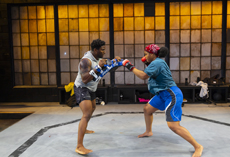
Theatre in Review: The Monsters (Manhattan Theatre Club/City Center Stage II) The Monsters offers one of the great pleasures of the theatre, namely the opportunity to see a character transformed in full audience view. At one point in Ngozi Anyanwu's time-jumping new play, about siblings skilled at sparring, in and out of the boxing ring, we see Lil, the female of the pair, as a girl, standing stock still as her semi-estranged brother, Big, drunkenly pounds on her door. The scene is eerily reminiscent of an earlier episode, featuring her abusive father, and in that moment, Lil appears frighteningly vulnerable. Mikaal Sulaiman's sound design underlines the sense of menace, adding low-end reverb that makes each knock sound like a physical blow. Then, thanks to Cha See's lighting design and additional sound effects, the scene shifts, and we see Lil harden, acquiring a new maturity and resolve; suddenly, we're in a boxing ring, a crowd cheering her as she triumphantly takes out an opponent. It all happens in less than a minute, but it deftly encapsulates a life in transition. (It also makes clear that Aigner Mizzelle, previously seen in smaller roles in ensemble pieces Chicken and Biscuits and 7 Minutes, is a bigger talent that we've had the chance to see.) The sequence is doubly affecting because, for the first half of The Monsters, Anyanwu appears to be shadow-boxing, setting up a fairly predictable pairing of opposites of the sort that usually ends in a big hug before the final curtain. It begins with an unexpected reunion: After a boxing match, Big, aka The Monster, is approached by a surprisingly pushy young fan; several minutes elapse before he realizes it's Lil, the half-sister she hasn't seen in sixteen years. They make an awkward, unprepossessing pair: Edging toward forty, his career is already on the downward slope; following her hard-luck mother's death, she lives alone, working a dead-end job at an Applebee's, spending her breaks downing rum cocktails in the parking lot. Over the course of several years, marked by more than a few psychological feints and uppercuts, the siblings establish a provisional relationship. Lil, wary of rejection, nevertheless wears down Big's considerable defenses, which often manifest themselves in a rigid set of rules involving sobriety, healthy eating, and a rigorous training schedule. Their hardscrabble past, a stony ground starved of affection and support, has shaped them into oddly solitary adults, trapped behind the faces they show the world. "You got anybody?" she asks. "Nah," he sadly admits. "They just want the Monster." She is guarded about her attraction to women, although when she shyly admits to a crush, he is unfazed, adding, "Boys are trash." Still, for her, friends and/or lovers are notably absent. But if you think you know where The Monsters is headed, Anyanwu has more than a few sucker punches at her command, as Lil, guided by Big, grows into a formidable figure in the ring, an achievement that, ironically, drives them apart. Among other things, she resents being sent to Las Vegas for professional training; she suddenly feels like a kid, being abandoned by her older brother. And, after she starts winning matches, she shows every sign of becoming an egotistical, substance-abusing hustler. "I'm my own monster now," she chillingly asserts. The twists keep coming, however, as their relationship whipsaws in various directions. As the play makes clear, despite their conflicts and the beatings they take in the ring, each of them is really battling for a sense of self. Anyanwu, who also directed, underscores this point with the aid of a grittily effective production design that includes Andrew Boyce's industrial-looking set with its upstage wall of grimy leaded glass, and Mika Eubanks' collection of worn, sweaty athletic wear. Lighting and sound continuously work to smooth the script's transitions between past and present. The choreographer Rickey Tripp and fight director Gerry Rodriguez, aided by MMA consultant Sijara Eubanks, fold sequences of movement, workouts, and fisticuffs into the action, resulting in a staging as restless as its characters' unhappy hearts. Both cast members prove skilled at verbal and physical combat. Mizelle, funny and ingratiating one minute and furious the next, makes Lil continuously captivating, whether shyly offering Big a gift of bottled water, candidly announcing, "You an enigma wrapped in a teddy bear wrapped in cinder block," or going mano-a-mano with him and surprisingly holding her own. As Big, Okieriete Onaodowan is tough, watchful, and wary of emotional involvement, bent on distancing himself from his painful past. He is especially poignant discussing the adolescent growth spurt that proved decisive, making it too easy for others to characterize him as a thug; seeking his freedom, he refashioned himself into the monster that others imagined him to be. This admission leads to a moment of truth that suggests both Big and Lil may find a way to put down their gloves and simply be themselves. It's an especially satisfying windup for having been so hard-won. Anyanwu, whose previous works have sometimes seemed overly conceptual and opaquely written, breaks new ground here; this time around, she scores a solid knockout. --David Barbour 
|