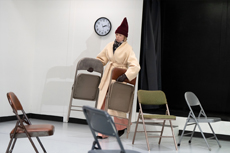
Theatre in Review: The Dinosaurs (Playwrights Horizons) The Dinosaurs is a stealth piece of writing, a brief (yet surprisingly detailed) play that begins on a confounding note yet quietly exerts a grip that won't be denied. The playwright Jacob Perkins, focusing on the all-female crowd of regulars at an Alcoholics Anonymous meeting, takes on a challenging task, penning an Annie Baker-style exercise in hyperrealism that also has a fantastic, time-traveling aspect: The action unfolds across a single get-together, but by the conclusion, years have elapsed and lives have been altered; one character has passed on, and at least one other has undergone wrenching personal changes. The Dinosaurs is a miniature that contains multitudes. Steel yourself, however: The action begins with a couple of lengthy passages that sound like writing-class exercises. An awkward encounter between Jane, the group's unfussy, can-do organizer, and first-timer Rayna (aka Buddy, a nickname she earned in her drinking days) yields this nugget: "You know what's funny? I've driven by two words my whole life and taken for granted their inherent meaning, but now, just now, standing here with you out of the blue, it dawned on me: the reason the store is called Dunkin' Donuts is because someone once dipped his donut into his coffee and said OK, sure, I'll start a franchise." This little gem is followed by an exhaustive etymology of the word "cupcake." Clearly, Perkins, an early-career talent, hasn't been advised to murder his darlings, and these little thickets of show-off writing pose a daunting obstacle to our engagement. But once the playwright assembles his characters and lets them share their thoughts and troubles, The Dinosaurs demands and deserves one's close attention. One of the play's insights lies in its appreciation of AA's ritual nature. The practice of strictly adhering to a standard format, with time limits on each activity, proves unexpectedly fruitful, as does letting the women reveal themselves without fear of judgment. Longtime members all, they are always there for each other, supportive in good times, and ready to help pick up the pieces when slips and setbacks occur. Many plays about addiction and/or therapy groups go for full-throated melodrama. The Dinosaurs is about patience and attentiveness, traits that, in this context, are life-savers. It takes a highly committed company to generate drama out of such seemingly mundane materials. Les Waters' production features an ensemble of expert spell casters, each deploying their superb listening skills. Kathleen Chalfant is Jolly, the eldest among them, who can't remember anyone's name but recalls the good old days when a whiskey sour set you back $1.98 (a metric that testifies to the length of her sobriety). April Matthis is Jane, who functions as greeter and organizer, deftly handling Rayna (a charmingly discombobulated Kelly McQuail), who hovers on the edges, tense and scattered at the idea of admitting she has a drinking problem. ("Like, am I really gonna admit to a bunch of strangers that I don't have power over my own life?") Mallory Portnoy is Janet, handling with remarkable control a lengthy speech about a dream that, for all its obscure symbology, suggests a deep-seated shedding of unwanted feelings. Maria Elena Ramirez is Joane, an enthusiastic gossip gleefully spreading the details of a high-school sex scandal; later, she tells a story on herself, offering a pained account of the encounter with her son that forever shatters their once-close relationship. Topping them all is Elizabeth Marvel as chic, world-weary Joan, who, assuming the closed eyes and pained expression of a true martyr, bravely faces the disorder surrounding her. You've met this woman; everyone has. She's a professional fault-finder, if only to prove her own necessity. (Hang one for the scorn she piles on an acquaintance who flosses her son's teeth in public; she might have a point about that.) Then again, hear the sorrow in her voice when, in a montage spanning several years, she rattles off the differing numbers of days since she last had a drink; it's a poignant revelation of a struggle that, for her, never seems to end. Indeed, the focus on quotidian reality crossed a sense of time's relentless passing -- a very Thornton Wilder device -- imbues the play with a deeper, more spiritual sense that lets us see how AA sustains these women over the long run. If membership helps to keep them off the bottle, it also gives them the strength to live. The production design is as plain and unfussy as the script. The design collective dots supplies an intentionally nondescript multi-use room that might be in a school, church basement, or civic center. Yuki Link's lighting, Oana Botez's costumes, and Palmer Hefferan's sound all contribute to the understated atmosphere. Perkins, whose previous work, The Gold Room, began with a gay hookup and expanded into a study of many male erotic relationships, has a knack for loading brief texts with multiple layers of meaning, and he doesn't strain to do it. (He also has his tics -- what's with all the "J" names? -- but give him time; he's a real talent.) Unusually for a young writer, he takes the long view: He closes out the play by bringing back one cast member, whose character has died, this time in a new persona, to show how the group renews and evolves. Curiously, the title is a misnomer: The dinosaurs died out; the women in this group are omnipresent and, in some sense, eternal. Individuals will come and go, but they will collectively endure. It's a beautiful thought. --David Barbour 
|