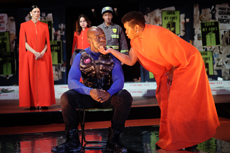
Theatre in Review: The Tragedy of Coriolanus (Theatre for a New Audience) Attending The Tragedy of Coriolanus the other night, I couldn't stop thinking about George Washington. I know this seems odd; let me explain. A few days ago, the political commentator Josh Marshall published an essay, "The Uncanny Artifice of George Washington," about how our first president, through sheer force of will and against his instincts, forged a stoic, impassive public personality. It was a massive effort, but it stood him in good stead in moments of crisis. Marshall adds, "And that really did play a crucial role in holding together and then shaping the young republic." It is undeniable that Shakespeare's protagonist might have benefited from having Washington as a role model. A commanding military hero, Caius Martius Coriolanus is incapable of handling public life; thanks to overweening pride and a too-reckless tongue, he refuses to kowtow to the Roman rabble. His one attempt at politicking is pretty much a disaster, and his open contempt for his fellow citizens -- few of whom, to be sure, distinguish themselves -- will have terrible consequences for himself and his country. Indeed, it's not off-topic to invoke various historical figures when discussing Coriolanus, because the play seems to function as a kind of weathervane of the times. A Red Bull Theater revival in November 2016, in the wake of the first Trump victory, was a powerful warning against the dangers of unchecked populism. A Shakespeare in the Park production in 2019 focused on the relationship between Coriolanus and his formidable mother, Volumnia, whose vaulting ambition was brought to unsettling life by Kate Burton. Ash K. Tata's production at TFANA is very much of the moment, highlighting Rome's conflict with the rebellious Volscians: Combining swordplay with drone warfare, it offers a mirror on the many wars of attrition circling the globe, captured by government surveillance and the 24-hour news cycle. It's a world in which upheaval is the new normal. This is an intriguing idea, although Tata may be a little too devoted to it. The opening scenes are overfilled with sound and fury, as the action ricochets between Rome and Corioli, where the struggle against the Volscians rages. There's plenty of rushing about and shouting, aided by Brandon Keith Bulls' sound effects and the omnipresent projection design by Lisa Renkel and POSSIBLE, which covers the decaying classical building on Afsoon Pajoufar's set and also appears on a three-sided Jumbotron over the stage. (The latter would be distracting but for the fact that it is placed outside the audience's line of sight; you have to crane your neck to see it.) It results in a rushed, noisy opening, making the action harder to follow. Once things calm down a bit, we see that Tata has a formidable trio of leads who get at the play's furious heart. McKinley Belcher III, so effective in contemporary plays, reveals his solid grasp of classical technique in the title role, capturing Coriolanus' stoic, self-regarding qualities as well as his explosively bellicose nature. The character is a bundle of contradictions: an unflappable warrior, a mother-dominated son, and a patriot capable of switching sides with alarming ease, but Belcher knits them into a coherent portrayal. He even endows him with an undercurrent of sardonic humor. Urged to "perform a part thou hast not done before" when faced with his fellow citizens, he murmurs, "Well, I must do it," with such perfect insincerity that you have to laugh. Later, when he turns on his country with unappeasable rage, joining the Volscians in a thirst for revenge, we see how his inflexible will, his inability to hear anyone's voice but his own, will lead to his ruination. It's an impressively well-spoken performance informed by plenty of nuance; I'm suddenly eager to see Belcher take on other great classical roles. Belcher's unstoppable force meets its immovable object in Roslyn Ruff's Volumnia, who, for better or worse, has made Coriolanus the man he is. One of the scarier mothers in dramatic literature, she offers a form of love that often seems adjacent to human sacrifice. She receives a report on her son's battlefield exulting, "O, he is wounded, I thank the gods for't." Indeed, she keeps a strict accounting of his wounds, noting that, before his most recent foray, he had twenty-five to his credit. When Coriolanus' wife asks, "But had he died in the business, madam, how then?," she responds, "Then his good report should have been my son." Really, it's all the same to her. Ruff brings an eerie composure to such statements, along with a dignified posture suitable for rendering in statuary. Even when she shows up in the Volscian with a cohort of women (and Coriolanus' young son), to sue her son for peace, she betrays not a hint of weakness. Catching her in a rare, unguarded moment, Coriolanus tells her, "Resume that spirit when you were wont to say/If you had been the wife of Hercules/Six of his labors you'd have done and saved/Your husband so much sweat." Son, behold your mother. Amid the bloodshed and denunciations that drive the play's action, Jason O'Connell adds a note of sweet reason as Menenius Agrippa, Coriolanus' urbane, politic friend and ally. Alone among the characters, Menenius has a sense of humor: O'Connell makes a small tour de force early on, comparing various social classes to parts of a human body; the public is the belly, as he makes graphically clear. But he grows in poignancy as he looks on in horror and regret when Coriolanus loses control of his rage, leading to disorder, war, and assassination. O'Connell makes his character the representative of a civilization that is slipping away at an alarming pace. If these three performances anchor the production, they have fine support from Barzin Akhavan as Cominius, a Roman general, offering a vivid account of Coriolanus in battle ("He was a thing of blood, whose every motion/Was timed with dying cries") and Meredith Garretson, poised and possessed of considerable presence as Virgilia. Tullus Aufidius, Coriolanus' blood enemy and, later, his comrade in arms, is here portrayed as a woman; as played by Mickey Sumner, there is an erotic charge between them that goes a long way toward explaining the mischief that ensues. Pajoufar's scenery, with its yards of plastic tarp and tattered posters, certainly suggests an empire in steep decline. If the projection design overreaches at times, it is also helpful in providing location updates for a plot that hopscotches around Italy. Avery Reed's costumes intriguingly apply a contemporary sensibility to classical silhouettes. Bulls' sound effects contribute to a sense of a world in tumult. The strange power of Shakespeare's plays lies in how, in different circumstances, they give off very different reflections. Nobody is going to bat for The Tragedy of Coriolanus as a first-rate work; it is too melodramatic, its plotting too mechanical. Yet at this strange moment, something about its meditations on the public and private faces of politicians seems strangely appropriate. We pretend to value authenticity when, in truth, we may really want reassurance, or even flattery. The people we choose to lionize may reveal more about us than we want to know. Being a hero and governing effectively require starkly different skills. --David Barbour 
|