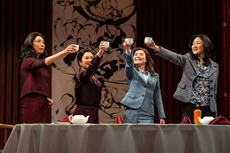
Theatre in Review: Chinese Republicans (Roundabout/Laura Pels Theatre)In the Chinese community, this is the Year of the Horse. In the theatre community, it might arguably be the Year of Alex Lin. Delivering a one-two punch of provocative new plays in less than three months, she has immediately established herself as a playwright to watch. To be sure, she isn't perfect: Both Laowang, seen at Primary Stages in November, and now Chinese Republicans have their problems. But Lin has a lively mind; a brashly cynical eye for the world's workings; and a knack for tough-minded, wisecracking characters, even the worst of whom gets a full hearing. Chinese Republicans is loaded with connivers, but they have their reasons. When it comes to backstabbing, these employees of the investment firm Friedman Wallace have learned their lessons well. Much of the play unfolds in a downtown New York Chinese restaurant where, once a month, Ellen, a managing director for South American trading, hosts an "affinity group" titled "Asian Babes Changing the Game." Also in attendance are Phyllis, the group's crusty elder, who wants to know why the event can't simply be listed on Outlook as a "lunch meeting;" Iris, a software expert born in China, given to criticizing the others' halting attempts at speaking Mandarin, and Katie, a senior research assistant in wealth strategies, who enters, crowing that she has just landed a promotion: "Twenty percent raise, baby!" Is Katie's personal success a triumph for the Asian Babes? We shall see. Ellen likens the group to a family, casting herself, Katie, and Phyllis as "mother, daughter, ancestor." (Iris gets relegated to maid status; for all their talk of mutual empowerment, the characters' sniping sometimes descends to the sitcom level.) There's some truth to this arrangement. The middle-aged Ellen, a graduate of the Phyllis School of Self-Reliance, is cultivating the twentysomething Katie, whom she has identified as a rising star. Indeed, she chooses Katie, who is half-Asian ("She looks French," sniffs Iris), to be her stalking horse in an audacious plan to take over a Chinese bank, thereby earning partner status for them both. Never mind that the deal would provide access to technologies that would let them fire untold numbers of workers. Katie, who got into finance to help others, blanches at the thought. As we see in a flashback, Ellen once entertained such ideas until Phyllis wised her up. But when Katie, up for a key promotion, is passed over in favor of the nice young white man who has been cultivating her, it's time for skullduggery that includes #MeToo allegations, a breach of security, an embarrassing email leak, and multiple betrayals that leave only one of them standing. By then, it is obvious that everyone's grasp of the corporate ladder is scarily tenuous, and survival requires some ugly skills. Still, the bad behavior in Chinese Republicans is usually rooted in a realistic appreciation that, for all their apparent access to power, the characters are more dispensable than they care to admit. At least Phyllis, an ex-feminist turned curmudgeon, has a spouse, children, and a Catholic faith; sidelined into a consultant role, she works assiduously to maintain her status as a corporate player. Ellen, in contrast, is a total grind, with a broken marriage and a heart attack to show for her efforts. Iris, who is in the US on a visa and getting nervous about it, has little use for her colleagues' attitudinizing about China, noting, with scalding irony, "You people...act like you're the experts on a place you've never even been to." Indeed, there are vast cultural differences among them: An argument about abortion rights sounds entirely false to Iris, who grew up under China's One Child policy, which drove families to produce male children at all costs. The script is packed with unruly ideas, but Lin would do well to sharpen her wit on a couple of fronts. Some of the dialogue is sour rather than funny, and she over-relies, to a numbing degree, on the use of "fuck" as a modifier. Instead of shocking us, it begins to bore; sometimes, the play's arguments are thinner than one would like. Also, Lin never quite knows what to make of Katie, who starts bright-eyed and effusive and, faced with disappointment, executes a baffling ideological U-turn, embracing Karl Marx and Howard Zinn. (Admittedly, it's amusing when, restyling herself as a "libertarian-socialist-conservative," she notes that "one of the most far-reaching immigrant laws in history that gives millions of migrants a pathway to citizenship" was signed by...Ronald Reagan.) Anna Zavelson struggles to make sense of the character's contradictions, but she is in a bind not entirely of her own making. It's often hard to see why, aside from her rather Caucasian looks, others view her as a comer. Still, the play succeeds as a vehicle for Jennifer Ikeda as Ellen, who, despite her cold-eyed awareness that she works for "freaks [who] have Gucci and Louis Vuitton leaking out of their assholes while they're pillaging all of sub-Saharan Africa for oil and diamonds," places her hopes and maternal feelings on Katie. That experienced scene stealer Jodi Long is fun as Phyllis, who, cautioned against slapping around her laptop, snarls, "First I can't hit my kids, then I can't hit my dog, now I can't hit my own damn computer?" (She also makes chilling sense of a decision that cues the chaos driving the play's second half.) As Iris, Jully Lee presides authoritatively over a dream sequence, a game show that exposes Ellen and Katie's inability to understand Mandarin. Even Zavelson scores in a gloves-off confrontation during which, delivering the verbal equivalent of a rabbit punch, she announces, "Money won't make you white, Ellen." Chay Yew's production doesn't paper over the play's weaknesses, but he keeps things fast-moving and lively, aided by his design team. Wilson Chin's set moves swiftly on a turntable from the restaurant to various locations at Friedman Wallace, with the help of Hana S. Kim's projections of New York City street scenes and graffiti-style renderings of Mandarin words. Anita Yavich's costumes keep the characters dressed for success. Jeanette Oi-Suk Yew's lighting and Fabian Obispo's sound design are solid contributions. Whatever the weaknesses of Chinese Republicans , Lin doesn't condescend to her characters, who must tangle with prejudice, patronization, and (in Phyllis' case) even random subway attacks. "You have to have money in this country to keep people like us safe," Ellen insists, but maybe there's not enough money in the world. Anyway, keep an eye on Alex Lin.--David Barbour 
|