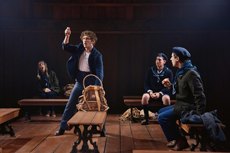
Theatre in Review: Marcel on the Train (Classic Stage Company)Marcel on the Train features some impressive feats of juggling, but they're nothing compared to that practiced by playwrights Marshall Pailet and Ethan Slater. Drawing on a not especially well-known incident from the early life of Marcel Marceau, the authors want to charm you, then make you break out in a cold sweat. Amazingly, they get away with it. How's that for a juggling act? Slater, who also plays the title role, enters and skillfully recreates some of Marceau's classic bits, picking an imaginary flower, trying to sit and falling, then standing up and pulling a burr from his rear end. Even if Marceau's art isn't to your taste, the actor's mastery is impressive. And, at this point, for all we know, Marcel on the Train might be the silent version of a jukebox musical, a tribute act glorifying a lost era of entertainment. Then we are plunged into the ugly details of wartime France. Marceau, a gifted visual artist at twenty, is busy forging identification papers for Jews. If it's a particularly sedentary form of resistance, he gives good value, and it suits his mild-mannered personality. Then his cousin and colleague Georges recruits him to smuggle a quarter of Jewish twelve-year-olds into Switzerland. "What exactly are my qualifications?" asks a nervous Marceu. "You're still alive," Georges replies. The journey that follows is eccentrically depicted in ways that, nevertheless, feel utterly right. The children are portrayed by adults: Maddie Corman as the fragile, silent Etiennette; Alex Wyse as Henri, who believes in the power of hiding in plain sight; Max Gordon Moore as Adolphe, spiky and ironic beyond his years; and Tedra Millan as Berthe, who is certain that she won't live to see next week, let alone adulthood. These characters veer between childish outbursts and an eerily articulate detachment that nevertheless works within the script's memory-play format. Just to keep us further off balance, the authors insert a series of flash-forwards, ranging from the halls of academe to a Viet Cong prison to Marceau's school in Paris, detailing the strange ways this incident reverberates in the children's adult lives. That we see them survive into middle age should foreclose on any suspense, but the lengthy sequence in which Marceau and his charges are detained and questioned by a Nazi officer is a study in understated terror. Wait for the moment he picks up the mayonnaise sandwiches into which an all-important set of faked IDs has been inserted. Is the officer toying with them, or has he sussed them out and is protecting them from his fellow officers? It's a question that lingers long after the lights come up. The authors have spun quite a cat's cradle of conflicting emotions, and Pailet's direction keeps them all in perfect tension. Slater, whose singular career includes a brief-ish run on Broadway as SpongeBob SquarePants and global fame as Boq in the Wicked films, is the compelling still center of the action, cracking jokes to fend off thoughts of the death camps. (He dreams of "a fight I used to have with my mother, about the Jewish view of when life begins. She says it's tradition that a fetus isn't viable until it graduates with its medical license.") With his enormous eyes and hesitant manner, he often appears to be gazing into a future too unthinkable for words. Moore and Wyse are believable as rowdy adolescents with adult sensibilities -- both are expert complainers -- but the play is subtly tilted toward the young female characters: Millan elucidates Berthe's insistence on visualizing her imminent demise, which becomes a kind of philosophical challenge that Marcel can't leave alone. Bereft of lines, Corman nevertheless makes Etiennette's presence felt throughout. Aaron Serotsky is fine in several roles, but he nearly walks off with the play as the genial, possibly vicious Nazi whose interrogation style leaves everyone hanging psychologically by a thread. Like the play itself, filled with fancies yet chillingly aware of the grave, the production design is both delicate and oddly stark. Scott Davis' set design features a thrust stage over which hangs the skeletal roof of a train car; the set's upstage wall opens to reveal a forest in winter, a perilous place to hide from one's enemies. The lighting design, by Studio Luna, is filled with stunning effects: uplight chases to suggest a train in motion, shadow play on the upstage wall, and the powerful use of strobes in an on-the-run sequence. Jill BC Du Boff's sound effects include train engines, explosions, gunfire, and passing cars, all of which contribute to a palpable sense of reality. Sarah Laux's costumes, especially the military and scouting uniforms, feel true to the period. In the midst of world-historical evil, what is the meaning of a single good act? Is it a gesture thrown into the void, or does it echo back in ways we can't always see? These are questions that Marcel on the Train leaves one to ponder. It leaves one wondering about the uncertain power of memory to shape our identities, and, not incidentally, how these events may have influenced Marceau's art. That's quite a lot to pack into a shortish evening. But, like Marceau, nobody involved in the production tips their hands. They make a difficult thing look shockingly easy. --David Barbour 
|