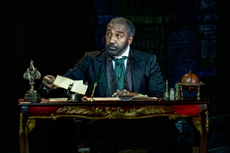
Theatre in Review: Monte Cristo (The York Theatre/Theatre at St. Jean's)Seeing Monte Cristo the other night, I was oddly reminded of "Reader's Digest," a number by Betty Comden and Adolph Green from their nightclub days, applying the famous magazine's approach to classic novels. (The Reader's Digest Condensed Books series was some years in the future.) Here's their take on Gone with the Wind: "Scarlett O'Hara's a spoiled pet/She wants everything that she can get/The one thing she can't get is Rhett/The end!" That pretty much sums it up. Librettist Peter Kellogg and composer Stephen Weiner have seemingly taken a similar approach to Alexandre Dumas' epic novel, which, in some editions, runs to more than 1,100 pages. (The musical also draws on Charles Fechter's stage version, which provided Eugene O'Neill's father, James, with a career-long vehicle.) They have run the book's astonishingly convoluted narrative through the musical comedy processor, slimming it down to something like the Classics Illustrated comic book version, populating this tale of suffering and revenge with oddly chipper musical numbers, many of which wouldn't be out of place on the Broadway of the late 1950s. It's a bizarre mismatch of material and style that leaves one wondering what its creators were thinking. Briefly: Dumas' novel follows the fate of Edmond Dantes (here spelled "Edmund"), a merchant sailor who, fulfilling the wishes of a dying friend, delivers a letter aiding the supporters of the exiled Napoleon Bonaparte. (France's unstable, paranoid atmosphere of the era is well-documented in the opening number "Dangerous Times".) Thanks to the machinations of his enemies, the apolitical Dantes is arrested for insurrection and spirited away to a remote island prison, robbed of his career and intended bride, Mercedes. Nearly fifteen years later, he escapes and, equipped with an enormous fortune, restyles himself as the title character, plotting his tormentors' comeuppance. The authors often ignore the novel's grim, relentless tone, with bizarre results. Dumas depicts Dantes' imprisonment as a grueling, soul-searing experience that radically transforms him, aided by the extensive education he receives from his fellow prisoner, the Abbe Faria. The characters don't meet for six years, when Faria, trying to escape, accidentally tunnels into Dantes' cell. Here, he pops in immediately and launches into "You Sent Me This," whimsically complaining that God has sent him such a know-nothing companion. What better place for a light comedy number than a filthy dungeon devoid of hope? And so it goes, Gaspard, the tailor who alone knows the truth about the plot against Dantes, is reinvented as a boozing innkeeper nagged by a shrewish spouse, cueing plenty of take-my-wife-please jokes. Instead of being killed, he is enmeshed in Dantes' schemes, being passed off as an Italian ("Gaspardo") and installed in one of the villains' homes. This leads to more vaudeville setups. "Gaspardo what?" inquires his employer, seeking information about his identity. "Just Gaspardo," he replies. "We had to sell our last name for food." Albert, here made into the son Dantes knows nothing about, and Eugenie, his air-headed intended, are a standard pair of comic relief lovers. ("How do we know this is right?/You have to go with your gut/What if the feeling you have in gut/Turns out to be gas, then what?") Rather than embrace the book's gripping melodrama, Kellogg and Weine often subvert it to no good purpose. Trying to find a workable, comprehensible storyline, the authors often make many strange decisions. Faria apprises Dantes of the existence of a vast fortune, passed down from the Borgias, hidden in an obscure location. This cues a long, digressive, and unintentionally hilarious number, featuring Lucrezia Borgia, poisoned cardinals, and a chorus of Latin-chanting monks. A climactic scene in Act II boils down hundreds of pages of action, including a secretly purchased newspaper, a manufactured financial scandal, and various assorted bombshells, into five minutes of revelations. Comden and Green would be envious. What Monte Cristo has going for it is a quarter of Broadway stars in excellent voice. If Adam Jacobs can't begin to get at Dantes' ruthless pursuit of retribution, he sings beautifully, especially when partnered with Sierra Boggess as Mercedes, who, secretly pregnant and deserted at the altar, pragmatically marries her cousin Fernand, unaware that he has helped to engineer Dantes' downfall. Boggess elevates each of her numbers, including the surprisingly lovely and poignant "How Did I Get So Far Away?," contemplating her life in a gilded cage. Norm Lewis is a prime case of luxury casting as Villefort, the corrupt prosecutor who, aware of Dantes' innocence, condemns him anyway; his gorgeous vocals are much missed after his character commits suicide. As Gaspard's garrulous, henpecking spouse, Karen Ziemba gets many of the silliest lines. ("Edmund was arrested for treason! Do you know what they do to people who try to help people arrested for treason? They arrest them for treason!") She also turns up as, yes, Lucrezia Borgia, handing out goblets liberally laced with fatal Mickey Finns. Also on hand, behaving with admirable professionalism, are Danny Rutigliano, pulling off a sidekick double act as Faria and Gaspard; Daniel Yearwood, slick and untrustworthy as Fernand; James Judy, imperious and ulterior as a corrupt financier; Stephanie Jae Park as Dantes' ward, a Turkish princess who holds the key to Fernand's unmasking; Eliseo Roman as Dantes' first benefactor; Kate Fitzgerald as Eugenie, who, in a twist Dumas never imagined, turns out to be lesbian or nonbinary or something; and Jadon Lopez, as Albert, who believing that, a) Fernand is his father and b) a pillar of virtue, is going to need some serious therapy. In keeping with the recent upgrade in production values at the York, the show benefits from Anne Mundell's set, an affair of bricks and Romanesque arches that nicely stands in for taverns, jail cells, and other locations. Shawn Duan's gorgeous projections of Marseille streets, stormy skies, and fireworks add plenty of welcome visual variety, and Alan C. Edwards' starkly dramatic lighting strikes the right tone. The costumes by Siena Zoe Allen and Amanda Roberge run the gamut from filthy rags to stunning period gowns (Caitlin Molloy's hair and makeup also make a significant contribution.) Joanna Lynne Staub's sound design is crystal clear throughout. Indeed, so impressive is the physical production that one strongly suspects hopes are high for a commercial transfer. This would be a mistake. One might get a workable show, in the Boublil-and-Schoenberg mode, out of Dumas' novel, although there is still that plot to contend with. But the approach taken here won't do. It's not that The Count of Monte Cristo is a sacred text that must be protected from vulgarians; in fact, it's a potboiler, if an exceptionally entertaining one. The trouble is, it is entirely unsuited to the jolly, old-fashioned approach favored by Kellogg and Weiner. There are plenty of other florid 19th-century novels with which they might have better luck -- not that I'm suggesting they try. --David Barbour 
|