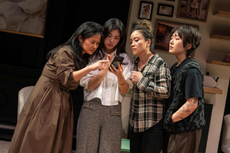
Theatre in Review: Jesa (Ma-Yi Theater Company/Public Theater)The title of Jeena Yi's play refers to a memorial service held for ancestors in Korean families, usually on the anniversary of their deaths. Yi corrals four mostly Southern California-based sisters to honor their late mother, with a side tribute to their dad on offer. The latter choice, made by Grace, who is hosting the event, is controversial; then again, in Jesa, what isn't? The sisterly sniping starts early, quickly rising to the level of psychological strafing, and climaxing in several catfights. (There is more physical tussling in this production than in SUMO, another Ma-Yi/Public collaborator, seen last season; fight director Chelsea Pace certainly earned her paycheck.) According to a note attached to the script, "Love is always here in this family. It's just hard to see sometimes." Indeed, you practically need a microscope. The participants in his domestic mayhem include Grace, a traditional homemaker ("My house is the only Cape Cod-style house in four blocks," she notes, proudly), who is also a world-class liar, sitting on a (to her) life-altering scandal; Elizabeth, a master-of-the-universe type, working in private equity, keeping under wraps a dark secret of her own; Tina, a blunt, hard-living chef whose troubled adolescence set a standard for her sisters to avoid; and Brenda, who fled to New York for a career as a theatre director permanently stuck in idle. (Her nemesis, "Trust fund Tyler," is, she notes, working on Broadway, "making movie stars walk slowly across the stage under deeply unflattering blue light and calling it avant garde, I'm stuck in production meetings where we spend three hours trying to figure out how to get the dog in the show to make one entrance and one exit without shitting all over the stage." There's no business like show business.) Nothing is held back when this bunch gets together. Grace, hitting at Tina, says, "Would you like to host Jesa next year? Be my guest! Oh, wait, no, you can't, because you live in a shithole." Brenda, fed up with Liz's airs, tells her, "Gimme a call when a remotely interesting human emerges from that husk you call a soul." Tina, insisting she alone (not their mother) raised Elizabeth, says, "If you had listened to me more, you would have gotten into Stanford." Elizabeth replies, "I never wanted to go to Stanford! You were just living vicariously through me because you fucked up so badly in high school." Along the way, we hear about their unforgiving, homophobic mother (at least one relative was banned from family events after coming out) and their boozing father, who together share a history of domestic violence. Writing about plays of this type, it's often customary to note that the knives come out. Here, they come out literally, sometimes leaving flesh wounds. Without question, Jesa is a genre piece, the family get-together that turns into a free-for-all, with insults hurled and skeletons enthusiastically exhumed. Yi, writing from the perspective of a first-generation Korean American, adds some piquant details, beginning with the Jesa format, which includes serving up the deceased's favorite foods plus ritual acts like bowing and pouring liquor. Less surprisingly, the sisters grew up with parents who didn't speak English and imposed harsh standards that have left indelible scars. (In a solid bit of observation, based on their birth order, each has a radically different view of their mother and father.) Adding a bit of flash, the playwright summons up the spirits of the dead, trying to get everyone to simmer down. But Yi is a new playwright, and her voice is still emerging; similarly, Jesa struggles to stand out among other pieces of this type. The zingers and bombshells are deployed efficiently, as if rolling off an assembly line, but they sometimes feel a tad prefabricated. Yi seems to force her characters into an existing scenario rather than allowing the drama to emerge from her characters. The first few shockers onstage earn gasps from the audience; after a while, a certain predictability sets in. The director, Mei Ann Teo, does well with the play's major moments, including a house haunting and an amusing bit when everyone lines up for a smiley-faced FaceTime tableau for an elderly aunt. But Teo has difficulty shaping a script that, rather than advancing the action, is structured like several rounds in the boxing ring. The cast does its collective best; Tina Chilip's Tina, the family truth-teller, is a real-attention-getter, especially when in her cups. Christine Heesun Hwang's Brenda, forever eyeing the exit, hides her disappointment behind a deliberately cultivated sense of cool. Laura Sohn's Elizabeth and Shannon Tyo's Grace both struggle to make sense of characters who aren't what they seem. You-Shin Chen's intentionally bland, beige, detail-free set speaks volumes about the evasive, conflict-averse Grace; one wouldn't be surprised to hear that the walls are made of Teflon. Jeanette Oi-Suk Yew's lighting is ultra-smooth most of the time, gearing up appropriately when a ghostly atmosphere is called for; Hao Bai's sound design is a big help in the latter case -- wait for the boombox that alarmingly turns itself on. Mel Ng's costumes clearly delineate each character's distinctive walk of life. Jesa gets better as it goes along, sufficiently so that one can understand what the Ma-Yi staff saw in it. Yi is pretty obviously a fast learner in terms of structure and mechanics; what she needs now is the ability to give her plot and characters that all-important kiss of life. As the play ends, it looks like next year's Jesa might take place in Vegas. ("No ghosts -- just buffets, bottle service, and blackjack," Tina says.) That seems like quite a premise for a sequel. Fortunately, for Grace and the others, what happens in Vegas stays there. --David Barbour 
|