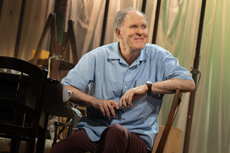
Theatre in Review: Giant (Music Box Theatre)A simple gesture causes the temperature to drop, precipitously, at the Music Box. Giant is a play about the care and feeding of sacred monsters, and the source of the onstage cold front is Roald Dahl, author of innumerable books for children and something of a big baby himself. It is 1983, and he is the eye of a hurricane-force controversy regarding his review of a book criticizing Israel's 1978 invasion of Lebanon. He has drawn a parallel between Israel and Nazi Germany ("Never before in the history of man has a race of people switched so rapidly from being much pitied victims to barbarous murderers"), suggesting that every Jew who doesn't fully agree with him is a coward. The media blowback has been incandescent with rage: "The most disgraceful thing to be written in the English language for a very long time," one critic pronounces. An anonymous phone caller promises to slit the throats of Dahl and his loved ones. The author, however, only sees a storm in a teacup. "Genuinely violent people don't call ahead," he airily notes. Rushing to Dahl's side, bent on defusing this ticking bomb and preserving the sales of his next book, The Witches, are his British publisher, Tom Maschler, and Jessie Stone, director of sales at Farrar, Straus, and Giroux, the distributor of Dahl's novels in the US. They are eager to apply a touch of verbal emollient, an ever-so-slight walking back of his most incendiary statements, which, they are certain, will consign the ugly episode to footnote status. Dahl, of course, can't be bothered, but he certainly enjoys toying with his luncheon companions. As played by towering John Lithgow with an untamed scraggle of hair, a counterfeit smile, and a hand forever seeking to assuage the nagging pain in his lower back, Dahl is on trouble patrol, looking for any available pot to stir. Regarding his menacing caller, he notes, "He said he wanted to be arrested, soaked in our blood," praising it as "terribly good image, really." He refuses to de-list his address for safety's sake: "The children won't write to a publishing house, Tom and I can't risk it. And this madman isn't going to ruin that." When Jessie informs him that his image adorns the office wall at FSG, he delightedly notes, "I'm a pinup," relishing in his self-imposed status as "Hunk of the Month." Then he opens a copy of his novel The Twits, which Jessie has brought to be autographed as a gift for her son, and a piece of paper drops out; it's a clipping of that notorious review, which Jessie has underlined and annotated with comments like "True" and "Not true." As Dahl peruses it, a dead silence prevails; you can see him sniffing out treachery, the others bracing themselves for the storm to come. Giant, which, up to this point, is a mildly amusing exercise in book chat, suddenly becomes a sustained exercise in mounting tension. Like all bullies, Dahl sees himself as a victim -- we are told, repeatedly, that he fled Alfred A. Knopf because he didn't feel sufficiently treasured -- and he turns on Jessie with relish. Quizzing her, he learns that she is Jewish. "And do you practice?" he wonders. "All the waving around the scrolls and the funny tassels and the fasting and whatnot?" He dismisses the American Library Association, whose good opinion is imperiled, as "Satan's Spinster Army. Gluttons for a wholesome message." Then, driven by his goading, Jessie tells him, pointedly, that, in light of his review, the characters in The Witches ("powerful, child-snatching, money-printing devils, posing as humans") can be plausibly mistaken for grotesque Jewish stereotypes. The look of bafflement, mixed with rage, and, perhaps, terror of rejection that illuminates Lithgow's face is terrible to behold. "Now I've written a secret coded hate tract," he says, before rising to a Lear-like fury. Gesturing at Jessie, he howls, "And whatever I say, it won't be enough. Ask her! She knows them. She is them. Nothing will be enough! So why give them anything at all!" Giant is an exercise in bearbaiting, albeit with the bear unchained and sharply clawed. The strength of Mark Rosenblatt's play is that everyone has a point and everyone is also wrong: Israel's Lebanon incursion was in many respects a disaster, resulting in thousands of civilian deaths and tarnishing Israel's reputation. But Dahl's writing goes beyond reasonable criticism to indict an entire race. This doesn't faze Tom, who arrived in England on the Kindertransport and has become thoroughly British, waving the casual antisemitism embedded in his country's culture as just another unpleasant fact of life, like the fog and too-frequent rain. ("And this is what?" asks Jessie, scathingly. "A British exemption clause?") Jessie, who doesn't uncritically support Israel and is genuinely alarmed that The Witches might suffer a boycott, fails to read the room, too enthusiastically embracing the bearer-of-bad-news role, driving Dahl to new rages by refusing to back down. At the same time, Giant takes note (possibly too lightly at times) of the parade of tragedies that have left Dahl permanently scarred: His brutalized boyhood, the loss of his oldest daughter to encephalitis, the son forever marred by an accident while still an infant, and the heroic effort with which he pulled back his first wife, Patricia Neal, from the brink of a catastrophic stroke. (Although, to be sure, he cheated on her for eleven years.) And when Jessie delivers the most devastating blow, it has nothing to do with politics; it's her cold-eyed assessment of Dahl as "a belligerent, nasty child. And these threats and cruelties...a child's. It's the gift of your work, but the curse of your life." Finally, a dealer in brutal honesty learns just how much the truth hurts. Plays as vigorously argued as Giant are rare on Broadway, and Nicholas Hytner's production delivers it with daggers drawn. Among the supporting cast, Aya Cash stands her ground bravely as Jessie, even when her one point of real connection with Dahl -- she, too, has a brain-damaged son -- is brutally used against her. Elliot Levey's Tom, practicing his tennis delivery and cracking wise about Ian McEwan, works valiantly at being a steadying influence, even in the face of being called a "house Jew." At first glance, Rachael Stirling as Felicity "Liccy" Crosland, Dahl's lover and future wife, might be mistaken for a bit of a doormat. But see how cornered he looks when she confronts him with his secret desire for a knighthood, or her announcement that, unlike Ms. Neal, she won't be his "collateral damage." (And consider the fright in Lithgow's eyes when she suddenly, casually makes the wedding seem conditional.) Also good are David Manis as Dahl's worshipful gardener and Stella Everett as his cook/housekeeper, who, dragged into the fray, suddenly sees her employer in a new and unflattering light. The production design is first-class all the way, especially Bob Crowley's set, depicting Gipsy House, Dahl's country home, during a gut renovation. (Crowley's costumes, especially that ill-fitting shirt for Dahl, are equally good; compare it to Tom's carefully composed ensemble and you will understand much about these men.) Anna Watson's lighting is full of subtle modulations that keep one's attention where it needs to be. Darron L West's sound design calls up the construction noises (drills, hammers) that prey on Dahl's nerves; it also plays a major role in the climactic phone interview with a journalist that signals further mayhem to come. Most of all, there's Lithgow as Dahl, comfortably seated atop a tripwire, cheerfully threatening new explosions at the slightest provocation. It's an evening-long dance on the high-wire, creating a character equally charming and repellent, possessed with an endless fund of unappeased rage reaching back to the nursery. Yet he is also a great artist; even Jessie admits that his books saw her through the darkest moments of her childhood. Giant is filled with arguments -- about Israel, antisemitism, free speech, the uses of power -- that can't easily be resolved; even more compelling is the mystery of the man who unleashes them. --David Barbour 
|