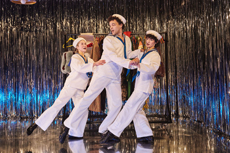
Theatre in Review: No Singing in the Navy (Playwrights Horizons)Maybe playwrights shouldn't contribute program notes; they can set you up for one kind of show, only to leave you bafflingly confronted with something different when the lights go up. Then again, the note for No Singing in the Navy is especially fascinating for illuminating the yawning gulf between theory and practice in Milo Cramer's new piece. Read them and wonder what exactly you are witnessing. In the playwright's essay, Cramer asserts that if Jesus Christ was for centuries the chief subject of European painting -- the Blessed Virgin would like a word -- "sailors (even, yes, silly sailors) are 'the' True Subject of the American Musical." Well, whatever. Clearly, they mean On the Town; I doubt they're a fan of Ankles Aweigh. They also quote an academic who "documents the long, twisted romance between American imperialism and Broadway, noting that dozens of 20th-century musicals were 'unflaggingly supportive of the US military and extremely successful'." Well, that's a conversation for another day. Speaking about their show, however, Cramer notes, "When the actors inhabit the sailor archetype, we get to see both this foundational genre trope refracted three times through an inquisitive contemporary lens, and we get to see the actors themselves, amazingly themselves, playing (shredding) on a huge and liberating canvas." Obviously, a big thinker, right? This is serious MFA talk. Cognitive dissonance sets in immediately. No Singing in the Navy begins with a trio of sailors singing, "Ah, the sea. The sea! Ah ah ah. The sea. The sea!" This passage is so nice, they deliver it twice. Then their captain appears, and we get a minute and a half of "Sailors" and "Yes, sir" sung in antiphonal fashion. This is followed by the Captain belting, "War War War. Waaa-aaa-aa-aar." The sailors wonder, "What for? What for?" To which the captain replies, "War!" We're several minutes in, and No Singing in the Navy has a smaller vocabulary than The Cat in the Hat. The show title is addressed as the sailors are banned from warbling on duty. "What about birthdays? Can we sing on birthdays?" they wonder. "No singing on birthdays, not even on birthdays," the captain insists. "What about singing in a group, as a choir like?" one of them queries. "No singing in a group, not as a choir like," is the answer. Other possibilities, including talk singing, are discarded. Of course, this is entirely sung, with melodies that may make you think longingly of that other sailor musical. It's just one damn thing after another in No Singing in the Navy. The captain reveals, "My own desires disturb me. Each night, I lie awake and dream about those sailors. I cannot help but think about little outfits." He adds, "Is it so wrong? To love a silly sailor?" Sadly, the question remains unanswered. We also get a view of life from the bottom of a bucket, where a talking crab lives with her equally loquacious father and brother; she gives the sailors singing lessons, then learns, to her horror, that sailors are pescavores. (This information is impaired by a pair of tiny ants, who, bitter about their lot in life, pronounce crabs as "disgusting and unlovable.") There are several abortive attempts at attending a "theatre show," which is inevitably pronounced "thee-ay-ter show," and boy, do they have fun with that. And let's not forget the Lighthouse Lady (actor Elliot Sagay in drag, with a lighthouse chapeau), who is wooed by a sailor who has tried, and failed, to kiss one hundred women. Or the number in which two sailors lament, "I'm too silly to read books, tried to read a book one time, but none of the words rhymed!" Rhymed? I'd be happy if they made sense. If Cramer is trying to make a trenchant comment about our screwed-up world, as indicated in the program, No Singing in the Navy is a complete bust. If, as I suspect, Cramer just wants to give free rein to their ultra-fey sense of humor, well, they have their fans: At the performance I attended, about thirty percent of the audience screamed at every gag while everyone else sat still as stones. Still, this must count as a step backward. School Pictures, Cramer's previous piece for Playwrights Horizons, had its ups and downs, but it had a point of view (about New York's wildly unequal education system) and a penetrating eye for detail. By contrast, No Singing in the Navy is vacuous, an inside joke shared mainly by the author and themself. The director, Aysan Celik, can do little to prevent this entertainment from wearing out its welcome, although her cast -- Bailey Lee, Ellen Nikbakht, and Sagay -- have an appealingly plastic quality that should serve them well with better material. Krit Robinson's set, which mostly consists of an upstage rain curtain, is lit so shimmeringly by Masha Tsimring that it becomes a distraction; it is more glittering than the cast. Enver Chakartash's sailor costumes are solid enough, and so is Tei Blow's sound design. No Singing in the Navy ends with a ballad with the frequent refrain, "I love you a lot/I love you a lot a lot/It's all that I got/I love you a lot." What to make of eloquence like that? If Cramer is paying tribute to On the Town, a light entertainment suffused with sadness for servicemen who, on a spree, may soon meet their deaths, the playwright is so far off the mark that comparisons are impossible. I'm afraid these sailors are too silly for words.--David Barbour 
|