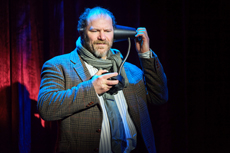
Theatre in Review: Seagull: True Story (Mart Foundation at the Public Theater)Seagull: True Story is dedicated to the proposition that exile is an artist's natural state, and who should know better than Alexander Molochnikov, the play's conceiver and director? He joined the Moscow Art Theatre as an actor in his early twenties, taking up directing only a couple of years later. With additional credits in Tel Aviv, he was on track for an international career until Vladimir Putin invaded Ukraine and Molochnikov spoke up about it. He now lives in the US; a production of his, still in the Moscow Art Theatre's repertory, is billed as "Directed by director." That's one way to become a non-person. If Seagull: True Story is written by Eli Rarey, the idea was Molochnikov's, and it is a fictionalized version of his own story, focusing on Kon, a young artist bouncing around, Candide-like, between national regimes, learning that the pursuit of freedom can feel like betrayal -- and, worse, may not be worth the effort. It is told in a cabaret-style format, complete with the odd musical number and an abrasive MC played by the commanding Andrey Burkovskiy. (Given the red curtain dominating Alexander Shishkin's set, and the hard-edge followspot looks courtesy of lighting designers Brian H. Scott and Sam Saliba, one half-expects somebody to burst into "Willkommen," backed up by the Kit Kat Klub orchestra.) While one is grateful for any play that takes a hard look at today's world, Seagull: True Story is hampered by stylistic issues. "It's too Russian. You're too Russian," a vacuous, venal theatre producer tells the play's hero after seeing his work. He might have a point. In Act I, Kon is directing a semi-avant-garde revival of The Seagull at the Moscow Art Theatre; in one of the script's more amusing inventions, Kon's mother, Olga, is playing the female lead, allowing for some real-life Treplev-and-Arkadina confrontations. ("I keep thinking of all the great directors who have directed this play before me," he says, nervous about working in Anton Chekhov's artistic home. "I have worked with these so-great directors! They were insecure idiots, just like you," she says, bucking him up and undermining him in a single sentence.) The production is humming along until the Ukrainian "special operation" is launched and Russia instantly becomes an international pariah. Kon falls into a depression over the new political reality; then the theatre's manager shows up with a list of necessary "adjustments." First to go is the production's "freedom dance." "They are passing new laws every day," he says. "This dance, the freedom dance, it violates multiple laws against cross-dressing. Against insulting the army." "You said it was meta," Kon insists. "Prison isn't meta," Olga, who has seen it all, warns him. Filled with high dudgeon spiked with panic, compromised by an ill-advised Instagram post that garners threats from the Wagner Group, Kon soon hightails it to New York, not stopping to think that his defection might harm anyone else. Olga works overtime, pulling every string in her power to rescue her son's reputation and smooth his return. Meanwhile, Anton, Kon's best friend and dramaturg, faces house arrest and, later, prison. (Callously, Kon deputizes Anton to read his dissenting speech on The Seagull's opening night, putting him in harm's way.) In New York, Kon's one professional contact is Barry, a gold-plated show-business phony bent on staging a virtual production (complete with VR glasses) of The Three Little Pigs. "Not just a play! An experience," he crows, having been inspired by a "totally immersive" production of Medea staged in Bushwick. "Ours is like that, but family-friendly," he adds. Reeling from that proposition, Kon ends up squatting in a warehouse with a bunch of artist types he meets through Nico, an aspiring actress who quickly takes him into her bed. As the MC notes, "It's fantastic! He comes all the way from Russia to live with communists!" Kon drafts his fellow artists for a reinvented version of his Seagull, starring Nico as Nina, but is hamstrung by a cast of non-professionals and their endless complaining about "triggering" dialogue and dead white male playwrights. "We're not trying to mess with your vision, man," somebody says, "but theatre is a collaborative process!" Opening night is overshadowed by Olga, who shows up to deliver her devastating verdict on her son's work; additional sucker punches are supplied by Barry, a dealer in false hopes, and Nico, whose attachment to Kon only goes so far. In outline, Seagull: True Story promises a trenchant satire on the discontents of authoritarianism and capitalism, even if it feels a tad false to depict them both as equally inhospitable to art. The reality is less effective, however. Based on the bits we see of the Moscow Seagull, Kon is less a new Stanislavski than a talent in the rough who grows notably tongue-tied when trying to explain his ideas. The atmosphere of evasion that prevails backstage in Moscow is well-evoked, but the American scenes don't have the same comic punch. Barry is a big, fat balloon of a caricature, just waiting to be blown up, but the script never manages it. His Three Little Pigs project makes no sense, even on today's IP-riddled Broadway scene, and the sequences focused on the Bushwick Seagull are overloaded with tired "woke" jokes. As a director, however, Molochnikov makes a case for himself as a rising talent, infusing the stage with hot-wire energy and getting several striking performances from his cast. Eric Tabach's Kon is a visionary in search of a concept, so self-involved that he can't help making one misstep after another; the actor keeps him sympathetic despite his terrible decisions. He holds his own against the dazzling, scene-stealing Burkovskiy, who, as the MC, the Moscow theatre manager Yuri, and Buddy, acts as Kon's perpetual foil. Others have to make up characters out of lesser materials. Elan Zafir is touching as faithful, easily betrayed Anton, although he is hard to buy as a dramaturg since he seemingly makes few, if any, contributions to Kon's work. The talented Gus Birney does her best in the thinnish role of Nico, who is both winsome and on the make. Making the most of every appearance is Zuzanna Szadkowski as Olga, who has survived more than one artistic and political regime and has no use for idiotic youthful ideals. In an especially mordant bit, she delivers one of Nina's speeches, showing Nico and the rest of Kon's ragtag American troupe what real acting is all about. The production design, including a subway station conjured up in an instant, is suitable for the script's purposes. In addition to those already mentioned, Kristina K.'s costumes and Diego Las Heras' sound design (including thunder, biting wind, and gunshots) are well-executed. (Fedor Zhuravlev is the offstage DJ, delivering samples of music and effects throughout.) Seagull: True Story is an odd bird, a striking debut that one dearly wants to be better. It's a bit like Kon: youthful, raring to go, yet not quite up to its own ambitions. The best thing about it is that it makes one interested enough to see what Molochnikov does next. --David Barbour 
|