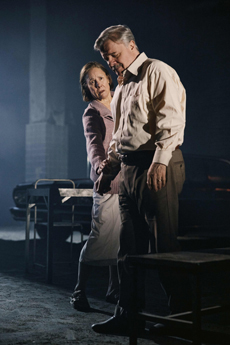
Theatre in Review: Death of a Salesman (Winter Garden Theatre)In Death of a Salesman, Nathan Lane gives us his Lear and Joe Mantello frames Arthur Miller's play not as the sorrows of one working stiff but the collapse of an entire way of life. Scholars have debated for decades whether, given its characters and milieu, this masterwork met the conventional definition of tragedy, with some arguing that it is too small in scope or populated by inconsequential characters. The production at the Winter Garden should end that discussion, possibly forever. It contains all the sorrow of the world. Mantello's staging rests solidly on the shoulders of four superb leads. Lane drives onstage, steps out of his car, and sighs with profound exhaustion, life escaping from his soul like air from a balloon. (It is no small tribute that, at the performance I attended, he emerged to no entrance applause. Only a minute or so in, the production had already cast a spell.) Hollowed out by fatigue, Willy is running out of everything -- time, money, energy, hope. Whether or not he once was a crack salesman with cash to burn and friends in every town, the world has moved on, leaving him to trudge through his rounds, suitcase in hand, to ever-diminishing effect. Worse, he is slipping into something close to madness, lost in a swirl of memories both rosy and bleak. The play's original title was The Inside of His Head, and in Lane's performance, it is increasingly treacherous territory. There's a sharp pitch of grievance in Willy's voice, an empty look in his eyes, an acute sense of a once-stable life slipping through his fingers. We also see him in the half-remembered heyday, dazzling his sons with bad advice about getting ahead in business. ("The man who makes an appearance in the business world, the man who creates personal interest, is the man who gets ahead. Be liked, and you will never want.") It makes a painfully sharp contrast with his present when he must scramble to survive. Lane makes Willy's skin feel like a wet wool sweater, providing constant irritation. One minute, we see him packing his son, Biff, off to a business meeting, warning him not to pick up any dropped objects when making his pitch. ("They have office boys for that.") A little later, he violates his own rule, stooping to retrieve a coffee cup lid from the employer who holds him in contempt. Observe the impotent fury when, abandoned by his sons in a restaurant, Willy hurls a wad of cash in a waiter's face. Or the poignant silence with which he greets the sight of a father and son embracing, a stark contrast to his own family. "Funny, y'know?," he says. "After all the highways, and the trains, and the appointments, and the years, you end up worth more dead than alive." His gaze, fixed on some invisible past, lets you know that a terrible fate is imminent. In many productions, Linda, Willy's wife and caretaker, is portrayed as a genteel, seemingly frail matron who sheathes a surprising inner strength. (Think Mildred Dunnock, who created the role and played it later on film and television, or Elizabeth Franz, opposite Brian Dennehy in 1999.) Laurie Metcalf's Linda has been worn down by life to a nub of pure steel; if she provides Willy with unquestioning support, she accurately sees her sons as lost souls and drifters. Metcalf makes Linda's most famous speech ("Attention must be paid") sound freshly urgent, a five-alarm warning of impending disaster -- it's both an indictment of and a to-do list for her worthless offspring, whose negligence, she insists, has brought her and Willy to the edge of ruin. There's also something heartbreaking in her assessment that "a small man can be just as exhausted as a great man." And you'll feel the primal terror in her scream as she watches the family she loves (and sometimes loathes) irrevocably ripping apart. As Biff, Willy and Linda's elder son, the cracked repository of their dreams, Christopher Abbott makes Biff rougher-edged than usual, with a pronounced Brooklyn accent, supporting the idea that he never was, never could have been the slick businessman his father envisioned. He's a wanderer, unable to stick with a job or a woman, his life draped in a mantle of quiet disappointment. But when Willy snaps dismissively at Linda, he grabs his father and roars, "Stop yelling at her!" in a white-hot rage that reduces the room to stunned silence. Biff's climactic confrontation with Willy, in which he bares his essential mediocrity ("Pop! I'm a dime a dozen, and so are you!"), is one of the most difficult scenes in American drama. It's an act of psychological bloodletting, a mercy killing designed to once and for all destroy the bond of guilt and grievance that ties him so painfully to his father. Abbott renders it as both an expression of wounded fury and a desperate plea for forgiveness, shattering in its anguish. Ben Ahlers makes the role of Happy, the younger son, feel unusually central to Miller's design. An operator with women, a slick dispenser of false promises, he is the ultimate product of the false values on which Willy has raised his boys. Nothing matters as long as he has a paycheck fat enough to keep the good times rolling. In all his mindlessness, he is the sad product of Willy's upbringing. The supporting roles have been luxuriously cast: Jonathan Cake, imperious and spectral as Willy's long-dead entrepreneur brother Ben; K. Todd Freeman as Charley, Willy's skeptical, sort-of best friend, his saving offer of a job brutally rebuffed; Michael Benjamin Washington as Bernard, Charley's son, a lawyer whose success Willy covets for Biff; and Tasha Lawrence as the good-time gal whose throaty, bawdy laughter haunts Willy's memories, for good reason. Mantello has approached this oft-produced drama with fresh eyes, beginning with a production design that reorients and expands on Miller's intentions. (A 2012 revival, starring the late Philip Seymour Hoffman, featured Jo Mielziner's original scenic design; it was interesting to see, but it threatened to give the play the patina of an antique.) Chloe Lamford's set -- intended in part, I suspect, as a way of dealing with the enormous Winter Garden stage -- places the action in a disused warehouse, an empty, industrial space supported by iron pillars. It's the first move in a strategy to uproot the play from its late-1940s time frame and place it in a liminal space that could be any decade between then and now. (Here, Willy drives a 1960 Chevy Malibu, not the Studebaker specified in the script.) In this framework, the action unfolds in the rubble of a ruined American Dream. Much of Miller's work is haunted by the 1929 crash, a disaster in his family, which exposed the dark side of capitalism; onstage at the Winter Garden, the system is permanently broken, a rebuke to would-be go-getters. Not every detail of this re-envisioning works. Rudy Mance dresses the actors in a range of time periods, an approach that could be better thought through. Caroline Shaw's music underlines certain scenes too heavily; with writing as incisive as this, we don't need to be told what to feel. In a generally excellent cast, John Drea is a little too slick and smirky as Howard, the boss who coolly dismisses Willy; the character is oblivious, not a villain. But I'm betting you'll leave the theatre shaken by Willy's encroaching madness: His howl of rage at Howard ("You can't eat the orange and throw the peel away -- a man is not a piece of fruit!"), or, when broken by truths that can't be taken back, his astonished cry, "Isn't that-isn't that remarkable? Biff-he likes me!" Equally moving is Willy's baffled, frantic response when Biff catches him in a compromising situation in a Boston hotel room. For the first time, Willy's lies catch up with him. In a production that is especially acute about the play's chain of failed father-son relationships, it constitutes Willy's dethroning, the moment when he becomes a fallen idol. There are many other felicitous touches, including lighting designer Jack Knowles' stunning, layered compositions, which keep track of past and present, reality and illusion, and Mikaal Sulaiman's sound design, which feels invisible except when certain effects are called for. Mantello supplies many grace notes, too, such as the first-act finale, in which Biff, having discovered the rubber hose Willy has stashed away, against the day when suicide seems the only way out, hurls the hated object to the floor, cueing a blackout, or the final scene, when Linda buries their paid-off mortgage in the dirt of Willy's grave. I've seen many productions of this landmark play, but this one stands out for its raw emotional power and its connection to our current national state of disillusionment. More than any other rendering, it speaks directly to today; to my mind, it is unmissable. --David Barbour 
|