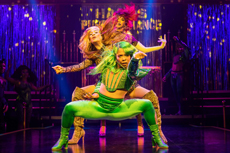
Theatre in Review: Cats: The Jellicle Ball (Broadhurst Theatre)Having sashayed uptown following its 2024 debut at NYC PAC, Cats: The Jellicle Ball delivers at least four indelible theatrical moments. The production's conceit views the now-and-forever musical, based on a collection of feline-themed poems by T. S. Eliot, through the lens of Harlem's ballroom culture, and the best bits result in an exciting double vision, reinvigorating a show that seemingly wore out its welcome during its original, eighteen-year, Broadway run. One: In the slyly staged opening number, individual dances are caught, frozen, in spot units, bathing them in saturated blues, purples, and yellows; as the music gears up -- a charming bit of Britpop by Andrew Lloyd Webber -- they take the stage, which, courtesy of set designer Rachel Hauck, features a runway abutting the audience. A velvet rope is dropped, and here they come, en masse, in a tight formation, vogueing, kicking, and striking poses with abandon, and daring us not to get excited. It's a delightfully fizzy way to get started. Two: The entrance of Old Deuteronomy, presiding elder of this cat pack, cues the appearance of Andre De Shields. It's always a good idea to have a Broadway legend on hand, and, sporting a mane more luxuriant than anything in The Lion King, the veteran star earns an ovation on the sheer strength of his presence. Having first landed on Broadway's radar in 1975 as the title character of The Wiz, he still has some wizardly moves left, as well as the ability to hold a note for unnatural lengths. Nearly triple the age of some sharing the stage with him, he is the production's irrepressible fountain of youth. Three: The second act begins with a historic montage, courtesy of projection designer Brittany Bland, of the Harlem ballroom scene -- fabulous creatures in fabulous gowns, basking in an aura of self-created glamour. (Not every image is joyous: We see shots of police raids, one price paid for living on society's margins.) Next comes a roll call of the "houses" that provided the ballroom scene's foundation in the 1980s. It's a brief, but potent, requiem for a generation lost to AIDS, violence, or the passage of time, and, remarkably, this giddy entertainment accommodates a gesture of documentary authenticity. Four: The above sequence cues the entrance of Junior Labeija, the ballroom emcee immortalized in Jennie Livingston's 1990 documentary Paris is Burning, as Gus, the Theatre Cat. He and De Shields share a moment, one icon facing another, and the thrill is irresistible. Aided by the talented Bryson Battle, Lebeija delivers Gus' number, delicately lamenting the theatre's decline, followed by a dance with his younger self that is pure theatre magic. Between these episodes and one or two others, Cats: The Jellicle Ball often marks time, however. During these less-scintillating passages, the show's dual concepts often come unstuck, leaving a yawning gap. As poignant as Gus' number is, why is it filled with references to Dick Whittington, telegraph wires, and the hoary old stage melodrama East Lynne? Why are these Uptown Manhattan denizens dwelling on quintessentially British foodstuffs, such as Strassburg pie, potted grouse, and salmon paste; London neighborhoods like St. James and Tottenham Court; and the reign of Queen Victoria? Of course, such questions arise only when one can hear what they are singing: The cast's diction is such that long stretches of lyrics are totally lost. The fact remains that, underneath the scattered glitter and bolts of taffeta, Cats: The Jellicle Ball remains...Cats, a lengthy and determinedly twee revue, populated by a cloying cast of anthropomorphized furballs and coasting on a charm that declines markedly across its nearly three-hour running time. Its main attraction is that of a pep rally: Surprisingly, this fortysomething musical, once dismissed as the last word in cheese, has been taken up by a fanbase as a vehicle for celebrating queer/trans/nonbinary lives in their moment of controversy and possible peril. Fair enough, but then even the most sympathetic audience member must listen to the songs from Cats; this hardly seems fair. (It doesn't help that Eliot's words, massaged into lyrics, are so sticky they seem covered with jam.) As one high-kicking cat anthem replaced another, and the full-on surge of high decibels and high spirits slowly sapped my energy, I wondered what an original musical set in the ballroom scene might look like. Even under these less-than-optimum conditions, several performers stand out. Ken Ard, a member of the original 1982 Broadway cast of Cats, drives the action as a DJ ensconced in one of the side balconies; Sydney James Harcourt makes Rum Tum Tugger into an irresistibly sexy male stripper; Dudney Joseph Jr. is an authoritative master of ceremonies as Munkustrap; Bebe Nicole Simpson and Garnet Williams sass up the number "Macavity," about the "mystery cat" (given a sleek, slinky profile by the towering, willowy Leiomy). The most storied role, Grizabella, the ratty, hopeless, abandoned "glamour cat," is brought to heartbreaking life by "Tempress" Chasity Moore. (A bit when, alone, she tries to prowl the runway and falls is especially poignant.) Moore brings a real brokenness and soaring vocals to "Memory," Grizabella's tribute to days gone by; aided by Adam Honore's jewel lighting, she makes the song into a show-stopping cry from the heart. The choreography, by Omari Wiles and Arturo Lyons, skillfully draws on a standard vocabulary of ballroom moves, achieving much more variety than I remember from the downtown incarnation. Directors Zhailon Levingston and Bill Rauch bring much more intimacy to the proceedings this time around -- the Broadhurst is a much better venue than the cavernous NYC PAC -- but they still have trouble shaping a show that is little more than a lengthy series of vaudeville turns. (This version reimagines each sequence as a competition category, like "Virgin Vogue" or "Up in Pumps," a strategy that doesn't add much sense of progression.) Hauck's retooled set design retains its warehouse feel, bringing banks of audience seating onstage. Honore's lighting sends hyperactive means flying in all directions. Kai Harada's sound design could shed a few decibels, but, as previously mentioned, the sometimes-muddy intelligibility is often the fault of the cast. Even more triumphant than before are Qween Jean's costumes, an outrageous parade of styles featuring feline patterns and/or Pride colors worked into every ensemble. Combined with the 1970s-era clothing seen in Liberation earlier in the season, it confirms her as one of the most creative costume designers working today. There's clearly a vast audience that cares nothing about the objections listed above, and, in the eyes of many, Cats: The Jellicle Ball spiffs up an aging property for a generation that only knows it from original cast albums, if at all. Much improved from its 2024 incarnation, it nevertheless remains a curious cat, a problematic vintage musical transformed by a random (if cannily chosen) production concept. Oddly enough, the more it gets away from its source material, the more entertaining it is; that can't be right. --David Barbour 
|