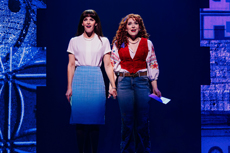
Theatre in Review: Beaches (Majestic Theatre)Accept no substitutes: These are words I associate with the advertising of my youth. They certainly apply to Beaches, a dutiful, yet blurred, copy of a best-selling novel and hit film from decades past, resurrected again in hopes of creating the next girls' night-out hit. Personally, I think the girls deserve something better than this strange throwback to another era. (Set mostly in the 1950s and '60s, it could have been written then, too.) Compared to premium musicals, this one is Brand X. In all its versions, Beaches hinges on the unlikely lifelong friendship of megastar Cee Cee Bloom, presented here as a kind of Carol Burnett/Bette Midler hybrid, with a TV variety show that holds America in thrall, and Bertie, a genteel, wealthy WASP type whose life is a series of disappointments and missed opportunities. They meet in 1951 under the boardwalk in Atlantic City. Cee Cee, roughly ten years old, is an alarming, pint-size version of Sophie Tucker, appearing in a kiddie revue. ("When I hear a guy who tells a joke that's blue/You bet your butt that I am gonna steal it!," she sings, making like a pre-pubescent Milton Berle). Putting one of her stage costumes on the shy, but dazzled, Bertie, Cee Cee barks, "Now shoulders back and stick out your titties!" It's love at first sight. From the get-go, the source of the girls' mutual admiration is hard to credit, despite them trading confidences in a number titled "Wish I Could Be Like You." (It's also never clear what Bertie, born to money, with a frigidly repressive mother, is doing in Atlantic City, which, even in the 1950s, was hardly a playground of the rich.) But the girls keep their friendship alive, first as pen pals and, later, in person, when Bertie, fleeing her family's expectations, crashes the summer theatre where Cee Cee is unhappily playing Uncle Jocko in Gypsy and Nana, the dog, in Peter Pan. They sleep with the same man, make unsatisfactory marriages, quarrel over a stupid misunderstanding, and, after an estrangement of several years, get back together when Bertie announces her impending single motherhood. Then, when the child, Nina, is ten or so, Bertie starts to feel unwell... Why are these women friends? Despite a legion of songs attesting to their devotion, Cee Cee and Bertie never seem more than the forced pairing of opposites. The book, by Iris Rainer Dart (author of the novel) and Thom Thomas, can't explain why Bertie is entranced by Cee Cee's vulgarity and diva behavior, or Cee Cee's attachment to a woman who skips law school for a dull marriage, and, after her divorce, a life of leisure. ("I can't imagine what she'd ever see in me," Bertie sings: I was wondering about that, too.) The film, which is scarcely more convincing, relies on the chemistry of Bette Midler and Barbara Hershey, genuine movie stars whose personalities fill in the script's many blanks. Impersonated here by a pair of talented musical theatre regulars, the glaring absence of star temperament exposes the show's central friendship for the contrivance it is. Not that anyone is supporting these hard-working stars. Kelli Barrett's Bertie, nervously eyeing the "bohemian types" at Cee Cee's summer theatre, wonders, "Do you suppose any of them are snorting marijuana?" Despite a few mild adventures, the character remains a cipher, bullied by her awful mother and patronized by the boor whom she weds. She alternates between looking headachy at Cee Cee's excesses and pledging eternal amity to her, but her true nature remains stubbornly elusive. As Cee Cee, Jessica Vosk throws herself in the role of boisterous good-time gal with a tough, don't-tread-on-me side, but you have to take her charisma on faith. You can practically hear the rimshots at the end of her wisecracks. "I look like the girl next door -- to a kibbutz," she snaps. Arriving at a hospital staffed by nuns, she jokes, "Looks to me like a dress rehearsal for The Sound of Music." Modeling a new beach outfit, she says, "This was the original hat worn by Carmen Miranda in Weekend in Havana. It's got more fruit than the audience at a Judy Garland concert." We're supposed to accept that Cee Cee is a Streisand-level star, but with gags like that, how did she ever escape the Borscht Belt? Among the supporting cast, Brent Thiessen is likeable as a director who grows tired of being Mr. Cee Cee Bloom and opts to run a theatre in Cleveland; their breakup scene is one of the show's more touching moments. Ben Jacoby does his best to make something of Bertie's spouse, a cardboard preppie obsessed with the thought that his wife doesn't understand him. They share a dispensable number, "God Bless Girlfriends," underlying the obvious point that each feels forced to play second fiddle to his wife's bestie. The actresses who play Bertie and Cee Cee as little girls are largely unintelligible, which gets the evening off to a rocky start. The songs tend to announce their intentions in their titles ("Show the World Who You Are," "The Brand New Me," "The Words I Should Have Said"), leaving little for one to discover. Mike Stoller, still at it in his nineties, provides some kicky 1960s-style melodies, and if Dart's lyrics are pedestrian, at least they rhyme. But they harp endlessly on the supposedly comic differences between Bertie and Cee Cee without ever getting at the foundation of their friendship. Fans of the film can be assured that "The Wind Beneath My Wings" has been retained as the eleven o'clock number, but without Midler's special way with sentimental ballads, the effect is surprisingly anodyne . The basic design concept, featuring sliders and headers that wipe the stage, setting the tone for (and suggesting the time frame of) each scene, is clever and effective; interestingly, it's hard to tell where James Noone's scenery ends, and David Bengali's projections begin. (The summer theatre scenes are framed in collages of vintage playbills, and a sequence depicting Bertie and Cee Cee's weddings features bridal imagery from vintage fashion magazines.) Rather like the recent revival of Gypsy, however, the design looks a little bit lost on the Majestic stage. After Phantom of the Opera's long, long run, designers may need to rediscover the knack of handling this vast space. Ken Billington's flawless lighting makes the stars look great and deftly underlines each of the song's emotional beats. Tracy Christensen's costumes may work too hard to emphasize Cee Cee's brassy tastes, but I suppose she is giving what the directors want. Kai Harada's sound design has a faintly hollow quality, although it improves whenever the adults are onstage. The direction, by Lonny Price and Matt Cowart, is efficient, but they bring much emotional authenticity to these synthetic proceedings, especially a farewell climax that proves to be mildly affecting at best. I must add that the man sitting on my right sobbed openly during the musical's final twenty minutes, so there may be an audience of Beaches fans out there, looking to haul out the Kleenex. But, to the more casual eye, the musical's PSA-like endorsement of sisterhood somehow rings false. Shouldn't a friendship be about something? --David Barbour 
|