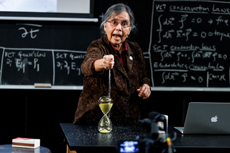
Theatre in Review: Rheology (Playwrights Horizons) Bulbul Chakraborty is an exceptionally indulgent mother, almost recklessly so. This accomplished physicist has not only signed up to collaborate with her son, Shayok Misha Chowdhury, on a play starring them, but she has agreed to be killed off onstage. Repeatedly. As an act of self-soothing. It's an endeavor that would make Sigmund Freud clear his throat, with emphasis. Rheology (a production of The Bushwick Starr, HERE Arts Center, and Ma-Yi Theater Company) begins with a physics lecture, complete with chalkboard and visual aids. (Fair enough: The Peter Jay Sharp Theater, upstairs at Playwrights Horizons, looks like a classroom; every time I enter, I feel like I'm back in Algebra I.) Bulbul, a natural performer, gives a talk on sand, which, intriguingly, has multiple physical properties: The individual grains are solids, but, falling into a vessel, they assume its shape, as do liquids. Then again, pour sand grains through an hourglass and, landing on a flat surface, they make a shape of their own. What to make of this? Such considerations lead Bulbul to invoke the enchanting term "capricious matter," which, she notes, is "a baffling phenomenon because...unlike regular solids, granular solids, jammed solids, or fragile solids, like sand dunes, are created by external forces. Thanks to her lucid, almost luminous, presentation, physics acquires an immediacy one never knew it possessed. (Seeing it one night after the Broadway revival of Proof, with everyone kvelling over mathematical equations, I was cruelly forced to face my STEM ignorance. Maybe that English degree was a folly, after all.) During her talk, however, Bulbul has a coughing jag so convincing that, at the performance I attended, someone in the audience called for help. It is a total fake-out: This is when the Chowdhury, known colloquially as Misha, pops up and explains: "I've always had a pretty acute phobia of my mother's death. Before we started this process together, I would have had a hard time even saying...'My mother's death'." He adds, "The only way I've ever been able to let the thought of her dying even cross my mind is by saying to myself, okay...if you were to die, I would just...die too." Thus, he plans to envision her final exit theatrically, to master the dreaded event before it happens. Lest you expect that Misha is suffering from some sort of Norman Bates fixation, I must add that the idea is largely Bulbul's. A scientist to her fingertips, skeptical of her son's overemotional fears, she has suggested that, as an experiment, Misha should stage her death scene, then collect evidence noting his reaction. It's simple: Having posed the hypothesis that he can't live without her, the only thing to do is to put it to the test. It's a hell of a way to prove a point. This proposition leads to passages that occasionally amuse and more often discomfit. A nuts-and-bolts wrangle about the correct way of expiring on an office chair will be familiar to anyone who has ever seen a play in rehearsal. (Bulbul shamelessly hams it up to express an opinion about Misha's direction.) Putting Bulbul on a table and wrapping his head in a scarf, Misha carries on hysterically, like a widow seeing her beloved on a funeral pyre. The scene that follows, performed in Bengali, with English surtitles, is pure Bollywood melodrama. "I will die with you," Misha moans. "We will burn together. I will bid farewell to my long, flowing locks. [Misha is bald, by the way.] Even as Bulbul tries to talk some sense into Misha, he derides himself: "You're right. I'm too dramatic. Who could ever love a boy like me? I will die alone and unloved." Alarmed, Bulbul responds, "Many men will touch you! Many, many men!" All right; that made me laugh, as did Misha's pledge to carry on his mother's work: "I will never rest until I find a rigorous stress-only theory of granular elasticity!" What greater promise can a son offer? More disconcerting is the sight of the forty-one-year-old Misha, in a child's pajamas, playing in a sandbox. Slowly, he unearths Bulbul's skeleton, carries it to the table, lies down beside it, and sucks his thumb. It was then that I began to speculate: If, thirty years ago, Bulbul had sent Misha to bed without his supper once or twice, would any of us be sitting in the Peter Jay Sharp Theater these nights? More than anything I've seen this season, Rheology functions as a Rorschach blot: Whether you find these mother-son edge-of-the-grave antics to be slyly amusing or distasteful and macabre will be entirely up to you. (It will probably say something about your upbringing, too.) Certainly, both stars give committed performances, and the production design is well-suited to the play's needs. Krit Robinson's classroom-lab setting nicely accommodates the action, and so seamless is the melding of the other elements that I could never tell if the lighting, by Mextly Couzin and Masha Tsimring, or the video, by Kameron Neal, was responsible for making the figures on the upstage chalkboard change colors and come to life. Whoever does it, it's a nifty trick. Neal also provides photos of mother and son from long ago, a gripping video of a sand lizard making its way underground, and images of Bulbul's mother when young, a century ago. Tei Blow's sound design combines well-done effects with discreet amplification. Enver Chakartash dresses the actors appropriately. Other key elements include the poetry of Rabindranath Tagore and a clinical dissection of the process by which the body shuts down after death, which is gorgeously written even as it pushes the production in a morbid direction. It's entirely possible to be affected by Bulbul's elegant argument that the movements of sand, as described in the opening scene, are an apt metaphor for the way in which grief moves through us physically, filling us with a deep sadness that we somehow manage to accommodate, making it part of our blood and bones. (In a sense, Misha is capricious matter personified, a shapeshifting persona buffeted by the idea of painful events he can't control.) But this doesn't mean that Rheology's middle passages aren't at times bizarrely performative: Is Misha really pre-grieving the eventual loss of Bulbul, or is he merely acting out? Do his sorrow and anxiety really have anything to do with her? That the piece presumably accurately reflects their dynamic doesn't save it from resurrecting the age-old stereotype of the overwrought gay guy overly attached to his mom. This is a play about love, but the true object of devotion remains obscure. --David Barbour 
|