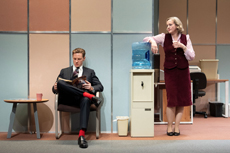
Theatre in Review: The Receptionist (Second Stage/Pershing Square Signature Center)If the acting thing ever dries up for Katie Finneran, she has a fine career ahead in office management. As Bevely, the title character of Adam Bock's American horror story, she is so much more than her job description: She works the phone console like a maestro, dispenses coffee like a master barista, shreds documents with alarming gusto, and wields a dust buster like a hunting weapon, still finding time to manage the personal lives of friends and colleagues. Beverly is also good at arranging office birthdays, including the selection of cakes and cards; producing one of the latter for her boss, Mr. Raymond, she can't contain her amusement: "I saw that, and I laughed and laughed and laughed. In the store! A pony with a pipe! People are crazy!" If you've ever worked in an office, you've met a Beverly. She is a cheerleader, coach, and mother hen all in one, who keeps everything moving without unnecessary friction. (She also functions as an in-house psychologist, foisting a copy of a book titled Help! I'm in Love with a Narcissist! on a lovelorn supervisor.) As a bonus, she and her husband are fanatical teacup collectors. You can laugh at her, dismiss her as a giggling fussbudget, but you do so at your peril; she is essential to the operation. Which, in this case, may not be such a good thing, a fact that becomes frighteningly obvious when Mr. Raymond enters, looking unhappy and distracted. "I had an unfortunate afternoon," he announces. "Yesterday. I broke his little finger. I thought that would do it." The finger belongs to a "client," the office term for victims of rendition, as practiced by the US Government during the Iraq War. First staged in 2007 (by Joe Mantello) at Manhattan Theatre Club, The Receptionist packed a gut punch, beginning as a light workplace comedy and ending in the unthinkable. Nineteen years later, it looks much thinner, more like an old Twilight Zone episode than a stinging comment on the normalization of torture. For one thing, the terms of government overreach have changed; instead of inflicting unendurable pain on alleged terrorists, we round up, imprison, and expel immigrants, smearing them wholesale as criminals. We don't break bones; we break up families. Each is a crime, but Bock's play doesn't address the current situation the way it originally did. It also draws an ironic contrast between the mild-mannered staffers and their grisly occupations that seems out of date in an era when top defense officials publicly froth at the mouth over the destruction of our supposed enemies. Was it only twenty years ago that people could still be shocked by the violation of long-held norms? The Receptionist isn't advertised as a period piece, but it plays like one, if only because none of the characters seems to own a BlackBerry, let alone a smartphone. Also, the director, Sarah Benson, overplays the comedy of the first half, especially when Lorraine, Mr. Raymond's associate, on the prowl for a boyfriend, shamelessly vamps the mysterious Martin Dart, who has arrived from "the central office" for an impromptu meeting. Watching Mallori Johnson, as Lorraine, bend and snap (as Legally Blonde's Elle Woods would have it) over an office machine, trying to get Dart's attention, is dismaying. The play's comedy is already so extreme, there's no need to underline it; the script works best as a reasonably realistic mirror of everyday life, an approach that puts extra metal in its punch when the action takes an ugly turn. Here, the early scenes are stranded somewhere between Eugene Ionesco and an old-fashioned three-camera sitcom, and they serve to undermine the overall effect. Still, Bock has a point about how the hunt for retribution feeds on itself, ultimately consuming the hunters. In The Receptionist, what goes around comes around, and anyone who reveals the slightest vulnerability is next in line for persecution. As the action darkens, Johnson's performance improves markedly, and there are solid contributions from Nael Nacer as Mr. Raymond, whose appalling day job contrasts with his kindness to animals, and Will Pullen as Martin Dart, whose affable manner conceals deadly intentions. The scenic design collective dots has come up with an ideally banal office dominated by beige and light blue paneling, solidly lit by Stacey Derosier and Bailey Costa. (There's another scenic element, a narrow metal cone, which is revealed twice to disturbing effect.) Enver Chakartash's costumes nicely suggest the everyday workwear of two decades ago; telling details include the Satanic red socks worn by Dart in his first appearance. Bray Poor's sound design makes unsettling use of telephones, shredders, and an out-of-left-field rendition of "Shine On, Harvest Moon." And there's the moment when cheerful, cunning, yet empty-headed Beverly, who never puts a foot wrong on the job, suddenly realizes, to her fear and bafflement, that she is in terrible trouble. "Loyalty is important," she says. "So important and sad when it's gone. And dangerous and sad and dangerous to throw away." She is about to find out just how true that remark is. If The Receptionist feels slightly out of date, the suspicion and ruthlessness that drive it never go out of style. --David Barbour 
|