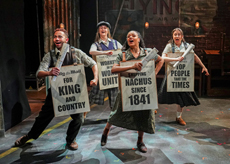
Theatre in Review: Cable Street (Brits Off Broadway/59E59)Cable Street is a fascinating story told uncertainly and in less-than-ideal circumstances. The new musical -- book by Alex Kanefsky, music and lyrics by Tim Gilvan, cries out for epic treatment. Set mostly in 1936, it unfolds in London's East End, an ethnically diverse neighborhood that draws the rage of Oswald Mosley and the British Union of Fascists, purveyors of a blood-and-soil ideology dedicated to driving out immigrants. The East End is roiled by nativism, antisemitism, unemployment, political divisions, and the ever-looming threat of homelessness. But when the BUF, a gang of black-clad bullies, plans an intimidating march through the district, the locals organize, with an assist from the Communist Party, leading to battles in the street. With its cast of Jewish, Irish, and Jamaican characters, Cable Street could have a score as rich and complex as Ahrens and Flaherty's work for Ragtime. The book's many scuffles, ambushes, and demonstrations could generate some Les Miz-level rabblerousing. But the show teems with too many characters, songs (and musical styles), and situations, all fighting for one's attention, leading to serious snarls onstage. The three protagonists are Sammy, who is Jewish and an aspiring boxer, struggling to find a job; Mairead, an Irish budding poet, crowded into a tiny flat with her many relatives; and Ron, a Lancashire lad at loose ends in London, saddled with a boozing mother and desperately in need of a sense of purpose. Thrown together in the ensuing social unrest, they share many woes -- including lack of work, crippling rent increases, and conflicts with their parents - but they make very different choices, culminating in a three-way confrontation on a rooftop that one of them may not survive. It's all compelling stuff, but there's too much of it, in part because the book must take time to sketch in the political and social realities of the era, often in a trio of comic numbers in which newsagents, hawking their wares, mouth the opinions of their publishers. Meanwhile, the characters suffer: Sammy's personality never really comes into focus -- his interest in boxing is stated but never explored -- and his numbers consist of Lin-Manuel Miranda-style rap rants that don't feel organic to the story. One minute, Mairead is scribbling out a few lines of (admittedly stirring) verse; the next, she is being offered a plum job on a New York newspaper -- really? Ron is defined entirely by his aimlessness, which makes him ripe for the fascist plucking, less so audience interest. All three compete for stage time with a full complement of supporting characters, a chorus of scheming blackshirts, and a modern-day subplot focusing on Steve, Sammy's nephew, a tour guide, and Oonagh, an American, whose true relationship to the story will be revealed in the fullness of time. It's a crowded canvas with little room to breathe. The score is top-heavy with rap interludes, rough-and-tumble anthems, and power ballads, most of which rattle the roof without illuminating the characters. The best numbers are quieter and more introspective, including "Let Me In," which tracks Ron's conversion to fascism; "Only Words," featuring Sammy's pacifist, Old World father Yitzhak, arguing, unconvincingly, that the troubles will fade of their own accord; and "Stranger/"Sister," a touching lament delivered by Rosa, Sammy's sister, who is only interested in building bridges in her divided community. But much of the time, the characters are shouting out policy positions rather than revealing themselves. The best thing about the production is the talented British cast. As Mairead, Lizzy-Rose Esin-Kelly has an engaging what-the-hell manner and nifty vocal growl, making the most of "What Next?," her scathing rejection of misty nostalgia for the old country. As a politically engaged American journalist, Preeya Kalidas lends her stunning voice to "No Pasaran!," rousing the East Enders to action. Ethan Pascal Peters etches distinctively different characterizations as a Jamaican Communist organizer and Sammy's gentle brother. Romona Lewis-Malley and Jez Unwin do very well by Rosa and Yitzhak's numbers. (He also turns up as a shifty, double-dealing fascist leader.) Isaac Gryn and Barney Wilkinson do their best with the less-defined roles of Sammy and Ron. Cable Street needs a more sweeping staging that can be achieved on a cramped theatre stage, so much of Adam Lenson's direction boils down to traffic control. Yoav Segal's two-level set accommodates the small band, but it struggles to serve the show's yesterday-and-today time frames and many locations. Ben Jacobs and Sam Waddington's lighting goes a long way toward ameliorating these problems, creating highly theatrical looks that pace the numbers. Lu Herbert's costume scheme cleverly initially dresses the characters in contemporary outerwear that they remove, revealing period outfits, as soon as the action slips into the past. Charlie Smith's sound design supplies solid reinforcement and plenty of ambient street sounds that evoke the life of the neighborhood. To be sure. Cable Street becomes clearer and more direct in the second act and builds to a series of genuinely moving revelations. In fact, the latter scenes are good enough to give a sense of what a more confident treatment of this story might be like. As the rousing audience response at the performance I attended indicates, it's a history lesson with a message that couldn't be more relevant to this fraught moment. --David Barbour 
|