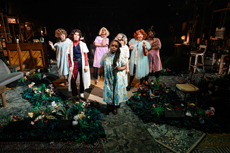
Theatre in Review: Animal Wisdom (Signature Theatre Company)For an hour or so the other day, I thought I might finally be converted to the Christian cult. I refer, of course, to Heather Christian, the composer and librettist who has been acclaimed for Oratorio for Living Things and Terce, theatricalized concerts delivered with a heavy overlay of nondenominational religious mystery. Whether deploying Latin texts or almost willfully obscure poetry, her work has been informed by a sort of Gertude-Stein-meets-the-Episcopal Church sensibility that many find entrancing, but which has repeatedly left me baffled. Animal Wisdom is a different sort of animal, if you will, a more overtly personal creation, an account of her upbringing with a matrilineal line of "New Orleans Catholics who are also musicians who suffer migraines and talk to dead people." To be clear, Christian grew up in Natchez and her relatives' syncretic faith was drawn equally from Roman Catholicism and various occult practices. Natchez, she notes, is in a constant state of erosion; "Houses just straight up fall into the river." (Check out Suzannah Herbert's documentary Natchez, now streaming, to see how the city has learned to monetize a cleaned-up vision of its antebellum past; you'll get a sense of how nutty the playwright's childhood must have been.) With a decaying landscape populated by seers, ghosts, and faintly menacing eccentrics, Christian has the making of classic Southern Gothic literature in the tradition of Capote and Williams. Christian's bizarre provenance includes her grandmother Heloise, who "got visitations from a dream dog that brought messages from the dead" and who "kept a two-liter Coke bottle full of holy water under the sink, next to the Drain-O;" Victor, a "a bump-in-the night poltergeist" who "freaks me out;" her godfather, Myles, who hung out with Prince Albert of Monaco, dated Sophia Loren, and was a CIA agent; and her great-uncle, Raymond Levi, whose dream was to "make enough money digging graves to buy up an entire acre of family plots," and then "lock himself in his room and wait to use 'em." For once, her writing acquires a new specificity, plunging us into a world both fantastic and tangible, where the living and dead seem almost interchangeable in their inherent strangeness. Immersed inEmmie Finckle's set, which places musicians on two sides of a stage scattered with hanging lamps, birdcages, light-up Mary and Joseph figures, and flowers, flowers everywhere, and captivated by Masha Tsimring's lighting, we are transported to a place that's oddly familiar and unsettlingly otherworldly. Alas, the spell doesn't last. In the script, Christian notes that the play's conflict, such as it is, involves a writer trying to create a piece and failing, using the experience as a gateway to something entirely new. It's putting it mildly to say that this concept doesn't translate onstage; Kenita R. Miller, who acts as Christian's stand-in, rolls out a full lineup of family ghosts without making anything dramatic out of them; as the show progresses, its intentions become increasingly vaporous, a collection of set pieces leading to no particular conclusion. Following an admittedly stunning staging coup, the lengthy climactic sequence (somewhere between twenty and thirty minutes) is played out in darkness relieved only occasionally by a nanosecond's flash of light. I have rarely felt more held hostage in a theatre. In this sequence and a sort of Holy Communion featuring passed-around cups of Coca-Cola, the director, Keenan Tyler Oliphant may be indulging his playwright not to her advantage. Anyway, Miller works heroically across the two-house running time, conjuring spirits, telling tales, vocalizing to haunting effect, and altogether acting as our Virgil, guiding us through Christian's spirit world. (The script is also structured around the Catholic Mass in a way that I, a lifelong church attendee, found impossible to parse.) Miller is surrounded by a crack team of musicians, whose participation includes a sequence in which each of them impersonates Christian's eccentric piano teacher, dispensing cracked life lessons while sporting a repertory of wigs. Brenda Abbandandolo dresses everyone attractively and Nick Kourtides provides excellent reinforcement for the music plus a variety of effects including wind, rain, and cicadas. It's almost too on the nose to note that the finale of Animal Wisdom leaves us in the dark, but there you are. It's also true that where I find myself lost in clouds of generalized spirituality, many audience members discover inspiration and some kind of soul nourishment. It's a testament to our rancorous times, I suppose, that so many attend the theatre hoping to find the kind of succor that was once the specialty of churches. Animal Wisdom ends with an ode to peace, expressed thusly: "May you string God's marigolds/To shape the world that you once knew/May you paint in tangerine/Your wild impressions of love and may you sing/Hosannah Hosannah Hosannah Hossanah." I'm beginning to think I liked Christian's work better in Latin. --David Barbour. 
|