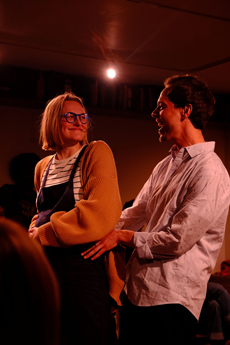
Theatre in Review: Obit (East Village Basement)The last time I was in East Village Basement, the Ninth Street townhouse that has become a hive of theatrical activity, it was all dressed up for the chic throuple drama Danger and Opportunity. The look is utterly different these nights; scenic designer Nessa Scabuzzo has created a squalid environment, packed with clutter, piles of newspapers, and a couch that looks like you'd need a blood test after sitting on it. We are in the home of the elderly, reclusive Jerry, who is so far gone that he doesn't recognize his son Charlie when the latter drops by. (He and Charlie are estranged, but still.) Then again, when Charlie brings along his very pregnant wife, Kay, Jerry instantly knows who they are; even more confounding, he remembers that Charlie, whom he previously mistook for an assistant super, has been a regular visitor. Clearly, father and son suffer from more than ordinary communication problems. Obit follows Charlie's halting attempts at sorting out things (before it is too late) with Jerry, who, by his own admission, was a less-than-stellar father. (Among other things, when Charlie was a boy, Jerry showed up with Jules, a little girl, the daughter of his lover, announcing that she was now part of the family.) It doesn't help that Jerry's grip on reality seems to change from day to day. Charlie is largely in denial about his father's hoarding ways and hostile relations with his neighbors; his awkward notion of rapprochement involves writing Jerry's obituary, offering it as a sort of pre-need tribute. (Jerry collects newspapers stretching back a quarter century, saving the death notices, because, to his mind, throwing them out is tantamount to erasure, if not outright murder.) Reliving (and, in some cases, relitigating) the past with Jerry does little for Charlie's rising panic over his impending fatherhood. Adding to his agita is Jules, Jerry's caregiver, who alone understands the old man's precarious mental condition and who doesn't appreciate interference from her alienated sibling. You can pick on Obit all you want: Its structure may be a little too neat, and playwright Trey Everett is stingy with his characters' backstories. There's a great deal more we should know about this family's fraught history, especially Jerry's marriage, which must have been wildly complicated. But Everett writes taut, engaging scenes with plenty of snappy, amusing dialogue, not to mention some notably powerful takedowns. He also confidently steers the plot toward a climax unfolding in two different rooms of the same hospital; if it isn't strictly believable, it brings Obit to an affecting and satisfying close. Obit marks the directing debut of the fast-rising actor Andrew Barth Feldman, who here demonstrates another side of his talent, eliciting a quarter of finely honed performances. Carson Higgins walks a fine line as Charlie, who is, all at once, a devoted husband; hopeful, expectant father; and aggrieved, passive-aggressive son. Despite the character's rather noticeable cluelessness, his charmingly sparring relationship with Kerstin Anderson's deftly realized Kay goes a long way toward keeping him sympathetic; in one of several revelatory passages, she gently notes that his golden memory of a father-son trip to Shea Stadium completely glosses over the sordid truth. Loren Lester captures the shifting moods of Jerry, who, as we often say of our elders, has good days and bad days; the bad ones are pretty spectacular. (Wait for his denunciation of the New York Times as a fascist enterprise.) Making a late-in-the-evening entrance as Jules, Jerusha Cavazos instantly commands the stage, reorienting everything we have learned about the characters so far. Lighting this tiny, cramped space is certainly a challenge, and one admires the designer Wheeler Moon's loyalty to the reality of each scene, but at times I wished to see the actors' faces more clearly; the designer makes a stronger impression with a stark white hospital room look and a deep red wash signifying a birth in progress. Amanda Roberge's costumes feel accurate to the characters, and Andrew Border's sound design makes good use of pop hits by Seals & Crofts and Billy Joel. (One note: The venue does not make a restroom available to audience members; if you decide to attend, consider yourself warned.) Overall, Obit is an appealing calling card for any number of talented young people, all of whom you can expect to hear from again, and soon. It has a fine appreciation of its characters, ensnared in a familial tangle of love and resentment, fighting for something like peace and self-acceptance. In other words, they're just like the rest of us. --David Barbour 
|