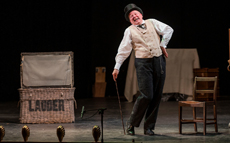
Theatre in Review: Lauder: Scotland's Kilted King of Broadway (59E59)The title of this charming and informative entertainment is a misnomer: Harry Lauder appeared on Broadway only once and briefly, although he did tour America on occasion. By then, such was his fame that he traveled on his own train, "the Harry Lauder Special." (As the Scottish entertainer wittily notes at 59E59, he could always scare up an audience in the US, thanks to local communities of his fellow countrymen, whom he dubs the "Scotia Nostra.") Anywhere in the British Empire, however, Lauder was a beloved figure, and, by 1911, the highest-paid entertainer in the world. (When he visited Hollywood, no less a personage than Charlie Chaplin was happy to greet him.) Because his natural habitat was the British music hall and his film career was minuscule, Lauder is largely forgotten today. But one of the many virtues of 59E59 is its penchant for programming shows about obscure, yet fascinating, English stars, including Vesta Tilley, Pat Kirkwood, and Gertrude Lawrence, each of whose life stories opens a window onto a lost world. Framed as an interview with a newspaper reporter, Lauder offers a quick recap of a life that began in a colliery and ended on the King's Honor's List, with the star making his final exit as the "Knight of the Music Hall." As he notes, success comes early; having won a following at home, he moves to London, where he is soon performing in six different theatres in a single evening. "I was ready to retire by 1914," he says. He was 34 at the time, and he resisted the temptation. In any case, his wealth continued to grow: "We didn't have a swimming pool, we had a loch! Cheaper to keep clean," he notes, slyly. Some of his stories should be taken with a large grain of salt, even if they amuse. He claims to have discovered his vocal prowess as a young boy, performing at a "Band of Hope" concert devoted to exposing the evils of drink. "It's for children between 5 and 14, very effective," he notes. "I never drank between 5 and 14." (He also delivers a wicked little ditty, "Whiskey," which, he says, caused a stampede of five-year-olds to the nearest pub.) He amusingly demonstrates his failed attempts at building acts around comic Irishman and Englishman acts. And he tells tales on himself: On a tour of the front, entertaining the troops during World War I, he recalls being told by a general, "I want you to sing to the boys so that when they are back at the front they will think of your singing and they'll face the Germans." Well, desperate times call for desperate measures. It's a potted biography crossed with a vaudeville act, and it exists largely to showcase Lauder's repertory of musical numbers. For collectors of theatrical memorabilia, it's a rare chance to hear such irresistible items as "I Love a Lassie," "Roamin' in the Gloamin'," and the anthemic "Keep Right on to the End of the Road." Jamie MacDougall, who stars as Lauder, looks the audience in its collective eye and sells each song in classic style, hurling it past the proscenium like an all-star game pitcher. Stars like Lauder could make even the largest music hall feel like a living room; at 59E59's Theatre B, MacDougall turns his solo show (with piano accompaniment by Derek Clark) into a get-together with friends. Technical details include assured lighting by David Cunningham, a parade of kilted outfits by Janis Hart, and uncredited video that includes newsreel footage of Lauder's funeral (which took on the trappings of a state affair) and a montage of his son, John, whose death on the battlefield in France was the great tragedy of his father's life. If the script stumbles a bit when dealing with Lauder's comically stingy persona -- a made-up trait similar to Jack Benny's miserly self-portraits -- it is genuinely touching when recounting his successful effort to raise a million pounds to help young men catastrophically wounded in the war. Someday, someone may produce a more analytical treatment of Lauder's life, noting his rise from poverty to wealth to knighthood, leapfrogging across social classes, while remaining a patriot and uncritical supporter of the British Empire. (The same is true of Noel Coward, Gertrude Lawrence, and other show business figures of the era.) This is also a show primarily aimed at those already interested in yesteryear's entertainments or with a fondness for Scottish culture; the audience at the performance I attended had a definite tartan tint. But on those terms, Lauder is an intriguing glimpse into a lost world. Interestingly, the piece, a co-production with Scottish Opera capably directed and adapted by Kally Lloyd-Jones, is by the late Jimmy Logan, himself a substantial figure in the UK as a stage and film actor and producer. Indeed, he came from show business royalty, being the nephew of Ella Logan, erstwhile Broadway star of Finian's Rainbow, and the brother of the legendary jazz singer Annie Ross. Somebody ought to do a theatre piece about him; if it ever happens, you can rest assured that 59E59 will pick it up. --David Barbour 
|