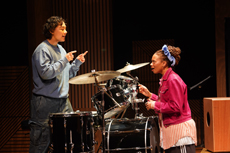
Theatre in Review: Girls Girls, Chance Chance, Music Music (Vineyard Theatre)About halfway through, the always-intriguing Girls Girls, Chance Chance, Music Music arrives at a moment of pure bliss. The characters are enrolled in a summer music program for adolescent girls in the Bay Area, and, until now, their relations have been cagey and competitive, marked by bursts of self-assertion, even aggression, followed by flirtations with self-harm and occasional suicidal thoughts. But then they come together and play. In the context of the script, the musically adventurous drummer Margot has composed the music; Fax, her sort-of best friend, is responsible for the lyrics and vocalizing, with Rile, a whiz at improvisation, on the piano. In reality, the song, "Never Been," is by the playwright, Eisa Davis, and it is a little thing of perfect beauty, an oasis in which these girls discover joy in music and in being themselves. Pam MacKinnon's production depends on actors with formidable musical skills, and all three performers deliver mightily. It's as transporting an interlude as anything found in this season's musicals. It's also a telling moment: The girls of Davis' play communicate better through melody than through words; growing up in a world built on a shaky foundation, both spiritually and literally (fires and earthquakes provide a steady drumbeat of menace, boys are a nuisance, and adults are at best unreliable), and still figuring themselves out, they collide, awkwardly and sometimes violently, leaving psychological marks that will linger into adulthood. When we first meet Margot, she is standing atop the building where classes are held, possibly getting ready to jump; frantically talking her down to earth is Fax, whose chatterbox ways, useful in these possibly dire circumstances, mask a universe of questions and insecurities. Margot is the snob in the crowd, fanatically dedicated to her craft and ever in search of the new. Stepping into a club, she denounces the smoothly professional band onstage as "jazz robots," who "could be doing something fresh, since that's totally your duty as a musician to carve out new territory." Eying an uncertain, sometimes tumultuous world, she says, "Impermanence, heartbreak, suffering...the only way to confront it is to make yourself steady to make yourself loyal, and I give my loyalty to music." Fax is Margot's opposite number, being cheerful, controlling, and thoroughly averse to experimentation. She's a notes-on-the-page type who, in a moment of reflection, admits, "I am in the best situation imaginable, and I still have this level of fear." (Among other things, she insists she is giving up bulimia because vomiting episodes are turning her vocal cords ragged.) Fax is especially irritated by Rile, who can casually run rings around a Rossini aria thanks to her knack for jamming. Then again, Rile's entire life feels like an improvisation; a "three-party baby" (with "mom carrying her girlfriend's egg with donor sperm from the bank"), she assumes an attitude of cool regarding her mother's parade of partners and a father who is only notional. As she notes, "It's just we're all blood, but no one is family." What a difference a couple of weeks makes. Only recently, I grumblingly noted the recent oversupply of plays about young girls on the brink, detecting a certain sameness among their ideas and approaches. Then comes Davis, placing her characters in an intriguing and highly specific context, treating them with an understanding flecked with tenderness, yet seeing through their pretenses and evasions with laser clarity. She clearly loves them, but she doesn't put up with their nonsense. It's a bracing combination. MacKinnon's production is packed with actors skilled at capturing each of the script's riffs and blue notes. Hillary Fisher's Fax is voluble, intense, entirely bent on signaling a normality she doesn't really feel. (She can be hilariously insensitive; sizing up Rile's carefully crafted outfit, she says, "What's great is that if you have your makeup perfectly done, then you can be wearing really ratty clothes like those pants and still have a finished look.") Worse, she is thoroughly rattled by her attraction to Margot, which is mutual: "You're like a sister who's a brother who's my friend; I can giggle with all night," Fax says, which is true enough but far, far from the whole story. Naomi Latta's Margot radiates the charisma of genuine talent, which, paradoxically, often leaves her lonely and vulnerable. Irritated by Fax and Rile, horsing around with practice kissing exercises, she suddenly announces, "Have you all read Siddhartha?" The silence that follows is deafening. If Yeena Sung's Rile is more centered than her friends, it's only because she has seen enough adult folly to last a lifetime; it's up to her to reveal a bombshell connection that lays bare the chaotic world into which these girls are slowly becoming women. Popping up on the sidelines is Gianna DiGregorio Rivera as Clementine, the disconcertingly gifted musician whose insouciance about her gift ("I'm just a grind") leaves the others speechless. MacKinnon's production, which comes from American Conservatory Theater, has a jazzy style all its own, beginning with Nina Ball's set design, an abstracted music practice room marked by acoustical detailing, made especially compelling by Russell H. Champa's precise, richly colorful lighting. Costume designer Mel Ng sees to it that each character has a highly idiosyncratic look. Fan Zhang's sound design includes an impressive earthquake as well as a clear, consistent level of reinforcement. The play includes one of those sequences, so popular in the girls' play genre, that flashes forward, filling us in on the characters' futures. Even this well-worn device pays off here, thanks to the quality of Davis' insights. You'll likely be captivated by the characters' adult choices, which are both surprising and utterly true to what we know of them. Just as jazz musicians take a well-known melody and give it a new identity, Girls Girls, Chance Chance, Music Music shows how familiar material, treated with sophistication and real perception, sparkles like new. --David Barbour 
|