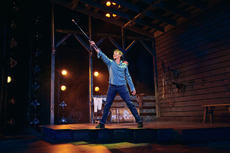
Theatre in Review: Small (Pershing Square Signature Center)One of the many remarkable things about Small is that it features several sequences that should only work on film, yet they generate pulse-pounding excitement. Robert Montano's solo memoir recalls a youth spent at the racetrack, pursuing his dream of becoming a jockey. More than once, the script recounts his near-disastrous adventures on horseback, including his first, during which he loses control of his animal, and, later, riding in a race, physically and mentally compromised by his reckless attempts at weight loss. The director,Jessi D. Hill, brings these scenes to life with a strong assist from Brian Ronan's sound design and Jamie Roderick's lighting; throw in Montano's taut, sharply descriptive writing and his narrative style, which has the intensity of a bullet in mid-flight, and you have some of the most hair-raising moments to be found in a New York theatre just now. Each passage turns the few minutes between post time and the finish line into an existential thriller, guaranteed to leave one breathless with suspense. This is the sort of solo piece that all too often feels like a literary exercise, a New Yorker Personal History feature put onstage for no good reason, but Montano, Hill, and their collaborators are having none of that. This is a purely theatrical enterprise: The skeletal depiction of a stable by scenic designers Christopher Swader and Justin Swader gives Roderick ample room to create muscular, highly directional looks; Ronan deploys a battery of effects that lend authenticity to the story. (He also supplies a kicky playlist of disco-era classics.) Thanks to their work and the vividly written script, Small is absorbing in the manner of a first-rate novel or memoir; it takes on into an alternate universe with a language, mores, and ethics all its own. It certainly helps that Montano -- who, in addition to his busy career as a character actor in regional theatre, film, and television, danced on Broadway in Cats, On the Town, and Kiss of the Spider Woman -- is a human perpetual motion device, racing around the stage, calling up a gallery of bizarre characters, and executing each gesture with balletic grace. It's all in service to his improbable tale: Growing up undersized on Long Island in the 1960s (his size making him catnip for bullies), he gets dragged to Belmont Park by his mother, who plays the ponies whenever household improvements are needed. It's a decision she will live to regret, as young Bobby quickly becomes obsessed with what he sees. Against his parents' wishes, Bobby horns his way into Belmont, apprenticing himself to the jockey Robert A. Pineda (an acquaintance of his mother's), and tangling with the eccentric, often barely socialized members of the racetrack set. Among other life lessons, the Puerto Rican Bobby learns to deal with racial epithets and, on occasion, pass as an Italian -- his name has a vowel on the end, after all -- if it helps him get ahead. One of these so-called mentors puts the fourteen-year-old Bobby in peril of statutory rape, from which he is saved by the kindly, wised-up lady chosen to deflower him. At first, Pineda, a dashing, long-haired figure who usually enters in a cloud of Aramis cologne and a burst of music from the Spanish pop singer Camilo Sesto, acts as a stabilizing father figure, imprinting his young ward with the necessity of approaching racing with dignity and discipline. But when he heads to Atlantic City to revive his fading career, Bobby, desperate to succeed, gives in to his worst impulses. Most worryingly, Bobby starts putting on inches and pounds at a rate guaranteed to get him disqualified from riding professionally. "I was ready to put a coffee table on my head, bind my feet, whatever I had to do to stay small," he says. Required to maintain a weight of one hundred and five pounds and indoctrinated to consider the scale "the monster," he resorts to all sorts of trickery -- running miles in a sweatsuit, slathered in Noxzema and wrapped in Saran, logging hours in saunas, and, when these don't work, starving himself and "flipping," i.e., purging like a bulimic. Aiding him are "black beauties," doses of speed that he learns to pop like candy. In the sweat-inducing climax, he mounts his horse only half-aware of what he is doing, hemorrhaging from his mouth and struggling to hear. It's Montano's good fortune that he ultimately realizes this path is unsustainable, but it isn't until tragedy strikes, out of the blue, that he realizes he needs a new career direction. Because everything that has come before is so gripping, Small's brief coda, detailing Montano's switch to a dance career, feels slightly anticlimactic. (One has the feeling he could probably spin a second show out of his show-business experiences.) Still, the actor's energy and commitment are unflagging, and his knack for quick-sketch characterizations is remarkable. Indeed, Hill's production, designed to match the writing's intensity, is a model of how to theatricalize a format that can be stodgy and bogged down in talk. There's no special pleading, either, not a shred of self-pity. Montano captures his youthful dreams in all their seductive and self-destructive glory. Fortunately, he pulled himself back from the brink. Clearly, the lively, youthful sexagenarian has seen it all. And does he have stories to tell! --David Barbour 
|