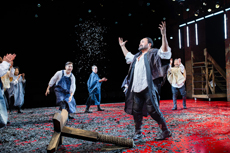
Theatre in Review: Henry VI: A Trilogy in Two Parts (NAATCO/Public Theater)Each era gets the William Shakespeare plays it deserves. The tragedies speak to times of heartbreak or tumultuous change, and the comedies offer solace in moments of loss and the necessary corrective of satire when society is too full of itself. This unhappy decade is best reflected in the histories, which reveal Shakespeare's political instincts to be utterly timeless. (Really, in his understanding of the crooked corridors of power, he could take a place at CNN, seated between Abby Phillip and Scott Jennings.) The blinding revelation of Stephen Brown-Fried's production is that Henry VI, a round robin of intrigues, tribalism, backstabbings, loveless political marriages, frivolous wars, populist rebellions, and acts of torture, is the uncanny mirror of the present day. Distilled by Brown-Fried from three plays performed over two nights (a common practice in the modern era), this deadly chess game is regarded with a cool, disconcertingly neutral eye. It begins after the death of heroic Henry V, leaving the boy king Henry watched over by a cadre of squabbling nobles who quickly separate into opposing camps identified by red and white roses. Consumed with power struggles, England loses its hold on its French territories, thanks to the militant efforts of Joan of Arc, who encourages Charles, the Dauphin, to reclaim his country. Meanwhile, the Earl of Suffolk, maneuvering around his rivals, marries off Henry to Margaret of Anjou, daughter of the King of Naples. (Suffolk has personal plans for Margaret himself, never mind her royal spouse.) The marriage is a disaster as Henry withdraws from the world and Margaret proves a ruthless politician, skills she needs as the Duke of York angles to gain the throne for his family. Meanwhile, England is beset by rebellious Ireland on one side and restive France on the other; civil war breaks out, and you'll need a score sheet to keep track as sides are switched and enemies are ruthlessly eliminated. Indeed, the first evening gets off on a somewhat confusing note as the characters take the stage in squads, already in full scheming mode. Keep your program close to figure out who is who; the production could be helped immeasurably by a projection design that keeps us up to speed on where we are and, early on, who is speaking. (I'm not one for rearranging Shakespearean texts, but, late in Part I, the Duke of York has a speech about the royal succession that, heard up front, would provide welcome clarity.) It doesn't help that the performances in the early scenes of Part I feel a little rushed. But the action picks up momentum in Act II, becoming absolutely propulsive in Part II, paced by the exciting fight choreography by Orlando Pabotoy and Kimiye Corwin. Part II features some of the most thrilling Shakespearean acting to be seen in New York in several years. This may be in part because the production is a revival originally staged by the National Asian-American Theatre Company in 2018, with many cast members returning. In any case, they go about their treacherous business with terrifying dispatch. In the title role, a scholarly, theologically minded recluse who makes Richard II look like a canny Tammany politician, Jon Norman Schneider provides the whirling action with a still center; this is literally so in a moment that places him frozen at center stage as a battle unfolds. (As his queen, Margaret, notes, "I would the college of the cardinals/Would choose him pope and carry him to Rome/And set the triple crown upon his head/That were a state fit for his holiness." That's not a compliment.) If Henry VI is a drama about the misuses of power, Schneider's Henry provides a powerful warning about monarchs who decline to exercise it, creating a vacuum that leads to havoc. Virtually every member of the company delivers one or more memorable moments. As the Duke of Gloucester, the young Henry's regent, Mia Katigbak is the subtlest of intriguers, giving way to fury over Henry's marriage to Margaret. Teresa Avia Lim's fierce intensity informs Margaret, whether she is denouncing Henry for making a spectacularly bad deal with the House of York, cradling the disembodied head of her lover Suffolk, or taking the battlefield in search of revenge. Orville Mendoza is an expert rabblerouser as Jack Cade, whose peasant rebellion causes additional upheaval in a kingdom already beset by troubles. David Shih is a heedless Edward IV, Henry's successor, whose rash marital plans offend the French king and incite fury among the English nobles, most notably the Earl of Warwick (Anna Ishida, displaying her assured classical technique). Especially impressive is Julyana Soelistyo as sly, viperish Richard of Gloucester, a seasoned pot-stirrer already laying the groundwork for the mayhem (including the elimination of his brothers) in the play that bears his name. For long stretches, the action is dominated by Rajesh Bose's Duke of York, hell-bent on refashioning the monarchy in his name; his savage takedown of Margaret, delivered just this side of the grave, leaves nothing but scorched earth. ("She-wolf of France, but worse than wolves of France, Whose tongue more poisons than the adder's tooth!" And that's just the first two lines.) He is, of course, justified in his rage; trapped and brutalized by Margaret's soldiers, she approaches him and wipes his face with a cloth stained with the blood of his murdered son. In these and other scenes, we are light years from the England described by Henry V as "This other Eden, demi-paradise/This fortress built by Nature for herself/Against infection and the hand of war." A once-great country has been infected with disunion; as Gloucester tells Henry, "Virtue is choked with foul ambition/And charity chased hence by rancour's hand/Foul subornation is predominant/And equity exiled your highness' land." Sound like anyplace you know? Brown-Fried's staging never lets up; barely has one crowd of conspirators left the stage than another is in place, unleashing new plots and complots. The scenic design by the collective dots, with its blood-red floor, half-covered in cheerless gray confetti, recalls Kimie Nishikawa's work on the 2018 production, which makes sense since she is part of dots. Mextly Couzin's lighting uses gaggles of LED bars to create a panoply of colorful looks. Kate Marvin's sound combines unsettling musical underscoring with bells, trumpets, drums, and other key effects. The eccentric costumes by the collective threeASFOUR sometimes leave one wondering if Alexander McQueen had a store in pre-Tudor England, but are styled to help us keep track of everyone's allegiances. The costumes also figure in the stunning final tableau. Edward IV, having firmly attained the throne, puts his family (including an infant heir) on display before his subjects. At this moment of seeming triumph, the stage is possessed by an army of the dead, simply and uniformly clad, testifying to the infighting that has repeatedly brought the nation to the edge of ruin. Surrounded by these walking corpses, their faces devoid of expression, Edward announces, "Sound drums and trumpets! Farewell, sour annoy!/For here, I hope, begins our lasting joy." Who is he kidding? We've seen the plays. It's about to start all over again. --David Barbour 
|