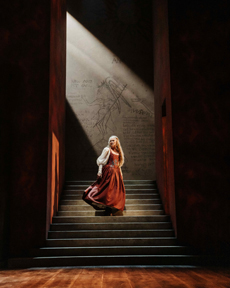
Theatre in Review: Giulia: The Poison Queen of Palermo (PAC/NYC) The country singer and sometime actress Jennifer Nettles does not lack for ambition, writing and starring in a musical melodrama about one way of solving the husband problem in seventeenth-century Italy. (The book, music, and lyrics are all hers.) And, whatever else you might say about Giulia: The Poison Queen of Palermo, you cannot accuse it of lacking earnestness. Despite its often-seamy plot developments, sincerity is the show's watchword. Even as its body count rises, it faces us with a tear in its eye and a song in its heart. And why not? The title character is the most inspirational mass murderer you've ever seen. Based, vaguely, on the life of Giulia Tofana, who may or may not have been the infamous dispenser of a tasteless, odorless, deadly substance known as Aqua Tofana (the historical record is far from clear), Giulia: The Poison Queen of Palermo is a feminist parable with a pop surface and an operetta soul. It is so devoted to its heroine that it throws all caution (and good sense) to the winds in its efforts to canonize her. As presented, she is a victim of circumstances: In a town where virtually every man is a wife-beater, a pedophile, or a garden-variety sexual predator, a gal's gotta do what a gal's gotta do. Indeed, the male element is the worst thing to happen to Palermo since the plague. Carlo, Giulia's husband, is perpetually unemployed, a boozer free with his fists. Giulia's friend Maria is secretly pregnant and terrified of telling her brute of a husband. Also pregnant is Renata, Giulia's former shop assistant, warily eyeing her impending marriage; she is stripped of any hopes by a mocking ladies' chorus in a number titled (of course) "Happily Ever After." The city's power establishment is even worse. Offering so-called spiritual support is Cardinale, an ice-cold prelate with a sizable syphilis sore on his neck. New in town is Governatore, a scheming, smirking demagogue with eyes for Guilia's underage daughter Vitoria. It's a slippery slope: To save Vitoria from Carlo's blows, Giulia slips him a fatal Mickey Finn. Having crossed a line once, she helps other friends, rescuing them from beatings and marital rape. Soon the notable oversupply of widows causes talk. Still, Giulia happily delivers upbeat ballads along with her lethal packages. ("You are the river/You are unstoppable/You'll flow around every obstruction and break through every obstacle") Things get sticky when the wealthy, entitled Duchessa shows up, looking for a little something to get rid of her dullard, impotent Duke. When Giulia balks -- her crimes require probable cause -- she ends up ensnared in a web of political and church intrigue. If this self-righteous approach to mariticide makes you queasy, you'll get no relief at Giulia: The Poison Queen of Palermo, which overloads its plot with motives for murder. The one righteous man is Father Paolo, a celibate. In the confessional box, he counsels Giulia, "There is so much more to tell/Than the world is black or white, wrong or right." But the libretto's Manichean viewpoint can't be denied. The characters are sorted into the saved and the damned, leaving the audience with little to discover. Some wit in the book and lyrics would help. But the scene-setting number, "What Happens Next?", is endless and repetitive. In "Happily Ever After," one woman sings of her marriage to a butcher: "He made a fortune selling meat/But his meat was a total flop." As for wordplay, the Governatore, wooing Vitoria with the offer of pretty things, including a new dress, offers, "Say yes! And I'll have it custom made/Say yes! And you'll have it made in the shade." The Cardinale snarls, "The name Giulia Tofana will mean nothing to me/Unless she's offering her hips to my hypocrisy." He adds, "Yeah, she's far from a damsel/But she's 'about to feel some damn distress. Oh, can I get a witness?" (Not from me, you can't.) If the lyrics struggle to find a consistent style, the music, effectively orchestrated by Cian McCarthy, leans heavily on power ballads, with occasional pop touches, all of which suffer from a sameness that becomes dulling. At times, the plot doesn't even make sense. Yes, the Cardinale is a power-mad woman-hater, but why does he plot to put Giulia away when she has the only available medicine to treat his venereal disease? And if Giulia: The Poison Queen of Palermo ever stopped to consider the moral side effects of its heroine's actions, perhaps with an ironic or black-comedy twist, it might have something to say. Instead, we are told, "This is the moment where the hero is the girl, and she starts seeing what that means." And what it means is the ends justify the means. The director, Mary Zimmerman, keeps things moving, aided by Austin McCormick's bustling choreography, but her only real option is to shore up the show's self-justifying point of view. Nettles is a competent actress with an enormous belt, but she doesn't radiate much star power; considering her character's extreme actions, she often comes across as surprisingly bland. Christopher M. Ramirez slithers around as the Governatore, blatantly advertising his villainy. Quentin Earl Darrington lends his natural dignity and presence to the Cardinale, making him a more formidable opponent for Guilia. (At one point, he strips to the waist and pulls out a whip, promising some Judge Turpin-self-flagellation. We don't need any reminders that Sweeney Todd treats a similar theme more effectively.) Some of the strongest work comes from Naomi Serrano as Vitoria, in part because she gets the de facto eleven o'clock number. "Fly Away," which is much better than its title suggests. Daniel Ostling's scenic design cleverly makes use of a set of doors that, at different times, open to show the city's harbor, a confessional box, and the entrance to a convent, among other locations. (The design also comes with a towering staircase suitable for grand entrances.) T. J. Gerckens' artfully sculpted lighting is generally subtle about reshaping the stage, except when deploying acid-green washes to signal that death is near. Ana Kuzmanic's gorgeous costumes are impeccably tailored; take note of such details as the flower motif embroidered into each woman's bodice. (Charles G. LaPointe's hair and wig designs effectively complete each look; check out the Duchessa's many-layered coiffure.) Palmer Hefferan's sound design starts fine but gradually becomes too loud yet remains clear throughout. Nettles wins points for trying to create an original musical rather than recycling numbers associated with her duo Sugarland or her solo career. But the show's clanky structure and single-minded insistence on uplift, whitewashing her heroine's crimes, make it a bit of a bore. Can Jennifer Nettles write a musical? Absolutely. Can she write a really good one? That remains to be seen. --David Barbour 
|