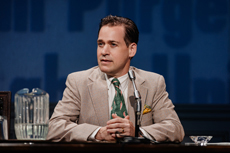
Theatre in Review: Are You Now or Have You Ever Been (City Center Stage I)This revival of Eric Bentley's 1972 docudrama about the Hollywood Red Scare, adapted from transcripts of the House Un-American Activities Committee's hearings, causes a strange kind of double vision. One the one hand, it fills one with disgust, bringing to harrowing life one of the more appalling episodes in modern American history, one that has peculiar resonances today. It's all here: the personal smears, the ginned-up panics, the demonization of creative artists, the showboating politicians trafficking in phony investigations and ruined lives. The terms of battle are different, but the ugly motivations are eerily similar. Seeing so many film industry figures subjected to intrusive grilling about their political beliefs and personal lives, one is struck by the enormous time, energy, and money wasted hounding actors, writers, and directors who, largely ineffectually, dabbled in Communist politics, often losing interest after a brief time. No wrongdoing was discovered but plenty of careers were ruined. (Not mentioned in the script but worthy of note is the suicide of Philip Loeb, a popular television actor, until his name turned up in Red Channels, the dubious field guide to Communist influencers.) At a moment when the American political scene feels irredeemably riddled with indecency and graft, Are You Now or Have You Ever Been is a sobering reminder that the battle for honesty and justice has been joined before and will be again. At the same time, Anna D. Shapiro's taut, crackling production packs more tension and suspense than just about any new offering in town. The production, which runs through the summer, features a core cast led by Michael McKean as the Chairman, representing several of the political hacks who led the anti-Hollywood charge, and with five roles filled by guest performers in two- and three-week stints. So seamless is the ensemble that it is impossible to tell who has signed up for the duration and who is dropping by for a visit. Those sticking around for the full run, often cast in multiple roles, include Brooks Ashmanskas, especially effective as the director Edward Dmytryk, his hand nervously drumming a tabletop when feeling cornered; Frederick Weller, pugilistic as Elia Kazan, who quickly offers to name names, and suave as Arthur Miller, offhandedly dismissing Kazan while insisting on the primacy of conscience; and Steven Boyer, supremely arrogant yet wary as Jerome Robbins, who, with remarkable economy, implicates a number of friends and colleagues. Oozing false sympathy, demonstrating an entirely spurious sense of high purpose, McKean leads the interrogations, assisted by his like-minded aides Adam Kantor and Jason Babinsky . Currently appearing are T. R. Knight as the actor Larry Parks, nervously pleading for mercy even as he admits, "It is doubtful whether, after appearing before this committee, my career will continue;" Molly Ringwald's Lillian Hellman, a cigarette held aloft and her face a mask of contempt, icily informing her interrogators that she has no intention of playing their game; and Norbert Leo Butz, as writer-director Abe Burrows, as affable as any game show panelist, slyly outfoxing the committee by pretending to cooperate while delivering no useful information. ("I'm here to tell the truth, the whole truth, and nothing but the truth, and there's an element of truth in the statement that I was a Communist. There's also an element of untruth.") The parade of witnesses includes two knockout closers: Bob Odenkirk's Lionel Stander initially comes across as friendly, seeking to claw back his career as a character actor, before he unleashes a tsunami of grievance, issuing veiled threats against "a group of ex-Bundists, America Firsters, and anti-Semites, people who hate everybody, Negroes, minority groups, and most likely themselves -- " that get him shut down. Even more devastating is Harry Lennix as Paul Robeson, who, deprived of his passport following a trip to Moscow, coolly announces, "I wouldn't argue with a representative of the people who, in building America, wasted the lives of my people. You are responsible, you and your forebears, for sixty to one hundred million black people dying in the slave ships and on the plantations. Don't you ask me about anybody, please." For once, the committee is at a loss for words. Shapiro's colleagues have provided a design that neatly fits the tense action. Andrew Boyce's relatively spare committee room set features an upstage wall that, backlit by Donald Holder, reveals a holding pen for the witnesses; it also serves as a surface for Brittany Bland's ripped-from-the-headlines projections, which evoke the era's climate of hysteria. Rob Milburn and Michael Bodeen's sound design merges with Holder's lighting to create punchy photo-click moments that punctuate the action. It's probably impossible to know how faithful the script is to the original transcripts and, at times, one would like more context about several points, including the committee's intense interest in Karen Morley, a now-forgotten leading lady in films like Our Daily Bread, about the ravages of the Depression, and Black Fury, a pro-labor melodrama. (Other persons of interest include Humphrey Bogart, who led a protest against the HUAC, and Edward G. Robinson.) A point worth noting, yet left undiscussed here, is that many films accused of being Red propaganda, like Song of Russia and Mission to Moscow, were made at the behest of the US Government as part of the war effort. Yesterday's patriots suddenly found themselves branded as today's subversives. Still, Are You Now or Have You Ever Been delivers on the grimly riveting spectacle of elected lawmakers trampling on the rights of US citizens in pursuit of a largely illusory conspiracy. In one especially satisfying revelation, we learn that committee chair J. Parnell Thomas was eventually convicted of corruption, leaving him and Dmytryk staring at each other across a prison yard. But the damage was beyond repair, as indicated by a final video crawl that lists many others dragged into spotlight, including Lee Grant, Henry Fonda, and Betsy Blair. Wait for the excruciating pause before Parks decides to give in and name names. "I think you could get some comfort out of the fact that the people mentioned have been subpoenaed," a committee member says. "If they do appear here, it won't be as a result of anything you have testified to." Parks replies," It is no comfort whatever." For him, as for so many others, it is all over and he sees no reason to deny it.--David Barbour 
|