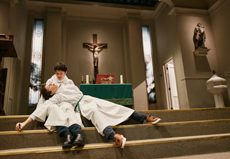
Theatre in Review: The Saviors (Atlantic Theater Company)Everywhere you look, there are crises of faith in The Saviors, and not all of them are about God. The playwright Bubba Weiler, who touched on religious matters in last season's Well, I'll Let You Go, here ensnares four Roman Catholics in a cat's cradle of love, longing, religion, and resentment; the only way out is to admit truths that nobody wants to hear. That each member of this quartet is achingly vulnerable only adds to the impact of this quiet stunner. Michael and Paul, best friends and altar boys (first seen packing up after serving at Mass), are on the edge of self-discoveries that will have shattering effects. Michael's religiosity, his fanboy's view of the RC Church and its rules, is beginning to grate on Paul, whose belief in God is wavering. ("Why do you like all the saints with horrible deaths?" wonders Paul. "That's like all the saints," Michael snaps back. "Have you been researching at all?") Even more worrisome for Paul, Michael has begun making tentative, unwelcome romantic advances. Their friendship, full of jokes and impromptu wrestling sessions, but fraught and surprisingly fragile underneath, is thoroughly destabilized when Julian, a homeless drug addict, enters the sanctuary, throws himself on the altar steps, and bursts into wracking sobs. The sight of Stanley Simons, who plays Julian, dressed by Avery Reed in multiple ragged layers and looking none too sanitary, would be enough to disturb anyone. But instantly and unwittingly, he drives a wedge between the two boys. Michael, taking the Pharisaic route, tries to make Julian someone else's problem, urging him to check out a nearby Presbyterian church. The unbelieving Paul adopts a more Christlike attitude, helping this stranger hide out during a bad storm and bringing him food. Paul's motivations aren't entirely selfless; worried that he is on track, like everyone else he knows, to attend the same prep school and Catholic college before assuming a rote adult existence, he is oddly fascinated by Julian's aura of danger and ruination. At the same time, Michael, baffled and hurt by his friend's wavering attentions, turns to Judy, the middle-aged widow who, rather ineffectually, presides over the parish's youth group. Inspired by the career of Judy's son, an African missionary, he calls her the "most faithful person in the whole parish" and a "church MVP." He also asks her to be his confirmation sponsor. But Weiler has a whale of a twist at the ready, delivering a brutal reality check that leaves everyone questioning their beliefs in God and themselves. (As Michael says, in what may be his first lesson in adulthood, "I keep thinking okay, what would Jesus do, but it never says.") Weiler takes an enormous risk here, hanging the play's plot on a lie that would be exceptionally difficult to maintain in a tightly knit parish community. In another, less accomplished, production, one might have trouble accepting it. But so surefooted is Jack Serio's direction and so finely tuned are the performances that The Saviors heads confidently to its devastating windup. It's equally risky to write a play that relies on two young actors, but Ivan Howe and Julius Rinzel easily convince that Michael and Paul are longtime pals; check out the moment when, in a burst of levity, they bring together their candle snuffers like crossed swords. Howe's Michael is perilously close to a reckoning that will challenge his faith as his yearning for Paul becomes painfully evident. (Among other things, only a nightly phone call from Paul can rescue Michael from his nightmares.) Rinzel quietly conveys Paul's growing fears of being railroaded by circumstances into a life he may not want, to say nothing of a friendship taking a turn he can't handle. "I shouldn't have to believe in God to be your friend," he tells Michael, plaintively. Coldly putting off another confidence from Michael, the latter's murmured response ("Please come") is a wounding cry from the heart. Taking on a hugely underwritten role, Simons implies the many levels of hell through which Julian has passed. ("I think it's all god," he tells an alarmed Michael. "Every fucking inch. Ancient and powerful and fucking...fucking scary when you think about it, but it doesn't give a shit about us. It doesn't care.") He's equally pitiable and awful, and one can barely imagine where he goes from here. Crystal Finn's Judy is, even for this fine actress, a gorgeously nuanced turn, whether guiding Michael through a meditation exercise that proves unexpectedly revealing, or gently, but firmly, explaining to Julian that even the greatest mercy has its limits. Serio's direction draws its power from restraint, even at the climax, when Paul uses the only means he knows to bring Michael down from a panic attack. The production design goes a long way toward rooting the action in a recognizable everyday reality. David Zinn's church sanctuary set, complete with statues and a signboard announcing the day's hymns, will be instantly recognizable to any Catholic. Stacey Derosier's lighting captures the warmth of an interior shaped by sunlight and stained glass, turning suitably chilly and institutional-looking in other scenes. A couple of nighttime sequences are played with daringly low light levels, in red washes from votive candles. Leah Gelpe's sound design includes storms, traffic, organ music, and popular hymns like "I Am the Bread of Life." If The Saviors is maybe a tad less accomplished than Well, I'll Let You Go, it is written with the same extraordinary perception and charity. Weiler is lucky to have the services of Serio, who understands the dramatic value of silence, and never oversells a moment of this moving piece. Together, they guide Michael and Paul toward an understanding that will change them forever. It's a terrible, yet necessary, moment, and one can only hope they offer each other the grace they both deserve. --David Barbour 
|