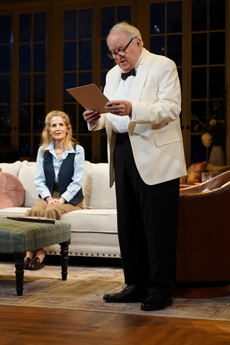
Theatre in Review: An American Daughter (La Femme Theatre Productions/Pershing Square Signature Center)"It's amazing how quickly popular opinions change," remarks one of the Washington swamp creatures populating Wendy Wasserstein's 1997 play. Truer words were never spoken: A ripped-from-the-headlines tale about a thwarted federal nomination, An American Daughter was the playwright's State of the Union speech, an indictment of gender imbalances and reputational blood sports in the Bill Clinton era. But oh, how times have changed; seen today, this comedy of political manners unfolds in a well-mannered Cloud Cuckoo Land so far removed from our own scorched-earth political landscape that one hardly knows what to make of it. Crossing the Zoe Baird brouhaha (nominated for attorney general, she was found to have employed an undocumented immigrant as her nanny, failing to pay her Social Security taxes) with the backlash to Hillary Clinton's notorious "cookies" gaffe ("I suppose I could have stayed home, baked cookies and had teas"), An American Daughter aims to map out the treacherous landscape for women seeking to make a difference in government. But, even for 1997, the play is surprisingly polite, and its critical view of ginned-up scandals seems positively quaint viewed from today's perspective, where adulterers, grifters, and practiced liars regularly assume the highest levels of government, blithely blowing past any attempts at accountability. Only thirty years old, it is a period piece, almost willfully innocent in its point of view. The title character, Lyssa Dent Hughes, a physician, married to an eminent academic and the mother of two boys, has been nominated as the next Surgeon General. At first, it looks like smooth sailing for a candidate who projects an unblemished image of professional accomplishment and domestic bliss. (That she is the daughter of a Senator, and a fifth-generation descendant of Ulysses S. Grant doesn't hurt.) Then, during an at-home get-together with a television reporter present, the news slips out that Lyssa once failed to respond to a jury summons. Also, noting her long-dead mother's lack of a "sense of adventure," Lyssa says, "She was the kind of ordinary Indiana housewife who took pride in her icebox cakes and cheese pimento canapes." Within days, Lyssa is being dragged through the media, characterized as a scofflaw bristling with contempt for the nation's homemakers. Riffing on current events, the script retains a strange unreality. How is it that Lyssa, a fixture of her father's campaigns since grade school, could be so green in the ways of politics that she guilelessly walks into a 60 Minutes-style interview without a coherent plan to defend herself? (For that matter, we are expected to believe that her father, the senator, is on his fourth wife without suffering any blowback from Midwestern voters.) Equally fanciful are the members of Alyssa's entourage. There's Morrow, a gay religious conservative (think David Brock meets Andrew Sullivan) whose ill-defined faith makes him an anti-abortion crusader. He's a loveless soul, clinging to Lyssa and Walter for some scrap of family life, and the play makes no attempt to understand his convictions. Then there's Judith, a physician whose overemotional nature is chalked up to the multitude of hormones and fertility treatments taken in a fruitless attempt at getting pregnant. Those must be some hormones: In a moment of despair, she flings herself into the Potomac, only to turn up, sopping wet, on Lyssa's doorstep. Judith takes up plenty of oxygen (and valuable stage time) with her many problems, none of which are germane to Lyssa's dilemma. Commenting from the sidelines, when she isn't throwing herself at Walter, Lyssa's husband, is Quincy Quince, a sex-positive third-wave feminist who churns out glib bestsellers with titles like The Prisoner of Gender and Venus Raging. She speaks almost entirely in gag lines: Sizing up Judith, who is both Black and Jewish, she says, "You're a walking Crown Heights." If An American Daughter, directed at a leisurely pace by Sarna Lapine, were an out-and-out farce, Quincy would be right at home. But the play, marked by a thicket of subplots, never settles on a tone; as always, one feels Wasserstein, a nervous hostess bent on giving her guests a good time, shying away from her play's angrier implications. Lyssa is the typical Wasserstein heroine, a woman at odds with changing social mores and feeling sad about it; her ultimate outburst, taking down the media, is left until very late. More damagingly, the playwright's take on Washington's tribal ways doesn't convince; to quote the number of a much better comedy set in the nation's capital, there are times when one feels Lyssa was born yesterday. As is always the case with a La Femme Theatre production, a blue-chip supporting cast has been assembled. Montego Glover injects Judith with doses of sardonic energy, especially when informing Morrow she has already had a gay husband, thank you; Robert Sean Leonard, flashing his crooked smile, trails clouds of wintry regret as Walter, who published a mordant critique of liberalism five years earlier and now feels like yesterday's news. Also fine are Dakin Matthews, smoother than Maker's Mark as Lyssa's father; Mary Beth Peil as his adoring, yet hawk-eyed, spouse; Ryan Spahn as Morrow, a Washington Post columnist shocked to think his opinions have practical consequences; Chris Ghaffari as one of those eight-by-ten glossies who deliver the news; and Carmen Zilles as Quincy, spitting out hot takes like a teletype machine. And, as is always the case with La Femme Theatre productions, the lead role is taken by Jean Lichty, the company's founder and executive director, who is unable to keep up with her co-stars. An actress with a limited vocal range, shaky diction, and a small presence, she has struggled with dramatic roles in Nora (Ingmar Bergman's take on A Doll's House) and The Night of the Iguana. Trying to anchor this overstuffed high comedy, she is in over her head, delivering one monotonous line reading after another and failing to project the magnetic personality that makes Lyssa a desirable commodity both socially and politically. The production design is first-rate, beginning with Mikiko Suzuki MacAdams' spacious, attractively lived-in Georgetown drawing room, its upstage windows offering a view of abundant greenery. Alan C. Edwards' lighting adds delicate touches of its own. Darron L West's sound design makes good use of pre-show selections by Jewel and Shania Twain as well as Boomer classics like "You're Sixteen," "California Girls," and "Twenty-Five or Six to Four." Interestingly, no costume designer is credited, but whoever came up with the Chanel suit, plus headband, for Lyssa's big TV appearance has a canny eye. Wasserstein fans and scholars may want to see the production, for it represents a new version of the script, culled from eight different sources, including post-Broadway rewrites and a television film adaptation, Trial by Media. (Unhappy with the play's critical reception in New York, she continued tinkering with it.) Among the biggest changes is a new closing scene, which adds to the running time without offering any significant improvements. Whatever one thinks of this production, it is likely to leave one feeling melancholy: An American Daughter laments how women are sometimes kept out of powerful positions, but at least it unfolds in a world of relative governmental competency; seen today, during a calamitous administration in which some of the worst malefactors are women, its arguments feel sadly irrelevant, if only for now. If we could get back to the (admittedly imperfect ) world in which Wasserstein's play was written, it would be a significant improvement. --David Barbour 
|