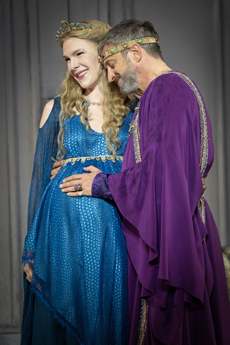
Theatre in Review: The Winter's Tale (New York Shakespeare Festival/Delacorte Theater)It's high time we stopped apologizing for The Winter's Tale. Time and again -- and I'm far from alone in this -- I've begun reviews noting the play's difficult, bifurcated, royal-tragedy-meets-pastoral-comedy structure, insisting that it requires all sorts of directorial gymnastics. Maybe so, but for a so-called problem play, it gets done all the time, and the last decade or so has yielded several perfectly good revivals, including a bang-up 2018 staging by Arin Arbus at Theatre for a New Audience. The current production in Central Park, which may be the best yet, proves the point: All a fine revival needs is a sure-handed director and a talented cast willing to play the script for keeps. The first half of Daniel Sullivan's production is dominated by Raul Esparza, as Leontes, King of Sicily, and Lily Rabe as Hermione, his queen; it's a rapturously happy alliance that, without warning, becomes a dance of death. You know the setup: Leontes urges Hermione to beguile his boyhood friend, Polixenes, ruler of Bohemia, to prolong his visit. Alas, she executes her task too well, however innocently, inciting her husband's unappeasable jealousy. Polixenes, marked for murder, flees the country, and Hermione is put on trial. Before it is over, Leontes and Hermione's son, Mamillius, will be dead, and their infant daughter, Perdita, left to die in the wilderness. It's a tragedy in miniature, the story of a man overcome with an envy that devours everything good in his life. It's also a fiendishly difficult sequence of events for actors, but Esparza makes Leontes' swerve into homicidal rage chillingly believable; even more interestingly, he does so without sacrificing a certain sympathy: His fury is also a self-inflicted wound, leaving him baffled at the loss of his seemingly rock-solid happiness. Listen to him brood on his suspicions ("And many a man there is, even at this present/Now while I speak this, holds his wife by th' arm/That little thinks she has been sluiced in 's absence"). The satanic undertone given to "sluiced" tells you plenty about how jealousy destroys both the man infected with it and the woman whose reputation it sullies. Even more stunning is Rabe's Hermione: Early on, she is the spirit of high comedy, batting around witticisms for the sheer fun of it, teasing both men with no thought of the consequences. Then compare this enchanting creature with the broken woman who, a few scenes later, emerges from prison, in rags, limping, looking as if she might faint at any minute. And consider how she begins to defend herself ("Sir, you speak a language that I understand not/My life stands in the level of your dreams/Which I'll lay down"), building by degrees to a righteous fury that reduces the court to stunned silence, shaking Leontes to his core. Rabe is well-known as the Delacorte's resident blithe spirit in As You Like It and Much Ado About Nothing; seeing her in The Winter's Tale, I wonder what she might do with Lady Macbeth, Gertrude, or some of the Greek tragic heroines. Once Hermione seemingly dies in public, causing Leontes to collapse, struck with the sudden, stabbing awareness of his crimes, the action shifts to sunny Bohemia, where music is in the air and festivity rules. Still, Sullivan makes certain the darkness of Act I casts its shadows, most notably with the appearance of Polixenes, filled with a Leontes-level fury at his son, Florizel, for wooing the lovely Perdita, who, for all anyone knows, is the daughter of a shepherd. Gilbert Owuor finds a coherent throughline in Polixenes, who, so violently wronged in the first half, reappears, only too ready to render some savage judgments of his own. No matter where The Winter's Tale wanders, forgiveness is often fiendishly difficult to find. Owuor is not the only lesser-known face to make an impression; Sullivan has cast the production with a canny eye for the play's relationships: Daniel Kyri, an ardent Florizel, looks every bit his father's son, just as Isabela Ferrer's delightful Perdita uncannily recalls the looks and mannerisms of Hermione, the mother she never knew. Indeed, when Polixenes vents his anger against the young lovers, one has an eerie sense of the first half's triangle playing itself out, in altered form, years later. The entire company performs with similar commitment, including Teagle F. Bougere as Camillo, the faithful friend torn between Leontes and Polixenes and tired of exile; Chuck Cooper, as the Old Shepherd, a benign patriarch who saves the infant Perdita from certain death; and Marsha Stephanie Blake as Paulina, the play's voice of reason, schooling Leontes in repentance, and stage-managing the fairy-tale finale involving a "statue" of Hermione that comes to life. Taking on the challenge of Shakespeare's least-amusing clown, the professional rogue Autolycus, Steven Skybell struggles at first, but later, adopting a dissipated air and languid, nasal delivery that would instantly earn him admission to Evelyn Waugh's Brideshead, he hilariously gulls several of the play's rustics with his aristocratic airs. (He is also fine as Antigonus, the courtier, who, ordered to destroy the infant Perdita, is himself devoured by a bear.) In an especially charming and affecting touch, young Matthew Eby, who returns in the second half as Time, filling us in on what has unfolded during intermission while poignantly reminding us of the permanent losses incurred by Leontes' rampage. If Maruti Evans' set design is unusually spare for the Delacorte -- a trio of doorways represents Sicily -- it is also highly flexible, and the moment when the green and pleasant fields of Bohemia roll downstage is exceptionally pleasing. Bradley King's lighting is clear and largely effects-free, except at the end of the first half when it combines with Brian Ronan's sound design to artfully suggest Antigonus' arrival, by boat, in Bohemia, and his ursine death. Linda Cho's costumes look smartly designed for this summer's hot, steamy weather; they also draw connections between parents and children, making the plot even easier to follow. (Wait for the moment when Autolycus, in his peddler mode, opens his coat, revealing his extensive inventory.) Other adornments include Tom Kitt's plangent incidental music and a lively country dance choreographed by Mimi Lieber. So solidly grounded is Sullivan's production that don't be surprised to find yourself tearing up at the play's wildly improbable finale, in which Hermione makes an eerie appearance, dressed as her own memorial. Esparza's Leontes, reduced to a monastic state of penitence, reacts to her with a mixture of awe and grief that perfectly sets up the reconciliation that follows. To hell with the problem-play smear; as Judi Dench notes in Shakespeare: The Man Who Pays the Rent, a hilarious and revelatory book of conversations about her adventures with the Bard, The Winter's Tale is a cracking good story, ending in a vision of forgiveness and renewal that couldn't be more welcome right now. For a precious few nights, Central Park feels like Bohemia, and it's a spiritually refreshing place to visit. --David Barbour 
|