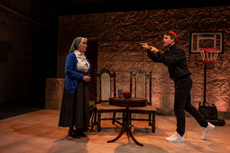
Theatre in Review: The Body of Mary (The Gym@Judson)The Body of Mary, a trilogy of sketches, is subtitled "a play in three acts (of God)," which should let you know what you're in for. Playwright Katie Cappiello takes a dim view of the Annunciation and Nativity narratives as expressed in the Roman Catholic tradition; hence this theological hatchet job. Everyone has the right to their own opinion, of course, and the RC Church is hardly immune from criticism. But it takes a very special playwright to aim at such a big, fat target and land so wide of the mark. The opener, "The Virgin," reframes the Annunciation as a put-up job; even before the Angel Gabriel shows up to inform Mary of her impending motherhood, she is vomiting into a bucket, wondering, worriedly, why her period is late. This less-than-angelic Gabriel is in cahoots with Anne and Joachim, Mary's parents, and all three are dismayed when Mary, told that she has been chosen to be the mother of Jesus, says, thanks a lot, but no thanks. But it is too late -- Mary's suggestion of a visit to a local woman who makes abortifacient potions is quickly dismissed -- and the young woman has little choice but to take on the yoke of necessity, which includes marriage to the much-older Joseph. (As a sop, Anne reminds her that at least she won't get raped by the Roman soldiers who keep passing by their house.) The piece is rather like an unfunny SNL sketch, filled with cracks that don't pay off, but at least it shows an original turn of mind. Indeed, it towers over "The Mother," a nuttily off-the-rails exercise that makes the most fevered Dan Brown novel look like a sober metaphysical exercise. Set five years in the future, it features Cardinal O'Malley, a thirtysomething bro-type with a lounge-act delivery, who summons the saintly Mother Mary Joseph, head of an order of nuns who care for refugees and victims of sexual trafficking. When Mother Mary notes that one of her clients is in her late sixties, O'Malley, making like the current president, sputters over that idea that anyone would want to molest anyone as obviously unattractive as that. David Hull throws himself into the role with unholy glee. Anyway, O'Malley has cooked up a plan to save thousands of frozen embryos via a monstrous and medically suspect act of medical engineering. To get Mother Mary Joseph's necessary cooperation, he employs blackmail with a flagrant disregard for the sanctity of the confessional. (He apparently feels empowered to fight mortal sin with mortal sin.) The longest portion of the evening, "The Mother" is also the most grating, being too crude and unfunny for satire and too detached from reality to succeed as critique. (Wait for the moment that, out of nowhere, references the priestly pedophilia scandals of recent years.) Cappiello may know a great deal about the Church's workings, but she sure doesn't act like it. The third piece, "The Dumpster," has the best writing, unfortunately shackled to a shaky premise. In Texas, another Mary, a disgruntled adolescent restaurant worker, discovers a baby tossed into a dumpster behind her workplace. Mary, on the phone with her friend Nevaeh (spell it backwards), panics about what to do next. What follows is a back-and-forth with Nevaeh that evolves into a plausible accounting of the social ills caused by anti-abortion laws. Then again, if Mary did the sensible thing and called 911, the play would be over in about ten seconds. Even weirder: At Neveah's suggestion, Mary decides to leave the baby at a drop-off window in a local church, although both women know it is just past midnight and the building is empty. (It is also wintertime.) What are the chances that the infant will survive a long, cold night there? They might as well leave it in the dumpster. Quite apart from the script's more lurid excesses, the main problem with The Body of Mary is that Cappiello is more interested in speechmaking than playwriting. The frames on which she hangs her arguments are alarmingly frail: One could make numerous cogent points about the Church's attraction to wealth and power, its unwillingness to put women in positions of authority, and the purposes to which its ideas are sometimes put by often-unscrupulous zealots. But that would mean confronting the institution as it is, not inventing fever-dream scenarios; a sense of humor would help, too. Acting as her own director, Cappiello doesn't make the best case for this trilogy. Still, if "The Mother" is at all watchable, it's because of Tracy Sallows' nuanced, subtle work as Mother Mary Joseph as she slowly confronts the horror of O'Malley's scheme. Also, Gracie Conn is utterly believable as the confused and angry Texas Mary, and Annalisa D'Aguilar, solid as Mary of Nazareth, transforms Nevaeh from a mere offstage voice into a flesh-and-blood character, no easy feat. (She also has the play's one true laugh, referencing Grey's Anatomy and The Handmaid's Tale.) The singer "Lluvia" LU Yi Peng gets a nice hand with a lovely rendition of Schubert's "Ave Maria." Production values are spare, although Forest Entsminger's set, defined by an upstage stone wall, serves well enough for all three pieces. (I doubt that most Roman Catholic cardinals have offices set up for shooting hoops, but whatever.) Lauren Bremen's lighting is a highly professional job. Jennifer Baumgardner's costumes have their amusing touches (Roman-era robes plus sneakers, for example), and Florian Staab's original musical (including some country-ish guitars) and sound effects (birdsong, marching soldiers, traffic) are well done. The preshow playlist of Tavares' "Heaven Must Be Missing an Angel" and Belinda Carlisle's "Heaven is a Place on Earth" makes for some mighty easy listening. But if she wants to advance her argument, Cappiello may have to choose between polemics and dramaturgy. The latter activity involves more than getting things off one's chest. --David Barbour 
|