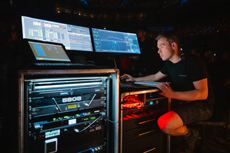
Shure Axient Digital PSM at 5 Seconds of Summer's World Tour 5 Seconds of Summer's monitor engineer, Mike Platt, has spent the band's latest world tour putting Shure Axient Digital PSM Advanced In-Ear Monitor System through its paces across some of the most demanding RF environments on the touring circuit. From packed arenas across the UK, Europe, and the US to festival main stages, including Lollapalooza in Chicago, the system has been tested in a wide range of real-world conditions. As one of Axient Digital PSM's earliest adopters, Platt has worked closely with Shure throughout the run, and a recent firmware update introducing a new single-carrier narrowband operating mode has, in his words, changed the way digital transmission performs. The system now handles 16 stereo mixes for a band and crew who move constantly between A and B stages, bunkers, and back- and under-stage positions, many with challenging sightlines and RF conditions. Alongside Axient Digital PSM, 12 channels of Shure Axient Digital AD2 microphones cover the band's multiple vocal positions, with Wireless Workbench providing full RF visibility from front of house. The systems were supplied by UK-based audio production company Adlib, with the North American leg of the tour supported out of Adlib's US operation. "As we've been relatively early adopters of the Shure Axient Digital PSM product, we've been through a journey with Shure on this tour, ultimately ending up with a really high-performing setup that everyone is really happy with," says Platt. That journey led the team to adopt the single-carrier narrowband firmware ahead of its official release, driven by an urgent need to solve moving-metal digital interference around the drum kit of Ashton Irwin, 5SOS's drummer. "Ashton has a large and diverse drum kit that he plays at a very high velocity throughout the show," Platt explains. "We had our transmission mode in Multi-channel Wideband, and we found that in the environment we presented with on this show, it wasn't performing to the standard that we needed." "Once we moved over to single carrier narrowband, it completely changed the game for us," says Platt. Unlike the OFDM (Orthogonal Frequency Division Multiplexing) transmission used in wideband mode, single-carrier narrowband draws on the single-carrier technology already used in Shure Axient Digital microphones. "The single carrier frequency firmly plants its transmission and is much more robust against the hostile RF environment that you'll find around a drum kit and in a busy arena show." Platt also observed that venue construction, spectrum coordination, and audience presence all influenced performance under the previous mode. These variables were difficult to predict but had a clear impact on signal quality. Using the Timeline function within Wireless Workbench, the team was able to log and compare RF receive levels, quality and dropouts before and after the switch. "The difference was night and day on the new operating mode," Platt confirms. "The performance really improved for the environment we were in." Running 16 mixes required two combiners feeding two short helical antennas. For the drummer, the team ran a BNC cable directly from the transmitter up to Ashton's riser, feeding a paddle antenna. "We found that it removed some of the quality dropouts we were having in some arenas," says Platt, who notes the trade-off is a busier coordination process. "OFDM mode was a little more forgiving on width, but what we have gained by using the new mode is fantastic." For monitoring and control, Wireless Workbench has been essential to Platt's workflow. "Especially during this show, where I had no clear line of sight for any of the band members, I need as much monitoring and timeline data as I can get to fix issues promptly and even before they become an issue," he says. For Platt, the standout benefit of Axient Digital PSM is audio quality. "The transmission is now a huge leap closer to sounding like a wired connection. This gives you more scope to make more detailed, wider and dynamic mixes for the artist," he says. "The days of having to compromise your mix for it to 'work' with the companding and inferior FM transmission modes are over. It's been the missing link in wireless monitoring we've been waiting for." The band and crew have noticed the difference, too. "Overall, it's been the best they've heard," Platt says. "And the noticeable reduction in noise floor is great. It sounds like it should." Platt also relies on Shure ShowLink for remote coordination. "I do use ShowLink, and it's great. Time saved on coordination and syncing is so good. Thirty packs of syncing a day would take an age. Also, for firmware updates, it was great to just leave it all on the network." Beyond the hardware itself, Platt highlights the role of Shure's software ecosystem in supporting efficient touring workflows. "I've always preferred Shure wireless for the quality of transmission, audio quality and for the software," Platt says. "It makes it easy to get the results I need." That extends to the support behind the product: Platt singles out Jack Drury at Shure UK for delivering fast solutions during the tour, and Sascha Helmstaedt at Shure Germany for his help at the band's Munich show. 
|