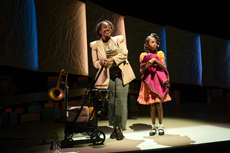
Theatre in Revue: creation stories and all the important importants (LCT3/Claire Tow Theater)The heroine of Mfoniso Udofia's new play is a highly accomplished woman, sprinting through life, determined to have it all, but starting to wonder if she isn't just running in place. (Udofia, who, as you can tell from the title, has her own ideas about punctuation, calls her thegrownwoman, and that's the last time you'll see that name in this review.) She is determined to excel at everything: writing, teaching, caring for her elderly mother, and, most importantly, getting pregnant through IVF. She is also tired, tormented by the same strange dream, and -- although she doesn't know it yet -- haunted by the presence of a young girl. And wait: Who is the strange creature in the pink tracksuit and gold braids? Time is running out, and her marathon of achievement is headed for the brick wall of indifferent fate. Circles are endemic to creation stories, beginning with the curves of Jason Ardizzone-West's set, a comment on the character's circular thinking and her endless, fruitless pursuit of nonstop excellence. A morning writing session ends in frustration when everything she pens is lifted from Shakespeare, Beckett, or Lorraine Hansberry. She frets over her wardrobe choices, psychs herself up for another round of bloodwork, and negotiates with her demanding patent. And still the tasks pile up: In playwriting class, she lectures on the well-made drama, giving her students an exercise in breaking Aristotelian rules, using as an example a Nigerian work, The Excellently Planned Woman Who Cut the Perfect Path Toward Her Necessary Obliteration. I wonder who that sounds like. There's also the Costco run, at which, shopping for her mother, she loads up on a "20-pound bag of Carolina Gold rice, five pounds of shrimp, three pounds of oxtail, and a case of Ensure." And she's about to undergo another round of egg extraction, for which she preps by pumping herself full of hormones. As she bravely notes, "It's going to be just fine. Fifth cycle is the charm." As lives go, it's exhausting to think about, let alone experience, and Udofia constantly adds new roadblocks of varying sizes. (Most amusing are the woman's tussles with Alexa about delivering the right mood music.) But she is about to discover her limits, at which point the little girl shadowing her demands to be seen and the play heads in a new, more surreal direction. There are times in creation stories when one feels the heroine is too fond of her own advice about flouting dramaturgical laws. A Nigerian spirit figure comes and goes, its role undefined. The little girl's first scene requires patience, especially since her significance is not immediately apparent. And the heroine's habit of narrating her own actions becomes grating. As Degenerates, which opened earlier this week, demonstrates, stage directions should be seen but not heard. But there's something terribly poignant about the character's endless, exhausting search for a reason to justify her life on earth. (The writing is exceptionally strong on the constant cycle of hope and disappointment, not to mention expense, that the IVF process can generate.) She is brought to exuberant life by Abigail C. Onwunali, last seen bringing the recent revival of Joe Turner's Come and Gone to a shattering finale. Here, she's a funny, feisty figure, grittily determined to reset her attitude after every setback, commanding attention in the classroom, steeling herself to become a "woman who will." When crushing disappointment comes, watch her determined smile crack, devolving into utter bafflement at news that can't be massaged, managed, or reset. It's one of the season's more striking performances so far. If the play succeeds most as a vehicle for Onwunali, she receives first-rate support from Savannah Commodore in the difficult role of the little girl and Donnetta Lavinia Grays as the oddball intruder who shall not be named. Ardizzone-West's elegantly appropriate set design serves as a fine canvas for Katherine Freer's projections, which include starry skies, sheet music, and motion-blurred images of New York streets, as well as video sequences, some seemingly taken from the heroine's past. Sarafina Bush's costumes are just right -- love that tracksuit! -- as is Alan C. Edwards' endlessly flexible lighting. The sound design, by Bailey Trierweiler and Uptown Works, runs the gamut from hip-hop to Gustav Holst's The Planets, plus traffic, phones, and the gently annoying voice of Alexa. Tamilla Woodard's direction rightly maintains a brisk, not to say relentless, pace. Udofia is best-known as the author of a nine-play cycle about a family divided between America and Nigeria, four of which have been seen in New York. It's unclear if creation stories is part of the cycle. Leaving the theatre, I was convinced it is the finale; now I'm not so sure. Possibly, the concluding moment of revelation is a comment on Udofia's efforts at finishing the cycle. Whatever the case, I suspect many in the audience will be moved by the character's pained understanding that some things, no matter how desperately desired, will forever remain out of one's control. Fortunately, as she learns, creation takes many forms. --David Barbour 
|