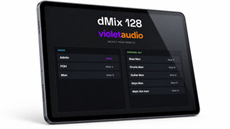
Violet Audio Introduces dMix 128 Firmware V2 Violet Audio announces Firmware V2 for the dMix 128, a major update that expands how customers can share, operate, and configure their mixing system. At the heart of the update is Mixer Split, which allows a single dMix 128 to be divided into as many as four independent logical mixer instances. Each instance can have its own allocated inputs, buses, effects, DCAs, shows, and scenes. For users, that means front-of-house and monitor engineers can work from the same engine, multiple rooms can have separate mixing environments, and different operators can manage their assigned resources within one integrated system. Shared-preamp gain tracking also makes shared inputs more practical when multiple operators use the same physical microphone preamp. Operators can maintain their desired gain relationship and see the active hardware gain, while authorized users can take direct control of the preamp when needed. The update includes the V2 offline editor and network manager for the dMix 128, enabling users to prepare shows and configure systems without connecting to a mixer. Shows can be created and edited offline, then transferred directly to dMix hardware when connected. The integrated Network Manager automatically discovers dMix 128 devices regardless of their IP address or subnet, making it easy to identify units, assign names, and update IP settings. It also simplifies routing and connectivity changes as network, audio and hardware connections change. "We designed the dMix 128 as a platform that could keep growing with our customers," says Danny Olesh, founder of Violet Audio. "V2 takes that idea much further. Whether you're sharing a system between front-of-house and monitors or giving musicians control of their own mixes, this update opens up new ways to work with the hardware you already own." A new profile-based access system gives administrators control over what each user can see and change. Admin, mixer operator, and personal mix profiles support permissions for functions including routing, configuration, and preamp gain, with optional four-digit PIN protection. For musicians, the dedicated personal mix interface presents only the channels and controls assigned to their monitor mix. Performers can adjust their own monitoring through a simpler interface while the engineer retains control of the wider system. This makes it easier to offer personal mixing without exposing unrelated system settings. V2 expands the matrix from eight by eight to 12 by 12, providing more routing flexibility for zone feeds, broadcast and recording feeds, fill systems, and multi-room installations. Everyday mixing is faster too, the company says. Engineers can copy and paste aux mixes to give performers similar starting mixes and to transfer EQ, compressor, multiband compressor, gate, de-esser and graphic EQ settings between channels. Improved metering, clearer EQ displays and faster navigation help operators see and reach the controls they need. "V2 offers many enhancements for everyday use. The ability to split the 128-channel mixer into two 64-channel mixers with flexible split bussing and gain compensation is incredibly flexible. Having two 64 channel 96K mixers represents an incredible customer value," says Phil Wagner, president and CEO, Violet Audio US. The update also makes productions easier to move and systems easier to restore. A new show format and equipment match wizard help operators adapt shows to different connected hardware and network configurations. Session import and export can capture broader system settings, including mixer allocations, profiles, streams, remote devices and preamps, for backup, duplication or restoration using PC or USB. Additionally, the new dMix Studio application provides comprehensive networking, recovery and show-editing tools. Users can also save and open shows, manage scenes, import and export shows via computer or USB, and edit routing, channel processing and mixes. 
|