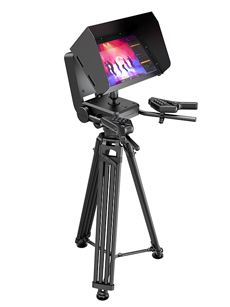
Ayrton Launches Falconer Followspot Control System Ayrton has announced Falconer; designed to retain the natural, responsive feel of a traditional followspot, it relies instead on a camera rigged where it provides the clearest view of the stage, so the operator can be located in the most convenient and comfortable position in any venue. The product combines a broadcast-style fluid head with a camera-based workflow, giving operators direct, instantaneous control of moving lights from a dedicated base station. It uses a camera mounted on a compatible Ayrton fixture, such as EagleStrike, giving the operator the "ideal" view of the stage, the company says. Alternatively, a separate Ayrton Horus camera, released alongside Falconer, can be used to integrate the system into any lighting rig. Falconer features two ergonomic handles. Its 18.5" full HD touchscreen monitor reproduces every detail of the stage with exceptional clarity, the company says. Customizable buttons and faders keep every control within easy reach of the operator without taking the hands off the handles. Based on GDTF file definition, Falconer's controllable parameters include cyan, magenta, yellow; CTO color wheel one; color wheel two; tint; dimmer; iris; Zoom; focus; gobos; and frost. User-definable presets containing any combination of parameters can be assigned to preset buttons on the handles and touchscreen for easy recall of looks and/or positions. Presets can include fade-in and fade-out times, and can be set to hold, fade out, or snap to zero when deactivated. The unit's control is said to deliver instantaneous response, in harmony with the operator's anticipation and interaction with the stage in real time, whether the trajectories are fast or slow. An infrared mode keeps performers clearly in view even in extremely low-light conditions. A single Falconer base station can control multiple fixtures, with up to 36 active fixtures recommended for optimal system performance (an unlimited number of fixtures can be patched as Falconer sets no fixed limit, but 36 active fixtures are recommended). The system supports both autonomous operation and integration with a lighting console, while its 3D calibration system allows multiple fixtures to track the same point in space, with the designer choosing which ones follow the action. The product's intuitive 3D calibration establishes the position of each fixture in space using just four reference points, so multiple fixtures can track the same performer in perfect synchronization. Not every moving light can carry a camera, so Ayrton has created Horus, a freestanding compact camera fixture that opens up the Falconer system to any manufacturer's lighting rig. Built into the housing of the Ayrton MagicDot Neo, Horus 14.7lb and can be installed easily. The user simply rigs it wherever it gives the clearest view of the stage. Horus uses the same camera module as the Ayrton EagleStrike: A 13.7-megapixel CMOS sensor, a 30 optical zoom, and a 65-degree field of view deliver a detailed image at any distance, while infrared modes keep performers clearly in view. The video feed is sent over the network via NDI with adjustable bandwidth, and shutter, anti-flicker, and color settings can be configured remotely from Falconer. Horus features 540-degree pan and 270-degree tilt driven by high-resolution stepper motors and 16-bit control. Because the camera works independently of the lights, either one can be repositioned without compromising the other. Horus features an IP65 protection rating and IP65 connectors and operates from -20 degrees C to 45 degrees C. While Horus stays out in the elements, followspot operators can stay indoors with Falconer. For ease of transport, Horus travels in the Falconer foam insert alongside the base station. Both Falconer and Horus operate as standalone solutions or alongside a lighting console. To learn more, visit vimeo.com/1237235790. 
|