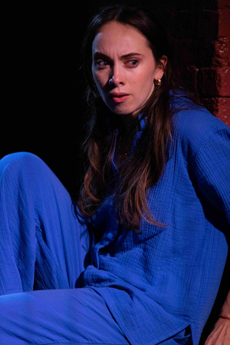
Theatre in Review: Livia: A Roman Tragedy (The Flea Theater) Livia: A Roman Tragedy is a sermon for the stage, and playwright Paul David Young is preaching to the choir. His chosen mouthpiece is, I guess, a version of Livia Drusilla, wife of Augustus, the first Roman emperor, and a pretty squirrely character, if I may say so. (A skilled poisoner, she was played in the TV series I, Claudius, by Sian Phillips, delivering to her son, mourning his father's death, the memorable line, "Don't touch the figs!") The real-life Livia got in on the ground floor of empire, so to speak, manipulating its rulers over three generations. Young's Livia is rather more virtuous, an appalled witness to Rome in decay from tyranny, endless warfare, and the suspension of civil liberties, all meant to remind us of our own crumbling democracy. To make this argument, Young fills his text with quotes from Shakespeare, Seneca, Corneille, Ibsen, the Stoic philosopher Epictetus, the German sociologist Norbert Elias, and Burt Shevelove and Larry Gelbart's book for A Funny Thing Happened on the Way to the Forum. Pay attention and take notes; there will be a quiz. To its credit, Livia is a work of considerable scholarship, but it's Young's bad luck that Caryl Churchill's Triumph, currently onstage at the Public, has a similar conceit, featuring a news presenter who is both of ancient Rome and today's Washington. The contrast is revealing: Triumph is founded on a tense dramatic situation, however, and runs only twenty minutes. Livia, which is more than three times as long, is little more than a rant detailing the many ways a society can go wrong. Livia's dire thoughts are poetically rendered, with an assist from Shakespeare, Seneca, et al. Citing an unnamed ruler, she says, "He has never shown wisdom of any kind, none, not that of any religion, or the ancients, or the philosophers who have so often cultivated in our emperors the capacity for rational thought and wisdom and selflessness." Rings a bell, huh? Quoting Corneille, she calls the tyrant, "The falsest man the earth has ever spawned." Gee, who does that sound like? What's worse: "He has never led an army, unless that crowd of thieves and rabble-rousers who frequent his table could be called an army. He could never fight. If not for the fools who follow him, he would long ago have met his just end." It's on the tip of my tongue... But the fatal problem with Livia is: Don't we know all this? You can fancy it up in classical style all you want, but the play's text is the daily stuff of the New York Times, the Wall Street Journal, CNN, The Guardian, and ten thousand Substack pages. The script offers no action, no plot, no change -- just seventy-five minutes of handwringing about how awful things are. For whom was this play written? Does Young think a single audience member at the Flea will find any of this revelatory? Maybe one of the backstage crew has a MAGA-leaning parent tucked away in Kansas or somewhere. If they make the trip to New York, catching a performance of Livia, maybe they'll be shocked. Also Livia treats tyranny like a plague that appears out of nowhere, mindlessly striking down the innocent. There's no hint that liberal insularity and smugness, an inability to understand the needs and fears of ordinary people, might be involved. In one of the script's more prominent quotes, Livia says, "The fault is not in our stars, but in ourselves, that we are underlings." Really? A truly apt allegory might suggest taking a good look in the mirror to understand how we got to this dangerous moment. If Livia is watchable, it's because Baize Buzan, the sole performer, is all in, attacking the script with martial vigor and unflagging commitment. The actress, who made a memorable impression last April as Leni Riefenstahl in Beauty Freak, makes good use of her piercing gaze, throaty voice, and eyebrows raised into permanent arches of skepticism. Her range is impressive: Prowling the stage restlessly, she offers furious denunciations; then she stops cold, her voice cracking with grief and/or fear; a second later, her voice positively drips with irony. She plunders the script for all it is worth, like the Visigoths sacking Rome, and Young should be grateful that director Danilo Gambini has found such a stirring interpreter. But, despite her work, the solid direction and fine contributions from scenic/costume designer Jimmy Stubbs, lighting designer Nicole Lang McDonald, and Liam Bellman-Sharpe (who fills the theatre with unsettling sound effects), Livia has nothing new to add to our current political discourse. And with elections posing the possibility of shakeups here and abroad, its cry of despair is awkwardly timed. Young's 2019 drama, All My Fathers, was an intriguing and original piece of work, but here his subject matter defeats him. In the last analysis, the play's parallels with Rome aren't particularly apt for a twenty-first-century America suffering PTSD over a pandemic, upset by rampant economic inequality, divided over immigration, and rattled by technological change that -- in the worst-case scenario -- might wipe us all out. Livia is designed as a warning, but its alarms aren't a patch on the problems facing us. --David Barbour 
|