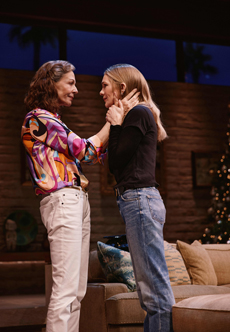
Theatre in Review: Other Desert Cities (Hudson Theatre) Broadway producers are like astrologers: They follow the stars. Thus, the current revival of Other Desert Cities draws on a quintet of luminaries from film, the stage, and video. Surprisingly, this is its least meticulous aspect, with certain choices that undermine its overall impact. It's a five-star production of a four-star play that yields three-star results. Fortunately, the good performers outnumber the questionable ones. Lily Rabe, enjoying a banner year following her triumphant summertime turn The Winter's Tale at Shakespeare in the Park, is equally fragile and ferocious as Brooke Wyeth, daughter of Polly and Lyman, a conservative Hollywood power couple, who is about to drop a nuclear bomb on the family's Christmas plans. With a resume that includes one well-regarded novel and years of clinical depression, Brooke has arrived home for the first time in years toting copies of her soon-to-be published memoir. The title, Love and Mercy, will likely seem strange to her parents, since it is almost entirely about her lost brother Henry, destroyed by drugs and toxic politics. Brooke may claim the book is an act of forgiveness, but she is unblinkingly clear that, when things got tough, Lyman and Polly turned their backs on their son. Rabe hints at Brooke's scarred state while projecting an image of recovery following a lengthy hospitalization. (As she admits to Lyman, "I have a very good memory for pain.") She also works hard at lowballing the book's conclusions, trying to frame Polly and Lyman as unreasonable for objecting to any invasion of privacy. She gets at Brooke's disingenuous side in her reluctant admission that a New Yorker excerpt is imminent, leaving Lyman and Polly with little or no time to react. But push her, and she is likely to explode: "I don't have an imagination! We are all I have," she shouts at Polly, angrily defending her work. And when a revelation drops, totally reorienting her understanding of Henry's story, Brooke's howl of pain shatters the air. Ed Harris presides authoritatively over this fraught reunion as Lyman, a former movie action hero turned corporate spokesman and GOP wheel. In a rare, but hilarious, moment of physical comedy, he demonstrates his technique of dying for the camera, deftly worked out as any Kabuki dramatics. He is also the family stoic, refusing to shed tears over Henry and declining to read Brooke's manuscript. Yet he expertly deepens the dramatic stakes when recalling how the Henry scandal sent him and Polly into social exile, noting with awed admiration how Polly clawed them back into the good graces of the Republican elite (the Reagans, the Annenbergs, the Bloomingdales). But Lyman has paid a terrible price for his apparent serenity, a fact Harris uncannily communicates with barely a change of facial expression. It's all the more shocking when he flings the book across the room, baring the rage he so often refuses to admit. Arguably, the biggest surprise is Joe Keery, the Stranger Things star and pop singer, as Trip, the youngest son. It's an extremely tricky role: A successful TV producer who good-humoredly endures many cracks about his magnum opus -- a grisly thing called A Jury of Your Peers, which sounds like Judge Judy crossed with Dancing with the Stars -- he styles himself as proudly superficial, as opposed to Brooke and Henry, with their multiple addictions and psychological ailments. But, peering out from behind his cynical carapace, he keeps close watch on his loved ones, offering plenty of tough assessments, especially about Brooke's intentions. As far as I can tell, Keery hasn't acted onstage since college, but he is right at home at the Hudson, holding his own with some theatre heavyweights. Other casting choices are less felicitous: Julia Louis-Dreyfus comes on strong as Polly, the family terror, riding everyone else's nerves with her gleefully unfiltered manner. John Benjamin Hickey directs the first thirty or forty minutes with the same laugh-harvesting skill he brought to a revival of Plaza Suite (in the Hudson) four years ago, and Louis-Dreyfus glitters in these early scenes. "This water needs vodka for flavor," she says, flatly, staring at a glass. "Sarcasm is the purview of teenagers and homosexuals," she notes, reprimanding Brooke for her attitude. "It's all or nothing with your generation. Either vegans or meth addicts or both at the same time," she announces, grandly, in one of many ex-cathedra pronouncements. Louis-Dreyfus nails each of these without apparent effort; Hickey has also devised some very amusing stage business for her, when she graciously lights the enormous Christmas tree via remote control or when, furiously, she practically assaults a set of couch pillows. But Polly is sitting on an enormous secret, which renders her entire life a lie, and when the script asks Louis-Dreyfus to go deeper, she can't. Stockard Channing, who created the role at Lincoln Center Theatre some years ago, found deep veins of anguish and fury in Polly while never missing a screwball laugh; as the play's tone darkens and ugly truths come to light, Louis-Dreyfus' Polly seems merely annoyed, her voice taking on an increasingly whiny, querulous tone. In this case, her comic expertise carries her only so far. Silda, Polly's sister and the family's wild card, a drunk skidding into poverty and dependence, is a juicy role that, in Allison Janney's hands, feels oddly diminished. In their salad days, Polly and Silda penned screenplays for a Gidget-like movie series, but they fell out, horribly, partly over Henry, and now Silda is unemployable and living off the sibling she loathes. They are Jewish, from Texas, but Polly has restyled herself in an haut-WASP manner that Silda finds bitterly hilarious. (Wounded by a remark from Polly about her cheap designer knockoffs, Silda says, "Honey, this Pucci is a lot more real than your Pat Buckley schtick.") In the original production, the contrast between Channing and Linda Lavin (and her replacement Judith Light) revealed plenty about both women. Janney leans into Silda's good-old-girl side, a less interesting choice. Also, she never gets at Silda's deep, underlying malice; for all her brutal honesty, Silda has had an editorial hand in Love and Mercy, which may be her payback project against Polly. Janney makes Silda more an observer than an active participant in the drama, and the character's absence is felt. The rest of the production is meticulously realized. Scott Pask, who trained as an architect and hails from the Southwest, provides a stunning example of Midcentury Modern architecture, capped by the most alarmingly color-free Christmas tree since Woody Allen's Interiors. Note the shifting angle of sunlight in Natasha Katz's design, as well as the late afternoon sunset evolving into night; it's another detail-perfect piece of work. Tom Broecker's costumes are wickedly observant, from Polly's accessorized outfits to Brooke's I-don't-give-a-dam casual wear. Mikaal Sulaiman supplies some emotionally resonant underscoring. Time has also had its way with Jon Robin Baitz's play, surely his finest work so far. First produced in 2011 and set in 2004, it was powerfully informed by America's post-9/11 misadventure in Afghanistan and Iraq. These days, however, Republicans like Lyman and Polly are relics from a political Jurassic Park, their neoconservative attitudes long ago stomped out by the MAGA horde. Still, the play has an uncanny grasp of dysfunctional family dynamics, the dialogue is salted with priceless zingers, and the second-act twist is honestly wrenching. Too often, one judges one's parents at one's peril, as Brooke finds out. If you've never seen Other Desert Cities, it's well worth a look. If you saw and treasured the original production, it's your call, but be prepared. The fault lies in its stars. --David Barbour 
|