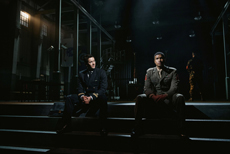
Theatre in Review: A Few Good Men (Lincoln Center Theatre/Vivian Beaumont Theater) When court finally convenes, A Few Good Men generates some electricity, but the discovery phase could use some juice. Aaron Sorkin's military-legal drama, which had a decent run a few decades back, is a slick, derivative piece of work better known for the film version, and it's not immediately clear why Lincoln Center Theater is giving it such a sumptuous staging. Michael Arden's production aggressively argues for it as an American classic, but the evidence is thin. It's less a revelatory revival than a probable case of misplaced affection. A Few Good Men centers on the mysterious murder of PFC William Santiago, assigned to the US Marine base in Guantanamo Bay, Cuba. Depending on who is talking, Santiago was a shirker or the victim of monstrous bullying; either way, his desperate reaching out to the authorities was a flagrant violation of the chain of command. Two soldiers cop to the killing, insisting they acted of their own volition. But Lieutenant Commander Joanne Galloway, a four-star workaholic from Internal Affairs, pushes to keep the investigation open. Her reluctant associates are lazy, negotiation-prone Dan Kaffee, basically sleepwalking through his single tour of duty, and Sam Weinberg, a new father more interested in domestic matters than legal ones. Against considerable bureaucratic resistance, they chip away at a cover-up involving Nathan R. Jessep, the commanding officer, and Code Red, an illegal hazing ritual designed to punish weak or underperforming enlisted men. The first act is one long flood of exposition delivered in the patented Sorkin style, with dialogue that sounds like screwball comedy only without the wit. "I'm wondering why two guys have been in a cell since this morning while their lawyer is outside hitting a ball," snaps Galloway. "We need the practice," cracks Kaffee. "That wasn't funny," claps back Galloway. "It was a little funny," he replies. Actually, Galloway wins that argument. The script suffers from a population problem; people come and go in droves, many identified only by rank, rarely attaining character status. The parade of nonentities results in a blur; at the performance I attended, when someone announced, "Markinson went U.A.," -- short for "unauthorized absence" -- my first thought was: Who is Markinson? (As a quick glance at the program reminded me, he is Jessep's second-in-command, whose tortured conscience makes him go rogue, turning him into the play's unearned deus ex machina.) The action picks up noticeably in the second act, in a series of courtroom skirmishes that constitute the undercard to the main event: Kaffee versus Jessep, with the former expertly rattling the latter's nerves, tricking him into all but confessing on the witness stand. (This is the scene with the famous line, "You can't handle the truth!", which Jack Nicholson delivered so memorably in the film.) At this point, one is so grateful for some raw conflict that it matters little that the scene plays like a revival of The Caine Mutiny Court-Martial. It's a neat bit of bearbaiting, nevertheless, and it gives Bradley Whitford, as Jessep, the opportunity to stage a scene-stealing meltdown climaxing in a wounded animal roar. If Whitford is obviously having a fine time playing this unrepentant Cold Warrior, his co-stars must work hard to keep our attention. Tom Blyth, so menacing on screen in the recent prison drama Wasteman, tends to blend into the scenery as Kaffee. To be fair, it's hard to know what to do with much of his character's wise-guy posturing. ("You hear about the Japanese pilot who hated jazz? He bombed Pearl Bailey.") Slightly better is Nick Blaemire as Weinberg, the inevitable wisecracking sidekick. Both get blindsided by Krysta Rodriguez's musical theatre energy as Galloway. But everyone looks a little bit lost thanks to the enormous, all-devouring production design. Dane Laffrey's set, a cross between a warehouse and an airplane hangar, is large enough for several armored divisions, a strange choice for drama that hinges on several tense, close-up interrogations. I thought everyone had learned the dangers of exploiting the full depth of the Beamont stage, but apparently not. Along with Gabriel Mann's bombastic underscoring, the creative team seems bent on pumping significance into a play that would benefit more from being treated like the sometimes-lively potboiler it is. If you peer closely at the stage, you'll see some fine actors at work, including Stephanie Berry as the stern (yet wisecracking) judge; Billy Eugene Jones in a blink-and-you'll-miss-it appearance as Kaffee and Weinberg's commander;Lavel Schley and Collin Kelly-Sordelet as the cagey defendants; Thom Sesma as the elusive Markinson, and John Zdrojeski, enjoyably snacking on his dialogue as Kendrick, Jessep's Jesus-freak hatchet man. Other ameliorating factors include Japhy Weidman's stunning lighting design, delivering abundant sunshine through the set's clerestory windows and sweeping downstage with a parade line of soldiers. His work goes a long way toward focusing the sprawling onstage action. Alejo Vietti's costumes, ranging from camouflage to dress uniforms, feel authentic. And Joshua D. Reid's sound design is blessedly intelligible. But Sorkin's early-career melodrama is a strange choice for a theatre best known for producing challenging new works while honoring the best of the past. Based on its grosses, it is a smart commercial move; one that, I suspect, caters to subscribers' nostalgia for the old Broadway of middlebrow issue dramas and those long-gone days when our military establishment was founded on honor and the rule of law. Only time will tell if either is coming back. --David Barbour 
|