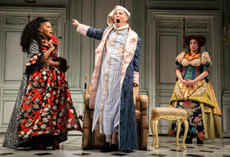
Theatre in Review: The Imaginary Invalid (Roundabout Theatre Company at Todd Haimes Theatre) The Imaginary Invalid is a delightful contradiction: an outrageous farce delivered with Euclidean precision. Brandon J. Dirden's direction of Moliere's lusty spoof of those who practice the healing arts explores the proposition that you can get away with murder if you act precisely and with dispatch. No gag is milked; an air of rigor prevails. The result is sumptuously staged vaudeville, executed by a cast of pros attacking their roles like a pack of logicians. Bill Irwin is in his element as the title character, Argan, a penny-pincher who nevertheless doesn't mind throwing away his fortune on an army of quack doctors. A desiccated specimen tucked into the seventeenth-century equivalent of a Barcalounger (complete with movable side panel for quick exits), he peruses a laundry list of bills for various enemas, purgatives, bleedings, and "an hepatic julep and somnolent, to help Monsieur sleep." Given his cracked, stream-of-consciousness mutterings, he is cousin to Irwin's portrayals in Beckett's Endgame and Waiting for Godot. And when Argan lovingly mentions his "primary care physician," details the side effects of his latest tonic ("some nausea to be expected, occasional hair loss"), and wonders out loud, "I mean, can one afford to be sick?", the freewheeling, contemporary tone of Irwin's adaptation, based on a translation by Doug Skinner, is obvious. As always, Irwin is priceless, whether tangled up in his bedclothes; reeling from the haymaker his startled daughter plants on him; or, in extremis, adding several inches to his height by elongating his neck. His Argan is a masterpiece of fatuity, played like a harp by a procession of pseudoscientific con artists. Then Dirden sends in the rest of the clowns: Brooks Ashmanskas appears in two roles, each an unctuous, overdressed physician ---in one appearance, he resembles a middle-aged Infant of Prague -- bent on chiseling every last sou out of Argan. Dylan Baker amusingly struggles to contain his ire as Argan's sensible brother, noting that only someone in the rudest of health could survive such an appalling medical regimen. Rachel Bloom is the classic insolent servant, running from her furious master with such vigor that she overtakes him several times. As Argan's avaricious second wife Beline, Crystal A. Dickinson strikes various grief-stricken poses, each more hilariously transparent than its predecessor. Ava Lalezarzadeh and Daniel Croix Henderson are Argan's overwrought daughter Angelique and her panicked lover, plotting to thwart the old man's plan to acquire a medically trained son-in-law, so he can be sick for free. Keeping everyone on their toes is Hiram Delgado as, among others, a shady legal advisor and an apothecary wielding an enema syringe big enough for Jumbo, the elephant. Delgado's best moments, however, come while playing Thomas, affianced to Angelique, a sort of 17th-century incel, given to weird ruminations about "the engendering of children upon a woman." He's also the author of "a thesis against the circulation of the blood and against the obsession with 'cleaning of wounds' prior to surgery." Delgado's bizarre, deadpan characterization is more than enough to steal scenes even in this formidable company. Complementing Dirden's tightly controlled direction is an equally exacting production design. Beowulf Boritt, on his second Imaginary Invalid in as many years, conjures a richly detailed hotel particulier out of darkness in the inventive opening sequence. Allen Lee Hughes' lighting ranges from warm candlelight to bright sun washes to dazzling floor patterns when Argan's home is invaded by a troupe of actors passing themselves off as medical professionals. Karen Perry's costumes are layer cakes of fabrics and patterns; wait for the moment when Beline, mistakenly thinking herself a widow, rips off her skirt and kicks up her heels. John Gromada's sound design contrasts his august underscoring with flushing toilets. Irwin is the rare clown gifted enough to anchor a comedy while making room for his co-stars to shine. Dirden, who made his directorial name with the works of August Wilson, executes a head-swiveling transition here, displaying a knack for high-style satire. Some wise producer should prescribe more Moliere in our theatrical diet; aside from Tartuffe -- with its obvious relevance to today's conniving Christianists -- we don't get enough of his wit. (Maybe with the MAHA gang running amok, we'll be seeing more of Argan and his companions.) If we're lucky, future productions will emulate Dirden and his company, illuminating the most irrational and corrupt behavior with the detachment of philosophes. --David Barbour 
|