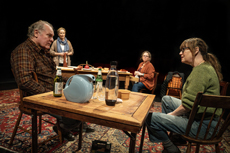
Theatre in Review: We'll See (The Public Theater) I don't know about you, but I spent Election Night with old friends. Thankfully, the Apple Family, whose conversations have talked audiences off ledges since 2010, was on hand to guide us through the most consequential election night in decades. It's another gift from playwright Richard Nelson. We'll See runs through November 22. If you're familiar with the Apples, it's a must-see. If you're new to their dinner table, there's no time like the present. For those who've come in late, The Apples are the foundational family in Nelson's Rhinebeck Panorama, which tracks an era of social change and political turmoil as experienced by a trio of families in Rhinebeck, New York. The Apple plays, which began in 2010 with That Hopey Changey Things, frequently unfold on election days, a device that gives an extra frisson to opening nights. When, at Tuesday's performance, Maryann Plunkett announced the date and time of the action, a murmur ran through the audience. Near the end, when Jay O. Sanders looked at his watch and said, "The polls are closed," another, more anxious, wave spread through the room. "Oh, my God, I forgot there was an election," said Sally Murphy. And maybe, for a little while, at least, so had we. For this edition of the Apple saga, Jane, the youngest of the four siblings, a freelance writer, is feeling homeless; she and Tim, her partner, an actor, have lost their Brooklyn apartment, taking refuge with Tim's daughter, her boyfriend, and an assortment of young people who come and go. Barbara, a middle school teacher, is being forced into retirement following a misunderstanding ginned up into a controversy by a vengeful parent. Now in residence with her is sister Marian, who teaches second grade and quietly mourns her son, who killed himself. Richard, a retired lawyer, has returned from a European vacation, where he couldn't escape his bete noir (and former employer), Andrew Cuomo. Richard is now with the rather younger Vyonne, an actress living with cancer. The quintet gathers on this night of nights, swearing a blood oath not to mention the name of the White House's current occupant. But they can't escape the consequences of his administration. Barbara volunteers with immigrants, teaching ESL courses, an activity made immeasurably more difficult by local ICE raids. Yvonne meets two Ukrainian actresses on a brief trip to New York, where an old woman hurls a Russian curse at them. Jane notes how the town's municipal politics have degenerated into bitter partisan infighting. "Why have we started to hate? What have we become?" she wonders. Richard is troubled by the memory of lunch with an ex-pat friend in Paris who, surveying the divided American landscape from afar, says, "You have let it happen." There's much more in Nelson's remarkably rich script, having to do with our coarsened national discourse and economic inequality, especially the flood of big money into Rhinebeck, turning a sleepy village with a settled place in political history (the Underground Railroad ran through it) and literary lore (Edith Wharton wrote about it) into another retreat for the ultra-wealthy. At the same time, hope glimmers in the darkest of times. Even if it reduces her to late-night tears, Barbara finds rich rewards in helping her ESL students. Marian cites a longtime friend and colleague who quietly volunteers at a suicide hotline on weekends. Jane and Richard are collaborating on a history of Rhinebeck, emphasizing its role as a historical crossroads. Nelson offers some barbed comments about the theatre, including its overreliance on TV and film stars and productions so top-heavy with cultural sensitivity seminars, sexual harassment training, and Native American acknowledgements that there's no time left to rehearse. Still, Yvonne notes that her work keeps her feeling healthy, and Barbara recalls how the cognitive problems plaguing Ben, the siblings' beloved uncle, a noted actor, vanished when he took the stage. "Now we have a name for that: Doctor Theatre," Barbara adds. Surely, We'll See was a strong, revivifying dose of Doctor Theatre on Tuesday night, but, even now, as most of us bask in the incredible midterms victory, the production offers much to ponder. As Richard notes, we are hardly out of the woods yet, with years of damage to be undone. And, quite apart from politics, the play is a moving, deeply dimensional portrait of an educated, literate, liberal middle class, now fading away. In a conversation rife with references to Walt Whitman, Franklin Roosevelt, George Eliot, Fyodor Dostoevsky, Oliver Sacks, and Francisco Goya, it's hard not to see the Apples as an endangered species. (Seated as I was, next to a young couple who, when not cuddling, busily perused their programs and checked their phones, the Apples suddenly seemed like the residents of some cultural Jurassic Park.) Under the playwright's direction, there's very little conflict onstage and, like all the Rhinebeck plays, We'll See has its occasional longeurs. But Nelson's group portrait has achieved astonishing depth, and it's a pleasure to spend time with characters who listen to each other so intently and with open minds. Indeed, the actors have inhabited their characters for so long that they wear their characters like old clothes: Plunkett's Barbara, fussy, generous, and fearful that whatever she is doing isn't enough; Sanders' Richard, forever the butt of his sisters' jokes and protective of his new lover; Laila Robins' Marian, looking on in dismay as the young couple to whom she sold her house at a discount instantly flips it for a king's ransom; Murphy's Jane. marooned in mid-life, worried about her relationship, and unsure what to do next; and Yvonne Woods, seamlessly joining the ensemble as Yvonne, matter-of-factly facing an uncertain future. As always, the production design is beautifully minimal, including Jason Ardizzone-West's set, Jennifer Tipton's lighting, Susan Hilferty's costumes, and Scott Lehrer's sound. "Sometimes I now feel like I've left my country and landed somewhere else," muses Jane, who isn't alone. Everyone in We'll See must contend with an America that has changed beyond recognition. Fortunately, none of them is ready to give up. And, given Tuesday's results, maybe it's time once again for that hopey-changey thing to rear its lovely head. --David Barbour 
|