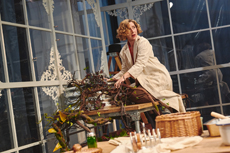
Theatre in Review: The Verge (Fiasco Theater at the Public Theater) Meet Claire Archer, the woman of The Verge. I don't know if they used the term "a piece of work" in 1921, when Susan Glaspell's drama was first produced at the Provincetown Playhouse, but it certainly applies. Claire is one dilly of an anti-heroine, a determined nonconformist bent on casting off the shackles of conventional morality. "I want to break it up! I tell you, I want to break it up! If it were all in pieces, we'd be shocked to aliveness," she says. Believe it or not, that's one of her less heated comments. Well, you can't say Claire doesn't live by her code. She enters and throws dirt in the face of her husband, Harry. Later, she denounces her daughter. ("To think that object ever moved my belly and sucked my breast!" ) She professes to be glad that her little boy died. ("Why should I want him to live?") She tells a neurologist summoned to diagnose her extreme discontent, "All I ask is to die in the gutter with everyone spitting on me." Besides the long-suffering Harry, she keeps two lovers on a string and, no spoilers here, one of them will be very, very sorry he got entangled with her. Claire is supposed to symbolize the postwar disillusionment sweeping the world, Topic A in American literature of the 1920s, when many, emerging from civilization's rubble, sought out what Hillary Clinton, speaking for a later generation, would call "more immediate, ecstatic, and penetrating modes of living." Indeed, Claire is an avatar of modernism in all its creativity and neurosis. And woe betide anything that doesn't live up to her metaphorical expectations. She views World War I as a big flop. "It was a stunning chance!" she says. "But [as] fast as we could - scuttled right back to the trim little thing we'd been shocked out of." (Eighty million killed, but what of that?) Turning to botany, she pours her hopes into a plant named, yes, Breath of Life, which, when it opens, shows its heart. She also breeds a healthy-looking creeper named Edge Vine but tears it up at its roots because it "is running back to what it broke out of." Brandishing a revolver, she announces. "I shall never shoot myself. I'm too interested in destruction to cut it short by shooting." Next to Claire, Hedda Gabler, was a piker, a mere Real Housewife of Oslo. Admittedly, Claire is surrounded by dullards who either worship her or cringe in her presence. Harry, shivering from the cold -- she has siphoned off the heat from their home to feed her greenhouse -- begs her for a kind word, but she only married him because he is an aviator and she gets a thrill from riding in planes; on the ground, she considers him a bust. Her daughter Elizabeth, an empty-headed finishing-school product, describes everything, including her recent European trip, as "just awfully amusing," and her activities as "the things one does;" comments that are like nails on a blackboard to her mother. Claire's sister, Adelaide, is the pious type, fond of hymns like "Nearer My God to Thee." For her pains, Claire calls her "a liar and thief and whore with words." One of Claire's lovers, Dick, is a total blank. The other, Tom, is a supplicant who says, "You are disturbed because you lie too close upon the heart of life." Well, that's one way of putting it. And yes, the men in her life are named Tom, Dick, and Harry. Fiasco and The Public got interested in The Verge at the suggestion of Expand the Canon, a program that "uncovers and uplifts classic plays by women and underrepresented genders." Fair enough; as the Mint Theater Company has shown us for years, the theatrical archives are full of stage-worthy plays with something to say to us. (The Mint's current production, Phyl, is a surprisingly contemporary comedy about female independence.) But, like those in her circle, everyone involved in this production has become fatally, uncritically entranced by Claire. The Provincetown Players had no use for the conventional, onstage or in their private lives, and I suppose this revival has a certain value as a historical document. But if it accurately takes the temperature of its time, it fails as drama: Claire expresses her ideals only in generalities, and the heavy-breathing dialogue becomes increasingly risible. You have to hand it to Miriam Silverman, who goes all in as Claire, pitching fits; casting pitying, dismissive looks; and engaging in random acts of destruction. But she can't explain why everyone else puts up with Claire, and the character's selfish, needlessly cruel acting out increasingly seems like one big temper tantrum. Among the supporting cast, Amara Leonard finds a nice satirical slant on Elizabeth, who has never had an original thought in her life, and Paco Tolson at least gets at Tom's strange fascination with Claire's whirling dissatisfaction. As Harry, who loves Claire because I don't know why, Noah Brody is especially at a disadvantage. Lawrence E. Moten's skeletal greenhouse setting is impressively spacious, and it transitions nicely to the tower room that is Claire's special retreat. The filmy white curtains surrounding the stage look a little flimsy, but they allow lighting designer Amith Chandrashaker to create a satisfyingly eerie lineup of silhouettes in the opening sequence. Sarita P. Fellows' costumes are especially helpful for those actors who are double-cast, giving them well-defined profiles in each case. Bailey Trierweiler's sound design includes a pleasant lineup of pre-show music, including Chopin's "Fantaisie-Impromptu in C-sharp Minor" and Gershwin's Rhapsody in Blue, plus some gripping storm effects. I'm not sorry to have seen The Verge, and I would love to experience more of the literature produced by the Provincetown Players, beyond the contributions of its most famous alumnus, Eugene O'Neill. But it's hard to imagine Glaspell's drama speaking to audiences of today; we're meant to see Claire as a kind of visionary, frighteningly hovering on the edge of self-destruction, but mostly she comes across as borderline sociopathic. "It must be very interesting, helping people go insane," she says to that neurologist. Actually, she doesn't need any help. --David Barbour 
|
|