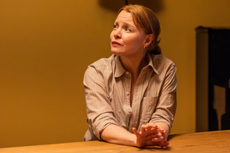
Theatre in Review: The Unbelievers (Manhattan Theatre Club/City Center Stage I) The Unbelievers begins with the disappearance of Oscar, an adolescent boy. It's every parent's nightmare, but never mind: Playwright Nick Payne has no interest in solving the case, despite the occasional appearance of a clue. Jumping between three time frames -- a week after the incident, its first anniversary, and seven years later -- he focuses entirely on those affected and how they process this loss. It is a dry, detached examination of a terrible, unfathomable event. Chief among them is Oscar's mother, Miriam, who, alone among his loved ones, holds out hope, chasing every lead, no matter how thin or implausible. For example, she meets a pair of "convivial conspiracy theorists" with plenty of ideas about UFOs, who insist they've seen Oscar exiting a record shop. It ends with a disappointed Miriam, locked out of her car, pounding on the window until her hand bleeds. She ultimately smashes the window with a garden gnome. Years later, she plans to visit a potential witness in Ghent, on what is obviously a wild goose chase, based on a photo that, according to David, Miriam's ex-husband, doesn't remotely resemble Oscar. Miriam balks at a seance, arranged by her daughter Nancy, but she has Googled many psychics, in addition to courting reporters and arranging TV interviews. Her single-minded pursuit leaves her extended family feeling neglected and dispirited. Rather than a standard study in grief, Payne makes Miriam hard-headed, practical, and prone to insulting others. Virtually every scene begins with her offering food and drinks to everyone else. She often adopts a disconcertingly cheerful attitude, making jokes that land like water balloons. When David has an anxiety attack before submitting to a swab from a policewoman, Miriam snaps, "Jesus, what a pussy." Greeting Lorraine, David's new partner, she offers her own form of consolation: "I was sorry to hear about your father. Cancer. What a c-t." Lorraine, whose warm, loving manner grates on Miriam like a Brillo pad, should take care: Responding to Miriam's request for a hug, she finds herself in a painful death grip. In contrast to such moments,The Unbelievers is crowded with religious references: It begins with Miriam lighting a candle in front of a churchy-looking portal; later, a stained-glass window, hanging in the auditorium, is illuminated. The dialogue is rife with references to unexplained phenomena, psychic research, and the noted atheist Richard Dawkins. (For a dreadful moment, I thought we were in for another British ghost story like Paranormal Activity or A Ghost in Your Ear, so in vogue at the moment.) Miriam's first husband, Karl, is a Church of England priest, although piety isn't his specialty. Describing a recent date to Miriam, he recalls, "She said to me she'd always wanted to fuck a vicar." That sort of joke is typical of The Unbelievers, which uses Oscar's disappearance to explore the characters' coping mechanisms. But Payne views his creations coolly, from a distance. His scrambled time scheme can be confusing --we're often several lines into a scene before we know when it is happening -- and does little to suggest how the family's dynamics change over time. Aside from Miriam, we get almost nothing of the characters' backstories or inner lives; they only exist in relation to her. And their relationships mostly seem notional: It is difficult to imagine Miriam married to David and impossible to imagine her living with Karl. As Miriam, a role that seemingly offers a shot at a tour de force, Lauren Ambrose is unafraid of the character's many irritating qualities, pulling out the stops when confronting others. Yet it's a series of star-turn moments that never fully cohere; Miriam says and does so many things purely for effect that even when apparently sincere -- for example, quietly recalling Oscar's many ailments and anxieties -- one feels skeptical. (The script raises, then quickly drops, the notion that Oscar ran away in response to his parents' decision to separate.) Tom Riley emphasizes David's squirmy, evasive qualities, but Hadi Tabbal, as Karl, at least, has a nice speech about faith as a practice, helping him to deal "with the incompleteness of the world around me." Marjan Neshat makes much of a brief appearance as Lorraine, who learns to tread lightly around this permanently anguished crew. The others, including Jack DiFalco as a son-in-law with a professional interest in puffins (making him yet another victim of Miriam's rage), struggle to make an impression. The action unfolds on a strangely under-furnished set, designed by Paul Steinberg to make room for onstage audience seating; it is subjected to colorless, clinical-looking washes by lighting designer Masha Tsimring. (A hanging lamp, featured in certain scenes, distracts one's eye from the actors.) Enver Chakartash's costumes are suitable creations ranging from leisurewear to police vests. Sinan Refik Zafar's sound design is solid, although a tad loud when Nancy, Miriam's daughter, sits down at the piano for a mildly irritating original song by Will Butler. The play improves markedly in its last half-hour, especially during a family intervention that finally pierces Miriam's ironic armor. Ultimately, however, the main problem with The Unbelievers is one of belief: The characters generally act not organically but according to the playwright's whim. Payne refuses to explore what happened to Oscar for fear of implicating the characters, whom he prefers to view as victims of a random disaster. Awkward stabs at humor include Miriam's visit to a themed restaurant and Karl's date with a "former oncologist retraining as a landscape gardener." Certain characters are assigned lengthy speeches -- about slow lorises (a type of primate) and a news item involving a father punishing his daughter for having sex -- that ignore germane commentary for showboating examples of the writer's art. In the end, Oscar's disappearance interests Payne only as an epistemological problem, not a tragedy affecting real, flesh-and-blood people. By the time one realizes this, one may no longer care. --David Barbour 
|
|