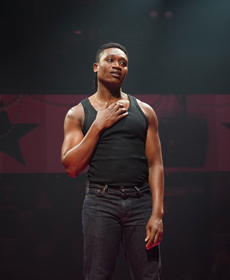
Theatre in Review: Ms. Blakk for President (Vineyard Theatre) This is the second major production of Ms. Blakk for President -- the first was at Steppenwolf Theatre in Chicago -- and it still feels as if it is in the process of becoming. Co-authors Tarell Alvin McCraney and Tina Landau have seized on a footnote from the history of the AIDS epidemic, tracking the career of Terence Alan Smith, a real-life Black drag performer who, as Joan Jett Blakk, ran for mayor of Chicago and, later, President of the United States. It's the wild tale of a modern Don Quixote, who, instead of tilting at windmills, crashes the Democratic National Convention, demanding action against AIDS and dignity for queer people. Such a bizarre episode surely calls out for theatrical treatment, but this isn't quite it. The authors clearly love their subject, but they're still figuring out how to make a play of it. We first see Terence onstage in a club, lip-syncing to Janis Joplin singing "A Piece of My Heart." Taken with his performance, Mark, an activist and frontliner in the fight against AIDS (his partner is gravely ill), enlists him and a band of like-minded souls to found the Chicago chapter of Queer Nation, described as "like ACT UP...but with the added goal of ending homophobia, too." (It's an early example of gay activists taking the derogatory word "queer" and reclaiming it as a raised-fist sign of strength.) In an era when no official would publicly pronounce the word "AIDS," the Queer Nation crew comes out swinging, staging public confrontations, insisting on new policy initiatives, and seeking access to new and untried treatments. (AZT, the only viable drug, was of limited use, in addition to producing dire side effects.) Taking to the streets, they stage die-ins outside pharmaceutical companies and insurers. Then, noting that Richard M. Daley is running unopposed for mayor, Mark decides it's time to kick it up a notch with a political campaign designed for "losing loudly." His strategy: "We put someone on the ballot we know is...out there. In drag. Make them see it." His ideal candidate will "need to have Jackie O pearls with bratwurst sensibility. And a maddening sense of naivete to keep 'em guessing." If only Queer Nation had such a flamboyant character with a gift for theatre and an outrageous sense of style... Thus is born Joan Jett Blakk, who hits the political trail with relish, using Madonna's "Lucky Star" as a de facto campaign song. Joan's Chicago campaign climaxes at a gala dinner where she snags a photo op with a dazed Geraldine Ferraro. Then a call comes from New York: The producer of the Manhattan cable access program, The Brenda and Glennda Show (starring drag queens Brenda Sexual and Glennda Orgasm) has a scheme to get Joan on the floor at the Democratic convention. It's a story made up of equal parts rage, rebellion, and fabulousness, but the authors tell it with a surprising lack of verve. Terence and Mark are woefully underwritten: We never get much, if any, sense of their personal lives or backstories; they keep their conversation focused on tactics. (The other characters barely rise to the level of one dimension.) The script is loaded with gags that might have seemed snappy in the 1990s: "We've always been here. You all know that. We've all seen Bewitched," Mark says, resurrecting an old trope about that sitcom's gay subtext. Joan's campaign slogan is "Lick Bush in '92," which was already tired when the second George Bush ran for national office. In one particularly threadbare sequence, somebody repeatedly confuses "runoff" with "jerkoff." The plot is similarly sketchy. Certain points, such as the death of the sex worker and "Saint of Christopher Street" Marsha P. Johnson, are name-checked without explaining their significance. Furthermore, nobody can agree on the point of Joan's campaign, which, at different times, is portrayed as a farce, an attention-getting device, and a megaphone for gay rage. This lack of clarity undermines the central narrative. Further muddying the waters, Joan's DNC caper fizzles, leading to an equivocal finale. Everything needs further fleshing out. Given the many bits of pop tunes inserted into the action, Ms. Blakk for President is like a libretto for a musical still being written; you can practically pinpoint where the numbers would go. As Terence/Joan, Ato Blankson-Wood must cope with plenty of weakish dialogue; Joan may be the least amusing drag performer you've ever seen. Fortunately, Blankson-Wood has plenty of presence and, seizing on a powerful eleventh-hour stump speech -- a justified outpouring of wrath -- the actor easily commands the stage. (In its fleeting best moments, Ms. Blakk for President evokes the fury of an era when gay men, dying in large numbers, were ignored by the media and political establishment.) Gideon Glick adds some welcome dynamism as Mark, but the character fades out so thoroughly in the later scenes that he doesn't get a decent exit. The rest of the solid cast, all of them playing multiple roles, includes Nic Ashe as a co-conspirator in the DNC scheme; Adina Verson as Lenny, the "cable access maverick"; Sawyer Smith as David Bowie in his Ziggy Stardust period (Terence' dream date). and Kelvin Moon Loh as Glennda. The splashy, in-the-round production features an intricate network of pink-and-black catwalks designed by David Zinn plus a battery of video screens displaying Rasean Davonte Johnson's footage of AIDS demonstrations, Ronald Reagan, Jesse Jackson, Maxine Waters (looking strikingly young), gay activist Bob Hattoy, and Elizabeth Glaser -- wife of TV star Paul Michael Glaser, and the rare heterosexual to go public with her HIV diagnosis. (Hang on for Jennifer Holliday entertaining conventioneers with the ballad "A Dream with Your Name on It." Such events were very different thirty years ago.) Ari Fulton's costume designs range from Mark's clone style to Joan's Chanel suits and Glennda's color-matched ensembles. (Of course, Ashley Wise's wig and hair designs make major contributions, as does La Sonya Gunter's makeup.) Lindsay Jones' sound design takes in sirens, police bullhorns, chanting protestors, and a bit of Appalachian Spring. Bradley King's lighting underscores the more theatrical moments with ballyhoos, spinning patterns, and chases; note also the red, white, and blue LED tape hanging overhead. A sometimes-timid tale of tumultuous times, Ms. Blakk for President shines when channeling the title character's fury at a society that looks away from people suffering a disease that, at the time, constituted a death sentence. "My America, my moral justice bends towards queer," Joan asserts, adding, pointedly, "If you leave us out of the equation today, see how it all adds up in 2028." It's a compelling thought, but overall, it needs to be made more forcefully. --David Barbour 
|