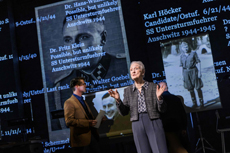
Theatre in Review: Here There Are Blueberries (Ethel Barrymore Theatre)"In surveys, people say that the least trusted parts of our society are the government, big business, and social media. One of the most trusted parts? Museums. And why? Because museums are fact-based." So says Sara Bloomfield, museum director, in Here There Are Blueberries. As it happens, she runs the National Holocaust Museum, and the facts at hand are real stunners. Moises Kaufman and Amanda Gronich's play is a detective story built around the discovery of a photo album that casts a new, confounding light on day-to-day life at Auschwitz: Simultaneously with the industrial-level extermination of Jews, the staff enjoyed parties, field trips, and Christmas celebrations, and, based on the evidence, everyone had a wonderful time. A devastating piece of documentary theatre, Here There Are Blueberries begins when a retired American Army officer reveals the album's existence, found during his tour of duty in Germany just after World War II. Photos of Auschwitz are extremely rare -- the Nazis weren't eager to publicize the details of the Final Solution -- but nobody has seen anything like these, showing social events and a party atmosphere at a nearby chalet reserved for the camp staff's rest and recreation. At first, Rebecca Erbelding, a curator, wonders why the photos exist. A little research reveals they belonged to Karl Hocker, "administrative assistant to the head of Auschwitz." Among his duties was filing reports on camp life: "At the district championships, our track and field athletes club won five of the seven championship titles awarded." The album is revealing in many ways. Before the war, we learn Hocker was a junior bank teller; Richard Baer, the camp's head, was a confectioner. And Commandant Josef Kramer was an accountant. An expert notes, "The trivial nature of their former jobs appears as a shocking contrast with the killers they became. But then, what would be a normal career preparation for Auschwitz?" A tranche of photos shows the "helferinnen," young women who worked "in the camp's office as telephone, telegraph, and radio operators for the SS." Several shots feature a Christmas celebration in December 1944; even as the war was lost and the camp was on the edge of closing, life went on as if the Third Reich were marching to victory. When the album's existence is publicized, it becomes an international sensation, and the repercussions begin. A German man, Tilman Taube, contacts the museum, having identified his grandfather, a doctor, in the photos. Stunned to hear that no one else has reached out, he offers to find surviving relatives. This leads to a series of brutally revelatory encounters. Peter Wirth is the son of Eduard, the chief SS doctor, who worked to eradicate the typhus epidemic among the inmates. "He asked for running water, heat for the barracks, medicine to combat the lice outbreaks, and more sanitary bathrooms," he says, adding that his father loathed the camp but stayed at the urging of a priest who told him he could do good. "So, you've come to terms with his participation," Tilman says. "Absolutely not," Peter replies. Rainer Hoss, grandson of Rudolph, who built Auschwitz, describes growing up in ignorance of his family history until he finds several incriminating volumes in his home library; he produces his collection of photos, showing his father as a child, playing in a neatly kept backyard only a few steps from the gas chambers. "My father's toy boat was built by prisoners," he notes. Horrified and fed up with his father's abuse, he recalls running away at fifteen. Filled with rage, he hits the streets, violently attacking total strangers until he realizes, "They would have recruited me. The Nazi stormtroopers, they would have taken one look at me and said: 'He's one of us'." The Baer album poses an ethical question for staff of the museum, which is dedicated to preserving facts about the victims, not their tormentors. But, as Rebecca reveals, another album exists, found by Lili Jacob, an inmate, on the day of the camp's liberation. It shows prisoners, newly arrived, lined up for sorting into groups of workers and those eligible for "special treatment," the Nazi euphemism for gassing. Some images feature Lili and the rest of her family, none of whom she ever saw again. "After all that happened," she says, "that it would be me who finds it...that shows the day I arrived there. I feel it was my destiny to find it. So, I kept it with me, always." Few plays depend on their production design as much as Here There Are Blueberries. Derek McLane's set, depicting a museum research room, serves as a canvas for David Bengali's projections of Baer's photos, many cropped and shown in close-up to reveal significant details; Lili Jacob's photos are given similar treatment. Video footage shows the elderly Karl Hocker, finally on trial in 1988, running from reporters. Especially chilling is a montage of images -- captured by new, portable cameras, a feature of the 1930s -- of middle-class Germans at play. The sequence ends with a shot of young children with swastika flags and armbands. Other design elements make important contributions. David Lander's lighting, working with often-enormous projected imagery, picks out the actors with laser precision. Among other things, Bobby McElver's sound design sends a volley of photo clicks rippling through the theatre and uses period dance band music as an ironic counterpart to the killing happening just outside each photo's frame. Dede Ayite dresses the company members appropriately. Kaufman's production finds its power in its calm, unemotional recitation of facts so staggering that one struggles with their implications. Most of the time, the cast purposely underplays, letting the images speak for themselves. This is especially true of Kathleen Chalfant as Judy Cohen, director of the museum's photographic collection, who, commenting on a shot of the helferinnen enjoying dishes of blueberries (hence the title), notes the "Puritanical shock that women were involved. That they participated in the factory nature of Auschwitz." Michael Cerveris captures the subdued anguish of Peter Wirth, saying, "When the Jewish prisoners arrived at the camp, my father was one of the doctors who stood there, at the ramp, and selected who was going to be sent to forced labor, and who was going to the gas chamber. So what does it matter? The good things he did?" Montego Glover alternates brilliantly as the ultra-professional Sara Bloomfield and as Melita Maschmann, the head of press and propaganda for the BDM, the League of German Girls, a feeder system for the Helferinnen. As Tilman, delicately invading the privacy of Nazi descendants, Conrad Ricamora shows that the ability to listen intently, subtly signaling profound emotion, is one of an actor's most effective tools. Even in this fine company, two performances stand out: Brandon Flynn's Rainer is a prime example of the Nazi's awful legacy: Victimized by his father, ravaged by his unspeakable patrimony, he turns on others, enjoying "the intoxicating power, the exhilaration, in cruelty," before choosing to break the cycle. He defiantly retains his family surname, noting, "It's my best revenge. To live my life differently." Delia Cunningham achieves a stark study in contrasts as Rebecca, ardently pursuing every available historical lead, no matter how upsetting, and Lili, fearlessly staring into the dark recesses of memory, refusing to forget the smallest detail. Rainer and Rebecca are among the many characters who ask the unanswerable question: "What would I have done?" And, as many characters note, the true horror of the photos lies in their normality. The Helferinnen look like sorority sisters. The chalet where staffers take those pleasure retreats looks like it could be in the Adirondacks. Here There Are Blueberries is at its most acute when cataloging various denial techniques. The sister of a Helferin says, wearily, "Why does anyone still stir in all this old shit?" Hitler wasn't so unique, she adds: "There are people who have such a power...all through history. Jesus had that power. Masses followed him too." Historian Stefan Hordler, noting how many compartmentalized their work, says, "The women think, oh, we just make phone calls; we don't handle prisoners. The SS doctors think, we just select if they're fit or unfit for work. Even the guard who takes people into the gas chamber says, I didn't select them. And everyone thinks, If I didn't do it, someone else would. No one feels responsible." Here There Are Blueberries is the rare Broadway play that demands you gaze into the face of evil, asking you to consider if you are looking into a mirror.--David Barbour 
|