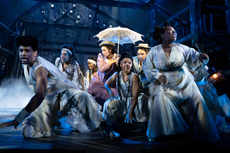
Theatre in Review: Wanted (James Earl Jones Theatre) Angelica Cheri reportedly based the libretto for Wanted on her family history, and maybe that's the problem with this loud, sometimes baffling new musical. As a tale gets handed down over several generations, it becomes pleasingly familiar, honed to its highlights for an audience that can fill in the blanks. Put it on a Broadway stage, however, and the result is disconcertingly different. The new musical is a churning melodrama, a twist-a-minute evening packed with brawls, gunplay, chases, lies, secrets, and an undone bodice or two. Watching its two heroines racing from one cliff-hanger moment to the next isn't dull, but one hardly knows what to make of it all. Martha and Mary Clarke, sisters and sharecroppers in 1893 Texas, are thrilled, having toiled long and hard, raising the money to buy their plot of land. They're tilling in a fool's paradise, however, cheated by a plantation owner who won't surrender an inch, let alone an acre; instead, he gins up a phony debt designed to keep them in perpetual economic slavery. Fed up, Mary suggests heading for parts unknown, passing for white. (Both young women are notably light-skinned and easy on the eyes, an inheritance from their no-good French father that, Mary suspects, can be converted into cash.) Tallulah, their mother, is horrified but, as the girls point out, the money has to come from somewhere. Dressed up in their white-lady finery, Martha and Mary hop a train and are promptly menaced by a couple of mashers; they escape, wielding the six-shooter Tallulah presented as a parting gift. In the melee, they also end up with the men's wallets. Knowing an income stream when they see it, they embark on a crime spree, holding up anyone who crosses their paths and pocketing the profits. They are equal-opportunity robbers: It's fun when they take down a charity auction hosted by the Daughters of the Texas Confederacy, less so when they clean out a barber shop and a Baptist church. But, for all its self-righteous postures, Wanted takes a laissez-faire attitude toward the sisters' larcenous activities. Two or three scenes in, the show already barely makes sense. The sisters' decision to pass is made on the spur of the moment, leaving one to wonder: Did Martha and Mary ever consider it previously? Has the idea been on their minds for some time? Has frustration been building up, finally reaching the boiling point? The script doesn't say. Similarly, they take to thieving like a pair of hardened gun molls, effortlessly evading the law despite their total lack of experience. The implausibilities pile up like bad debts: When the sisters land in the clutches of wealthy mystery man Jesse, who plies them with champagne, Paris gowns, and opera visits, Mary starts to hear wedding bells. But, amazingly, running around with his wealthy cronies, she never seems to hear one racist word. Nor does she stop to question the source of a 19th-century Texan's familial wealth. As it happens, there's plenty Mary doesn't know about Jesse (and about her father), all of which gets aired in the last 20 minutes, largely because the plot demands it. But that's Wanted for you, a collection of story beats strung together with little regard to character. The sisters have virtually interchangeable personalities; for a good chunk of the first act, Martha is the ringleader, on the prowl for a good time, while Mary nervously temporizes; then Mary, trying to bag Jesse on the bridal path, takes over, leaving Martha to moon about returning home. (To be fair, Martha does shoot up Jesse and Mary's wedding; she's not a total doormat.) At the intermission, I had trouble remembering which one was Mary and which was Martha. You could spin the heroines of Wanted in all sorts of ways, as rebels striking violent, righteous blows against racism; as hilarious gold-diggers, robbing the gullible and chiseling their way across the Lone Star State, or as desperate fugitives careening from one near disaster to another. (Many other possibilities exist.) But Cheri can't seem to choose a point of view. This two-woman crime wave is put on hold all too soon, and the deeper Mary gets in with Jesse, the more unpleasant and grasping she becomes. Martha's counterpoint flirtation with Elijah, a bartender tired of being invisible to white people, fizzles after a promising beginning. Wanted is about female empowerment, by hook or (mostly) by crook, and men are strictly disposable items. The book might work better if the songs did something other than restate points already made in the dialogue. The lyrics alternate between a kind of blank verse and couplets pretending that "victory" and "history" rhyme (or, worse, "hallelujah" and "peculiar"). Instead, a kind of pained sincerity rules: In a typical passage, Jesse sings, "I've been cut 'cross the heart with a razor of shame/And from time to time, the stitches rip and bleed/They say cowboys don't cry/So I keep my tears in my chest/But I'm through holdin' back/It's time to give my heart a rest." That's a lot of work to arrive at "chest" and "rest," but at least it rhymes. Ross Baum's music, written in a generic funk/soul idiom, isn't unpleasant, but has nothing to say about the characters or their setting. One number, "Frenchman Father," sung by a dancehall floozie but really a comment on the sisters' upbringing, results in the show's most ambitious, and, alas, incoherent passage. Playing characters who are little more than attractive blanks, the leads work extra hard, fighting to make an impression. Solea Pfeiffer, looking strikingly like the late Esther Williams, struggles to keep Mary on this side of likable, which isn't easy. At least she handles her numbers authoritatively; as Martha, Liisi LaFontaine's breathy pop vocals make her songs hard to make out. Bradley Jaden's Jesse is necessarily a cipher until the eleventh hour, when we finally get the inside dope on him. At least Luke James' imposing, well-sung Elijah generates some chemistry with LaFontaine's Martha. The one-named Ledisi supplies some welcome dignity as Tallulah. In a musical about theft, the most brazen crimes are committed by the scene-stealing Awa Sal Secka and Aurelia Williams as Jesse's servants, who see through Martha and Mary's imposture with 20/20 accuracy and don't mind sharing their opinions. Serving as the evening's insolent, wisecracking Greek chorus, they provide the bulk of Wanted's entertainment value. Stevie Walker-Webb's direction makes little effort to endow the narrative with nuance or psychological insight, but he has a fine design team at his command. The musical plays out on a single set, by Beowulf Boritt, a skeletal house/barn structure with a movable wall that easily stands in for multiple locations. Stefania Bulbarella delivers evocative video images of cotton fields, treeless forests, passing scenery, and colorful paisley patterns, many of which bleed insinuatingly across the upstage wall. Adam Honore's lighting includes chase effects during a sequence set on a train, and an interesting blue-green palette when Mary has a nightmare that shows her the error of her ways. Emilio Sosa's costumes range from elaborate (sometimes gleefully vulgar) gowns to artfully conceived rags for a chorus of ancestors, seemingly dressed by Miss Havisham, couturier. Gareth Owen's sound design is too overpoweringly brassy for the modestly sized James Earl Jones. The score, which leans toward big, belting finales and freestyle gospel singing, doesn't need that much help; the songs become increasingly unintelligible, largely, I suspect, because of ear fatigue. Anyway, it all ends happily, thanks to a little grand theft larceny topped by second-degree murder. It tops off an evening full of bustle and clatter that isn't funny enough for satire nor serious enough for drama. (Never mind that their chances of staying out of jail are slim to none.) These gals are straight-shooters, but their aim is off. --David Barbour 
|