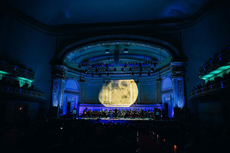
Robe Gear Featured on We Choose to Go to the Moon We Chose to Go to the Moon is a special theatrical concert and "living documentary" that was recorded at Carnegie Hall and aired last week on PBS, PBS.org, and the PBS app on the eve of Veterans Day. Created and narrated by writer and historian John Monsky, produced for television by Academy Award-winning RadicalMedia, and directed for the stage by Tony Award-winner Michael Mayer, the event, part of the American History Unbound series, was lit by Mike Baldassari, who specified Robe moving lights -- T2 Profiles, FORTES, iFORTES and a RoboSpot system -- as the backbone of his lighting rig. The show follows America's dramatic race into space through the personal stories of the astronauts, engineers and their families, set against the transformative cultural and social backdrop of the 1960s - from the civil rights movement to hippies, beatniks, and Star Trek. The soundtrack was inspired by music of the era and delivered by the 45-piece Orchestra of St. Luke's plus six Broadway vocalists, and staging the show presented many challenges to the technical production team, especially for lighting. Covering multiple people onstage was one galvanizing aspect for Baldassari, and ensuring that it looked great for television, a multi-cam shoot, and the live audiences for the two recorded concerts was another. Added to these was the fact that flags -- from a small sliver of the famous flag planted on the moon by American astronauts Neil Armstrong and Buzz Aldrin on July 20, 1969, to the poignancy of the three Apollo 1 burial flags -- had an integral role in the storytelling; projections onto the walls behind the stage were another essential narrative element. On top of that, time was extremely tight. The production get-in was midnight on the day of the first show being recorded that same evening. "Color was super important," Baldassari says, "and being able to color-match between different fixtures was essential." That's why, working closely with director of photography Declan Quinn, he chose these two types of Robe fixtures to be prominent on the rig. Twenty-four of the 32 FORTES were in front positions. Goal posts were constructed to the side of the high boxes, stage left and right, each rigged with ten FORTES; another four FORTES were attached to the front central balcony rail. The other eight were on the floor, left and right, in "shin buster" positions with two on each side for uplighting the proscenium arch. Baldassair notes that these are "excellent" fixtures for key lighting and specials. Pointing in from the front of house, the FORTES and their white LED engine had to blend perfectly and precisely with the 18 T2 Profiles hung on three over-stage trusses with their multispectral LED engine. The colors were matched between the two fixture types during their three days of pre-viz, and they replicated precisely once Baldassari and his team arrived on site. The FORTES were used as keys for all the solo performers or vocalists onstage, so the colors also had to be consistent throughout the performance. Sometimes performers were revealed directly one after another, a process that Baldassari refined during pre-viz by dialling in different color variants for the faces. The focus, shuttering, and edge blending of the fixtures also had to be identical and spot-on. "That repeatability was mission-critical," Baldassari says, "and the FORTES delivered each and every time!" Some FORTES also highlighted the venue's architectural features. The relatively light weight of the T2 Profiles also made them suitable for this setup onstage to comply with the historical venue's weight loading restrictions. On the mid over-stage truss were two iFORTE LTX Follow Spots running on a RoboSpot remote followspot system, with the operator in the attic. "These Robe fixtures were perfect for this show," comments Baldassari, noting that next time he does a televised event like this at Carnegie Hall, he will replace the house spots with two iFORTE LTXs fitted with LightMaster handles for a bit more punch from the front-of-house spotting positions. Main Light was the lighting equipment supplier, and working alongside Baldassari were lighting director Mitch Fenton, moving light programmer Jason Marin and theatrical gaffer Sarah Arnold. Also involved were general and production manager Bethany Weinstein Stewert and film director Michael John Warren. The venue's head electrician is Tim Donovan, and the production's best boy team comprised Michael Mustica, Stephanie Freed, Mark Krasnov, and Max Breslow. "I'm extremely pleased with the results, and very proud to have the opportunity to honour our amazing veterans and astronauts in such a unique, interesting and entertaining production," Baldassari says. 
|