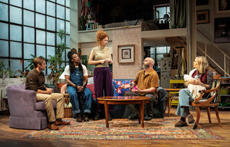
Theatre in Review: The Visitors (Second Stage)"What is family but coercion?." asks a member of the increasingly exasperated clan that populates Bryna Turner's latest play, which offers a novel twist on the dysfunctional family comedy. The nifty trick of The Visitors -- about siblings pitched with a moral imperative and whiffing, spectacularly -- lies in Turner's mercilessly satirical take on these caustic, frequently embattled souls, not ignoring the consequences of their massive self-absorption. The playwright assembles them for a family reunion none of them will forget, for all the wrong reasons. Joanna, the youngest of the quartet, unexpectedly, mysteriously summons the others to her New York loft apartment. Henry, an abrasive Type A specimen, arrives lugging his infant daughter. (His wife is either on a girls' trip to Mexico or hiding behind her living room curtain, for reasons unknown.) Theresa, struggling with a rebellious daughter who has branded her with the c-word ("She thinks she's British"), is undergoing the mother of all midlife crises; she wants to open a horse farm, noting, wide-eyed, "It's the first dream I've ever had." The surprise guest, and not in a good way, is Rory, a substance abuse basket case whom nobody has seen in well over a decade. He swears he has finally grown up, but practically the first thing he does is feed Henry's baby with honey, a potentially toxic substance for newborns. Joanna's summoning has nothing to do with reliving old times. A recent physical has revealed she is suffering from kidney failure and needs a transplant, pronto. Her best chance of finding a match is with Henry, Rory, or Theresa. Apologizing for the rushed nature of her request, she wonders: Are they willing to undergo screening and, if circumstances permit, donate an organ? The answers are roundly affirmative, and things are looking up until a disappointing series of results gives way to the alarming likelihood that someone is lying about their eligibility. Joanna, enraged, at first tries to slyly suss out the truth; when that fails, she stages a farewell meal based on the "dialysis diet," wielding a menacing cake knife, with plenty of dire revelations served up between courses. I missed Turner's earlier works, Bull in a China Shop and At the Wedding, so I was completely unprepared for their disarming, deadpan wit and fierce moral sense. At first glance, Joanna and the others are almost too ripe for spoofing, as is Naomi, Joanna's spouse, whose politically correct attitudes extend to worrying whether the board game Catan, enthusiastically played by the others, secretly condones colonization. But the real-life games on display have life-or-death consequences. Home may be, as Robert Frost says, "the place where, when you have to go there/They have to take you in," but that doesn't mean they're committed to keeping you alive. Jenna Worsham orchestrates this family circus in sneakily understated fashion, letting the laughs fall where they may before zeroing in on a surprisingly moving finale. Mary Wiseman's Joanna has a studiedly childlike manner contrasted with an accurate radar for BS. Theresa, in a misguided attempt at comfort, offers the example of a woman testifying online that her metastatic ovarian cancer cued the happiest period of her life: "She was always worried about things going wrong, and now that everything has gone wrong, she's finally free." "She's free to what?" snaps Joanna. "To watch her hair fall out and to walk to and from the chemotherapy ward?" Celia Keenan-Bolger amusingly captures Theresa's vaguely Hallmark spiritual side and My Friend Flicka-style fantasies (fueled by obsessive video watching) which cause plenty of eyeball-rolling among the others. Will Pullen's Henry is composed of equal parts grievance and malice. When he gets snarky about Joanna's vinyl LP collection, she tells him, "If you don't revert to analog, you're gonna wake up one day and discover you don't own anything; you're leasing your entire life." He coolly replies, "I own a house; you own Tapestry by Carole King." Later, his attempts at luring Joanna into a black-market organ purchase are roundly rebuffed. Danny Wolohan's Rory is an eager-beaver disaster magnet, with no money, no prospects, and a daughter in foster care; he is less concerned about Joanna's illness than getting her to write a letter of recommendation for the judge overseeing his case. At the performance I attended, Anita Parrott stepped into as Naomi for Esco Jouley, earning a well-deserved hand for their assured work as the play's more-or-less voice of reason, dispensing Buddhist wisdom that usually drives Joanna around the bend. Kate Noll's excellent, thoroughly lived-in set accurately depicts the kind of loft apartment you might find in Bushwick, in which every inch of storage space has been accounted for. It features a large leaded window, with frosted glass, at stage right, which Stacey Derosier transforms with attractive color treatments between scenes; she also creates intricate looks using the many onstage practical lamps. Also pacing the scene breaks is Fan Zhang's sound design, including banging pipes and hissing radiators. Asta Bennie Hostetter's costumes tell you plenty about the characters' various stations in life. Worsham stages many amusing moments, including all four siblings uncomfortably crowded in a pullout bed, with Henry finally getting expelled, and Joanna, tearing up, offering her heartfelt thanks to the others, who are too lost in thought or riveted to their phones to hear her. That board game amusingly becomes a minefield of childhood resentments. And when, near the end, the action strays into psychological thriller territory, the director helps make the transition feel seamless. With the play clocking in at a trim ninety minutes, Turner could take time to get at the roots of the family's conflicts; they could also explore Naomi's desire to have a child as a way of resurrecting their relationship with their mother. But this is a fast, fearless, bracing piece of work. So many comedies about fractured families take detailed inventory of everyone's neuroses before concluding that they'll all get along somehow. Turner will have none of that; as The Visitors builds to its melancholy conclusion, Joanna has learned exactly who she can count on, and the number of candidates is dispiritingly low. --David Barbour 
|