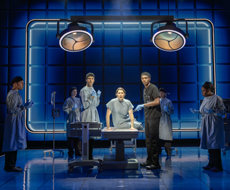
Theatre in Review: The Heart (Roundabout at Laura Pels Theatre) Musical theatre is like modern architecture: Form follows function. (This fact is sadly ignored by the purveyors of jukebox and bio musicals, but what can you do? These are not the happiest of times.) Wise creatives know: If you take on unusually challenging material, the old formulas won't suffice. The surprising truth is the best shows come from the least promising material. Consider The Heart, drawn from a situation that could make up an episode of the HBO Max series The Pitt. Handled innovatively and with remarkable humanity and feeling, it makes a telling comment on the rapid medical and technological transformations that daily reshape our lives. Kait Kerrigan's book, based on a French novel but Americanized for the stage, begins in catastrophe: Simon, a California teenager, returning home from an early-morning surfing session, is caught in a car crash. By the time he arrives at the ER, he is brain dead. There's no time for tragedy, however, as the brisk, efficient hospital staff gets into gear: Simon's estranged, heartbroken parents must be found and approached about organ donation; his heart and other vitals must be harvested; and potentially life-saving matches quickly identified. It's a relentless, ticking-clock series of events filled with wrenching, life-altering decisions that must be made, pronto, if hope is to be snatched from the wreckage. Kerrigan's book is lean, built for speed, and populated by a gallery of vivid characters, each with a role in sending Simon's heart on its journey to another life. She and the songwriters, Anne Eisendrath and Ian Eisendrath, have, almost counterintuitively, opted for an electronica score, its rapid, heartbeat-like pacing driving a plot that is essentially a race against time. Also, the music's digitally rendered sounds are ideal for a story about the way we live (and die) now, aided by technology every step of the way. And it proves useful when the action makes a couple of stops at a dance club for scenes with Simon's girlfriend, Juliette, a DJ. The production design facilitates The Heart's speedy, almost ruthlessly paced action, adding contemporary notes of its own. Robert Brill's set, a reflective black box lined in LED tape, hosts Lucy Mackinnon's attractive video imagery of oceans, EKGs, grids, abstract patterns, video games, and a digital clock. Amanda Zieve's lighting makes good use of plentiful side positions and a broad color palette to reshape the stage. Gareth Owen's sound design achieves a near-perfect intelligibility while also delivering various effects. In a production featuring actors who are often double- and triple-cast, Sarafina Bush's costumes meet the challenge of identifying characters at a glance. Director Christopher Ashley, aided by Mandy Moore's choreography, has assembled a confident, engaging cast, everyone capable of swapping out identities at a moment's notice. Heidi Blickenstaff is fine as an all-business doctor, and deeply moving as middle-aged Claire, the heart's eventual recipient, who, on the brink of accepting her imminent death, must contend with this unexpected gift. Drew Gehling brings plenty of gruff good humor to Dr. Breva, who removes and reinstalls the heart. (Hearing that Claire has been drinking that day, he discreetly decides to delete that inconvenient little fact.) Joaquina Kalukango and Jason Tam are devastating as Simon's parents, still angry with each other but tentatively coming together for a choice neither ever imagined having to make. Nick T. Daly's Simon glows with such innocence and energy that it's easy to understand the full impact of his loss. If this quartet drives much of the action, they are sturdily supported by Lincoln Clauss as a sympathetic counselor delicately negotiating with Simon's parents; Bre Jackson as a nurse who talks to her patients no matter how dire their conditions; Max McKenna as Simon's girlfriend, unprepared for unexpected loss; and Wren Rivera as a staffer at the National Organ Donation Registry, moving swiftly and without second thoughts to make matches between donors and recipients. The score proves supple enough for several reflective moments, including "Right Now," featuring Cordelia, the chatty nurse, baring the difficult details of her life to Simon, who is on life support; "Too Young," in which Claire contemplates the "infinite debt" that Simon's death imposes; and "A Life for Life," featuring the entire company commenting on the gravity and the miraculous quality of these unfolding events. There are occasional missteps. "The Goldfinch," the overwrought introduction to Thomas, the counselor, seems to hail from an earlier draft of the script. (It was previously done at La Jolla Playhouse.) And a post-op fantasy sequence isn't as well-defined as it might be. The rest of the time, however. The Heart is all of a piece, a unique and profoundly emotional story for which the right style, the right words, and the right music all come together. See it and be prepared to weep. --David Barbour 
|