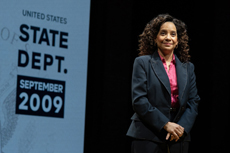
Theatre in Review: Public Charge (Public Theater)A friend, describing the appeal of the HBO Max series The Pitt, calls it "competency porn," meaning it is about professionals acting professionally; it makes such a refreshing change from our daily headlines. You can apply the same term to Public Charge, about Julissa Reynoso's adventures in diplomacy. Unfolding during the Obama Administration, this account of government officials going about their business without corruption, ignorant self-promotion, or buffoonery seems like a report from a distant, misty past. Can it really be only a decade or so ago that we took such behavior for granted? See this new play and weep. But be aware that Public Charge is better as a guide to the corridors of power than as a gripping drama. Reynoso, a lawyer, academic, and former ambassador -- the co-author, with Michael J. Chepiga, of this theatricalized memoir -- has her first run-in with American policymakers at age six, seeking entry into the US from the Dominican Republic. Her paperwork doesn't impress the consular officer reviewing her case: "It looks like her mother makes less than minimum wage," he comments, sourly. "How is she going to feed this girl? We have enough people like you on food stamps." Give me your tired, your poor, indeed. Fast-forward three decades or so, and Reynoso, a graduate of Harvard, the University of Cambridge, and Columbia Law School, is tapped by Secretary of State Hillary Clinton (referred to in the script only as "her") for the State Department. Given Reynoso's lack of diplomatic experience, she is stunned to be offered the desk overseeing the Caribbean and Central America. Does her ethnic background and longtime residence in one of New York's Latino neighborhoods make her qualified? As Ricardo Zuniga, a career bureaucrat and Reynoso's permanent foil, pointedly notes, "Some of us had Latino neighbors too, but had to serve six tours, including hardship posts in Afghanistan, to get a job like this." Indeed, Public Charge positions Reynoso as a Candide-like innocent who gets wised up to the internecine battles and turf wars that can make the simplest policy goal hard to accomplish. The plot features two narrative lines that converge on a single end: At the State Department, Reynoso tries to free Alan Gross, a USAID subcontractor -- remember USAID? -- who has been taken prisoner by the Cuban government for giving computer gear to Jewish groups in Havana. This issue gets entangled in other concerns when the US, trying to rush medical equipment to Haiti following a devastating earthquake, requests permission to fly over Cuban airspace. The Gross situation drags on interminably, eating at Reynoso's conscience; it arises again when, appointed ambassador to Uruguay, Reynoso enlists the help of President Jose Mujica, a move that raises eyebrows back home because of his revolutionary past. But it is he who brokers a novel deal, a "swap that's not a swap," involving a US-Cuban exchange of prisoners, with Gross tossed in as a "humanitarian gesture." One of Public Charge's virtues is its keen appreciation of the semantic gymnastics required to allow politicians to evade their stated positions. The playwrights rarely miss an irony. Reynoso's perfectly logical questions -- What was Gross really doing in Cuba? How many Jewish groups even exist in a country with a minuscule Jewish community? -- are met with noncommittal answers. There are occasional flashes of wit: "Policy is our bedrock," Zuniga says, "It's the Bible. You can't just say it means whatever you want it to mean." "That's exactly what we do with the Bible," snaps Reynoso. When the non-swap is arranged, it involves the transfer of a sperm sample from a Cuban prisoner to his wife, whose biological clock is ticking. Apparently, such gestures make the world go round. But as the play's action moves from one impasse to another, there's little tension or suspense; mostly, we hear policy points and governmental positions spelled out in textbook fashion. This is enlightening in the manner of one of those detailed, three-page reports about this or that issue in the Sunday New York Times. But despite the considerable human stakes, Public Charge moves smoothly through diplomatic channels without becoming especially dramatic. Perhaps because Gross remains offstage, his dilemma seems less urgent. It may also be that Reynoso, ever the diplomat, is unwilling to get too colorful when depicting such real-life figures as Zuniga or Cheryl Mills, her State Department mentor. Sitting in the Newman Theater, however, I couldn't help being reminded of the Public's production of David Hare's Stuff Happens, another docudrama populated by real-life political figures; its coolly critical view of George W. Bush's cabinet lent it a constant crackle missing from Public Charge. More recently, Corruption, J. T. Rogers' recap of the Rupert Murdoch media empire's phone-hacking scandal, seen at Lincoln Center Theater, featured a teeming cast of well-known politicians and journalists and a labyrinthine plot, but the playwright's gift for invective kept things humming. Public Charge is never boring, but it often feels like homework. The cast, however, provides considerable consolation, beginning with Zabryna Guevara's wide-eyed, but never unintelligent Reynoso, especially in her sparring sessions with Dan Domingues' Zuniga, who sees Cuba as "a combination of Devil's Island, Alcatraz, and the Gulag." That remark is made by Marinda Anderson, who gives each of Mills' lines an extra dash of salt. Also passing through, making strong impressions, are Maggie Bofill as a steely Cuban bureaucrat and Al Rodrigo as, among others, the philosophical, seen-it-all Mujica. At the performance I attended, Deirdre Madigan, stepping in for Barbara Walsh, effectively channeled the mounting frustration of Gross' wife, Judy. Doug Hughes' staging has many striking moments, including a clandestine lunchroom encounter between Reynoso and Mills that keeps getting interrupted by staffers with their meal trays. The production design is ideally suited for a story that jumps across time and many locations. Arnulfo Maldonado's set places four rows of audience seating on the Newman stage, supplying a series of platforms on which the action plays out. Lucy Mackinnon's projections keep us up to speed on where the characters are and when. Ben Stanton's lighting reshapes the space confidently, often making use of vertical strips on the side walls. David Van Tieghem's sound and Haydee Zelideth's costumes add to the sense of authenticity. Public Charge is a welcome development; we can use more plays that grapple with current events. But one can cheer the production while wishing it had rather more impact. In any case, it leaves one nostalgic for the days when the government was in more capable hands. Its most bitter irony comes near the end, when Reynoso looks forward to a new Clinton Administration, adding, "Sixteen years of good government. Eight from a Black man and eight from the first woman president. We're gonna be the most progressive, inclusive country in the world." All right, but does she have to rub our faces in it? --David Barbour 
|