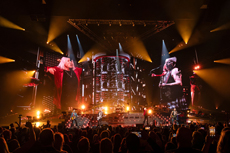
Def Leppard Vegas Residency Features Robe GearIconic hard rock band Def Leppard recently played 12 sold-out shows at the Colosseum at Caesars Palace, Las Vegas, complete with a new visual and lighting design created by Montreal-based Luz Studio. On Luz's lighting rig were some core Robe products, including WTF! IP-rated LED strobe-wash-blinder fixtures, Tarrantula wash beams, and four RoboSpot systems running with 18 BMFL FollowSpots, all supplied by Christie Lites, coordinated via its UK office. Luz Studio was brought on board to produce a completely fresh live performance environment for the band: a full visual package, including a stage set and video content. A starting point for the stage aesthetic was a 110'-wide-by-40'-high upstage LED screen, with a triangular-shaped double-layered set of risers in front, flanked by two diagonal staircases and two ground-level raked diagonal trusses per side. The band entered via the venue's large stage lift, then ascended to stage level, framed by an automated triangular-shaped truss that flew out during the first number, completing the last segment of a Union Jack-shaped truss facing the audience. This was a nod to the band's British roots, hailing from Sheffield. Creative director Matt Larivee had seen the WTF!s during a visit to the Robe factory in the Czech Republic at the end of 2025. "They looked fantastic, so I thought they would be ideal for this residency, especially to cut through the massive video wall," he says. "I really needed fixtures with plenty of power and options." The 18 WTF!s were deployed of four floor-level angled trusses traversing the stage set at a height of around 8', two per side. The set was a combination of Def Leppard's classic anthems, moments, and greatest hits from nearly five decades, together with edgy new material, so Larivee needed plenty of latitude and dynamics in the lighting to cover all eras of the music. He praises the WTF!'s zoom feature, as well as the pan and strobing options, but it was actually the fixture's warm-white LED zone that was the dealmaker. He knew he could get that classic retro blinder effect to define a range of classic "big-rock" looks -- which was juxtaposed with the video content. The 24 Tarrantula wash beams were split into two batches of 12. One set was positioned on the downstage truss, used for general band and midstage wash, and picked for its intensity and relatively directional beam, so he could contain the field of light without it spilling onto the diagonal-shaped set piece upstage of the band. The other 12 were on the floor, on either side of the stage, washing across the band from a lower level, again using the contained beam path to avoid messy encroachment onto the side walls. Eighteen BMFL FollowSpots were used, running on four RoboSpot systems, each following the four mobile band members with three BMFLs from the front, plus either one of two from the back. The operators were positioned offstage. Larivee would have ideally liked to use FORTES on the system, but he was happy to go with BMFLs. He specifically likes this remote follow system because of its straightforward application and abundance of good operators. "We -- us, the band, management -- all wanted the show to have an arc, so songs and timings were carefully selected where we could build those moments, and create big, bold, memorable looks that were not overcomplicated, so they really spoke out to the audience," Larivee says. These looks reinforced the songs and narrative, providing an additional tempo, framework, and drama for the show with lighting and video combined. Notables included a giant leopard, which looked about to pounce off the screen and onto the stage at any moment. Many of the video environments also included virtual lighting, calculated to riff and contrast with the real lighting onstage. The Luz Studio team worked closely with Def Leppard's longtime lighting director, Cole MacDonald, who flew out to Montreal and pre-vizzed with them, as well as being on-site at the Colosseum and running lighting for the shows. Luz Studio's Pierre-Luc Bedard led the lighting programming with Philippe Marquis and MacDonald. 
|